Browse by Category
Fiction
- Action & Adventure
- African American
- Anthologies
- Children's Fiction
- Classics
- Comics & Graphic Novels
- Coming of Age
- Contemporary
- Cultural & Regional
- Drama
- Erotica
- Fantasy
- General
- Historical Fiction
- Horror
- Humor & Satire
- Literary Fiction
- Mystery, Thriller & Suspense
- Poetry
- Religious & Inspirational
- Romance
- Science Fiction
- Short Stories
- War & Military
- Westerns
- Women's Fiction
- Young Adult
Non-Fiction
- Antiques & Collectibles
- Arts & Photography
- Biographies & Memoirs
- Business & Money
- Children's Non-Fiction
-
Computers & Technology
- Artificial Intelligence
- Computer Science
- Cybersecurity & Cryptography
- Data Science & Analytics
- Databases & Big Data
- Game Development & Design
- General
- Hardware & DIY
- Mobile App Development
- Networking & Cloud Computing
- Operating Systems
- Programming
- Robotics
- Software
- Software Engineering
- User Experience (UX) & Design
- Web Development & Design
- Cooking, Food & Wine
- Crafts, Hobbies & Home
- Education & Teaching
- Engineering
- General
- Health, Fitness & Dieting
-
History
- African History
- African History - North Africa
- African History - Sub-Saharan Africa
- American History
- American History - 20th Century
- American History - Civil War
- American History - Colonial Period
- Ancient History
- Asian History
- Asian History - China
- Asian History - India
- Asian History - Japan
- Asian History - Southeast Asia
- European History
- European History - Ancient Greece
- European History - Ancient Rome
- European History - Medieval
- European History - Modern
- European History - Renaissance
- General
- Middle Eastern History
- Military History
- Military History - Aviation
- Military History - Naval
- Social & Cultural History
- World History
- Humor & Entertainment
- Industrial Technology
- Language Learning
- Law
- LGBTQ+ Non-Fiction
- Literary Criticism
- Medical Books
- Parenting & Relationships
- Philosophy
- Politics & Social Sciences
- Reference
- Religion & Spirituality
-
Science & Math
- Agricultural Sciences
- Astronomy & Space Science
- Behavioral Sciences
- Biological Sciences
- Botany & Plant Science
- Chemistry
- Earth Sciences
- Engineering - Chemical
- Engineering - Civil
- Engineering - Electrical
- Engineering - Mechanical
- Environment
- General
- Geology
- Mathematics
- Nature & Ecology
- Oceanography
- Paleontology
- Physics
- Statistics
- Self-Help
- Sports & Outdoors
- Study Aids
- Sustainability & Green Living
- Textbooks
- Transportation
- Travel
- True Crime
- Urban Planning & Development
- Veterinary Medicine
- Writing & Publishing
Jump to Section

Want unlimited access to all books published by MixCache.com (plus their audiobooks)? Try MixCache.com Total Access. Look for the MTA badge on book covers to identify included titles.
Access to infinite ebooks: Don't see the book you want? Suggest it and we'll create it (free!) for you from scratch with our powerful AI book writer. Then read it with MTA - besides profiting from any sales it makes!
Iron and Ivory: The Kingdom of Kush and Meroe Reclaimed
MTA
Urbanism, Metallurgy, and Trade in Sudanese Antiquity
About this book:
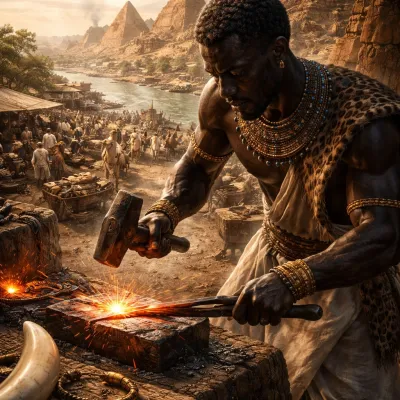
"Iron and Ivory: The Kingdom of Kush and Meroe Reclaimed" offers a comprehensive re-evaluation of the ancient Kingdom of Kush, aiming to move beyond an Egyptocentric view to highlight its sophisticated urbanism, advanced metallurgy, and extensive trade networks. The book argues that Meroe, the Kushite capital, was a dynamic center of power and production, demonstrating innovation and autonomy rather than mere imitation of its northern neighbors. It synthesizes interdisciplinary research, combining archaeological excavation, remote sensing, and material science with social theory and epigraphic analysis to reconstruct a vibrant African state.
The book details the intricate relationship between Kushite society and its environment, exploring how the Middle Nile's landscapes, resources, and routes shaped political, economic, and social development. It traces the kingdom's political evolution from Napata to Meroe, highlighting both transformation and continuity in governance, royal succession, and the role of powerful figures like the Kandakes (queens). A significant portion is dedicated to Meroe's urban planning, infrastructure, and daily life, revealing a city designed for concentrated labor, ritual, and commerce, with distinct neighborhoods for domestic activity, elite residences, and extensive industrial zones.
Central to the book's argument is Kush's mastery of iron production, detailing the entire chaîne opératoire from prospecting and procurement of diverse ores to furnace technologies, charcoal production, and the skilled transformation of bloom into finished tools and weapons. It also explores complementary metallurgies, including gold, copper, and stone, and their integration into the material economy and aesthetics. The book further illuminates Kush's extensive trade networks, analyzing riverine and caravan routes that linked the Nile Valley to the Red Sea, Arabia, the Indian Ocean, and broader African intersections, emphasizing the state's role in securing and profiting from these corridors.
Finally, "Iron and Ivory" examines Kush's complex entanglements with Ptolemaic and Roman Egypt, as well as with emerging powers like Aksum, revealing a kingdom adept at diplomacy, resistance, and cultural exchange rather than passive absorption. It concludes by reflecting on the concepts of crisis and resilience in Kushite history, portraying the kingdom's eventual reconfiguration as a testament to its adaptability. The book also discusses the methodological advancements that have enabled this reinterpretation and considers the ongoing legacies and heritage of Kush in contemporary Sudan and its global context, advocating for a nuanced understanding of African antiquity.
What You'll Find Inside:
- Meroe was a planned industrial city where palaces, temples, workshops, and residential zones were integrated to concentrate labor, ritual, and production while managing water, fuel, and raw materials.
- Kushite iron production is traced from ore prospecting and procurement through furnace technologies, fuel management, and craft specialization, revealing sophisticated metallurgical skill and its environmental and social impacts.
- The kingdom’s trade networks connected the Nile Valley to Red Sea ports, Indian Ocean markets, and African interior corridors, moving ivory, gold, textiles, and other goods through caravans, riverine shipping, and state‑regulated infrastructure.
- Political power in Kush operated through kings, kandakes, councils, and priesthoods, with ritual economies, temple estates, and monumental architecture serving as central mechanisms for resource redistribution, legitimacy, and state finance.
- The book concludes with Kush’s enduring legacy in Sudan and worldwide, highlighting advances in archaeometry, isotopic sourcing, and spatial analysis, and discussing heritage management, public engagement, and the continued relevance of Kushite urban‑industrial achievements.
Who's It For:
This volume is intended for scholars and graduate students of African archaeology, ancient history, and historical anthropology, particularly those interested in urbanism, metallurgy, and long‑distance trade in northeastern Africa. It will also be valuable for heritage professionals, museum curators, and policymakers in Sudan seeking a comprehensive, evidence‑based understanding of Kushite civilization and its contemporary relevance. General readers with a strong interest in pre‑colonial African states and the interplay of technology, environment, and power will find the interdisciplinary approach accessible and illuminating.
Author:
Published By:
Date Published:
May 6, 2026
Type:
Nonfiction
Language:
English
Word Count:
63,021 words
Reading Time:
4 hours 25 minutes
Sample:
Order:
Order Iron and Ivory: The Kingdom of Kush and Meroe Reclaimed (Paperback) on MixCache.com:
Buy NowPrint copy is made to order and ships worldwide. Includes the ebook free, ready to read instantly.
$5 account credit for all new MixCache.com accounts, usable toward any ebook purchase!*