Browse by Category
Fiction
- Action & Adventure
- African American
- Anthologies
- Children's Fiction
- Classics
- Comics & Graphic Novels
- Coming of Age
- Contemporary
- Cultural & Regional
- Drama
- Erotica
- Fantasy
- General
- Historical Fiction
- Horror
- Humor & Satire
- Literary Fiction
- Mystery, Thriller & Suspense
- Poetry
- Religious & Inspirational
- Romance
- Science Fiction
- Short Stories
- War & Military
- Westerns
- Women's Fiction
- Young Adult
Non-Fiction
- Antiques & Collectibles
- Arts & Photography
- Biographies & Memoirs
- Business & Money
- Children's Non-Fiction
-
Computers & Technology
- Artificial Intelligence
- Computer Science
- Cybersecurity & Cryptography
- Data Science & Analytics
- Databases & Big Data
- Game Development & Design
- General
- Hardware & DIY
- Mobile App Development
- Networking & Cloud Computing
- Operating Systems
- Programming
- Robotics
- Software
- Software Engineering
- User Experience (UX) & Design
- Web Development & Design
- Cooking, Food & Wine
- Crafts, Hobbies & Home
- Education & Teaching
- Engineering
- General
- Health, Fitness & Dieting
-
History
- African History
- African History - North Africa
- African History - Sub-Saharan Africa
- American History
- American History - 20th Century
- American History - Civil War
- American History - Colonial Period
- Ancient History
- Asian History
- Asian History - China
- Asian History - India
- Asian History - Japan
- Asian History - Southeast Asia
- European History
- European History - Ancient Greece
- European History - Ancient Rome
- European History - Medieval
- European History - Modern
- European History - Renaissance
- General
- Middle Eastern History
- Military History
- Military History - Aviation
- Military History - Naval
- Social & Cultural History
- World History
- Humor & Entertainment
- Industrial Technology
- Language Learning
- Law
- LGBTQ+ Non-Fiction
- Literary Criticism
- Medical Books
- Parenting & Relationships
- Philosophy
- Politics & Social Sciences
- Reference
- Religion & Spirituality
-
Science & Math
- Agricultural Sciences
- Astronomy & Space Science
- Behavioral Sciences
- Biological Sciences
- Botany & Plant Science
- Chemistry
- Earth Sciences
- Engineering - Chemical
- Engineering - Civil
- Engineering - Electrical
- Engineering - Mechanical
- Environment
- General
- Geology
- Mathematics
- Nature & Ecology
- Oceanography
- Paleontology
- Physics
- Statistics
- Self-Help
- Sports & Outdoors
- Study Aids
- Sustainability & Green Living
- Textbooks
- Transportation
- Travel
- True Crime
- Urban Planning & Development
- Veterinary Medicine
- Writing & Publishing
Jump to Section

Want unlimited access to all books published by MixCache.com (plus their audiobooks)? Try MixCache.com Total Access. Look for the MTA badge on book covers to identify included titles.
Access to infinite ebooks: Don't see the book you want? Suggest it and we'll create it (free!) for you from scratch with our powerful AI book writer. Then read it with MTA - besides profiting from any sales it makes!
Proxy Battlegrounds: Cold War Politics, Coups, and Liberation Movements in Africa
MTA
Superpowers, Local Actors, and the Politics of Intervention, 1945–1991
About this book:
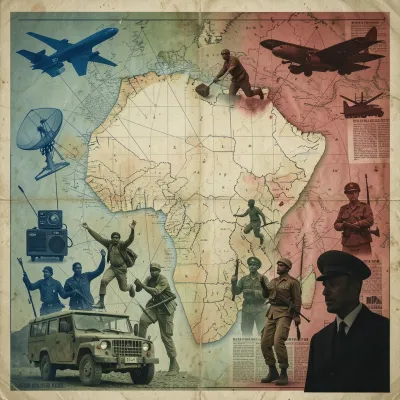
"Proxy Battlegrounds" meticulously chronicles Africa's role as a pivotal, yet often misunderstood, arena of the Cold War from 1945 to 1991. Challenging the notion of Africa as merely a passive battleground, the book argues that African leaders, movements, and communities actively leveraged, resisted, and repurposed superpower interventions for their own agendas of liberation, order, and survival. The narrative centers on four key theaters—Angola, the Congo, Ethiopia, and Somalia—demonstrating how global rivalries translated into regional instability, proxy warfare, and complex state-building efforts.
The book details how various forms of intervention—aid, covert action, military assistance, and cultural diplomacy—were deployed by external actors including the United States, the Soviet Union, China, Cuba, and South Africa. It highlights the inherent contradictions: aid meant for development often entrenched patronage, and security partnerships frequently supported authoritarian regimes. The text emphasizes that "proxy" did not equate to "powerless," as African actors skillfully navigated a crowded field of suitors, extracting resources and maintaining autonomy where possible, sometimes playing patrons against each other to maximize benefits.
Furthermore, "Proxy Battlegrounds" examines the profound impact of the Cold War on African domestic politics, particularly through the mechanics of coups and countercoups, and the devastating effects of economic warfare, sanctions, and commodity price shocks. It explores how ideological competition extended beyond battlefields into education, media, and religious institutions, shaping the cultural and intellectual landscape. The book concludes by tracing the legacies of this entangled history, arguing that the Cold War’s end did not erase its institutions, militarized societies, and deep-seated patterns of dependency, which continued to influence post-1991 African politics.
What You'll Find Inside:
- African actors actively navigated superpower rivalries to pursue local agendas of liberation, order, and survival rather than serving as passive pawns in Cold War politics.
- The book examines four key theaters—Angola, Congo, Ethiopia, and Somalia—to reveal the mechanics of proxy warfare and the possibilities and limits of local agency.
- Development aid functioned as a strategic instrument where modernization schemes, socialist transformations, and market-centered reforms were deployed as tools of influence and control.
- Covert operations including intelligence networks, mercenaries, and arms trafficking created complex security landscapes that endured beyond the Cold War era.
- Economic dimensions such as commodity markets, oil shocks, debt crises, and structural adjustment fundamentally shaped African statecraft and superpower relations.
Who's It For:
This book is ideal for students and scholars of African history, Cold War studies, and international relations who seek to understand how global superpower rivalries interacted with African agency to shape postcolonial conflicts and state formation. It will also benefit policy makers, development practitioners, and researchers interested in the historical roots of contemporary African geopolitics, intervention dynamics, and the legacies of external influence on the continent.
Author:
Published By:
Date Published:
May 5, 2026
Type:
Nonfiction
Language:
English
Word Count:
64,918 words
Reading Time:
4 hours 33 minutes
Sample:
Order:
Order Proxy Battlegrounds: Cold War Politics, Coups, and Liberation Movements in Africa (Paperback) on MixCache.com:
Buy NowPrint copy is made to order and ships worldwide. Includes the ebook free, ready to read instantly.
$5 account credit for all new MixCache.com accounts, usable toward any ebook purchase!*