Browse by Category
Fiction
- Action & Adventure
- African American
- Anthologies
- Children's Fiction
- Classics
- Comics & Graphic Novels
- Coming of Age
- Contemporary
- Cultural & Regional
- Drama
- Erotica
- Fantasy
- General
- Historical Fiction
- Horror
- Humor & Satire
- Literary Fiction
- Mystery, Thriller & Suspense
- Poetry
- Religious & Inspirational
- Romance
- Science Fiction
- Short Stories
- War & Military
- Westerns
- Women's Fiction
- Young Adult
Non-Fiction
- Antiques & Collectibles
- Arts & Photography
- Biographies & Memoirs
- Business & Money
- Children's Non-Fiction
-
Computers & Technology
- Artificial Intelligence
- Computer Science
- Cybersecurity & Cryptography
- Data Science & Analytics
- Databases & Big Data
- Game Development & Design
- General
- Hardware & DIY
- Mobile App Development
- Networking & Cloud Computing
- Operating Systems
- Programming
- Robotics
- Software
- Software Engineering
- User Experience (UX) & Design
- Web Development & Design
- Cooking, Food & Wine
- Crafts, Hobbies & Home
- Education & Teaching
- Engineering
- General
- Health, Fitness & Dieting
-
History
- African History
- African History - North Africa
- African History - Sub-Saharan Africa
- American History
- American History - 20th Century
- American History - Civil War
- American History - Colonial Period
- Ancient History
- Asian History
- Asian History - China
- Asian History - India
- Asian History - Japan
- Asian History - Southeast Asia
- European History
- European History - Ancient Greece
- European History - Ancient Rome
- European History - Medieval
- European History - Modern
- European History - Renaissance
- General
- Middle Eastern History
- Military History
- Military History - Aviation
- Military History - Naval
- Social & Cultural History
- World History
- Humor & Entertainment
- Industrial Technology
- Language Learning
- Law
- LGBTQ+ Non-Fiction
- Literary Criticism
- Medical Books
- Parenting & Relationships
- Philosophy
- Politics & Social Sciences
- Reference
- Religion & Spirituality
-
Science & Math
- Agricultural Sciences
- Astronomy & Space Science
- Behavioral Sciences
- Biological Sciences
- Botany & Plant Science
- Chemistry
- Earth Sciences
- Engineering - Chemical
- Engineering - Civil
- Engineering - Electrical
- Engineering - Mechanical
- Environment
- General
- Geology
- Mathematics
- Nature & Ecology
- Oceanography
- Paleontology
- Physics
- Statistics
- Self-Help
- Sports & Outdoors
- Study Aids
- Sustainability & Green Living
- Textbooks
- Transportation
- Travel
- True Crime
- Urban Planning & Development
- Veterinary Medicine
- Writing & Publishing
Jump to Section

Want unlimited access to all books published by MixCache.com (plus their audiobooks)? Try MixCache.com Total Access. Look for the MTA badge on book covers to identify included titles.
Access to infinite ebooks: Don't see the book you want? Suggest it and we'll create it (free!) for you from scratch with our powerful AI book writer. Then read it with MTA - besides profiting from any sales it makes!
African Cities: Urbanization, Informality, and Everyday Life from Lagos to Kinshasa
MTA
Slums, Markets, and the Making of Modern Urban Culture
About this book:
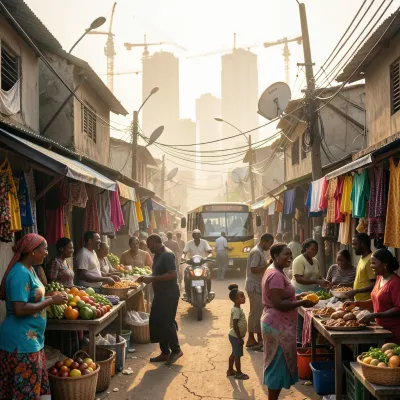
"African Cities: Urbanization, Informality, and Everyday Life from Lagos to Kinshasa" delves into the multifaceted and dynamic growth of urban centers across Africa, challenging conventional notions of "slums" and "disorder." The book argues that informality is not a deviation but a central, ingenious, and often resilient set of practices that enable survival, mobility, and creativity for millions. Moving beyond Western-centric urban theories, it offers a ground-level perspective on how cities like Lagos, Kinshasa, Nairobi, and Cairo function, highlighting the everyday ingenuity of residents in constructing homes, managing livelihoods, and navigating complex social and political landscapes.
The book meticulously examines the historical legacies of colonial planning, which established segregated and inequitable urban structures, and how these continue to influence contemporary challenges in land tenure, infrastructure, and governance. It explores how rapid population growth, driven by internal migration, strains formal systems, leading to the proliferation of self-built housing, vibrant informal markets, and adaptive transport ecologies like matatus and moto-taxis. Rather than viewing these as problems, the text frames them as organic solutions developed by residents to bridge the persistent gaps in formal housing, water, sanitation, and electricity provision.
Furthermore, the book dissects the political economy of African cities, illustrating how urban governance is a continuous negotiation between state ambition, market forces, and community self-organization. It scrutinizes the impact of mega-projects and speculative urbanism, often driven by foreign investment, which promise modernization but frequently lead to displacement and spatial inequality. Concurrently, it emphasizes the vital role of cultural production—music, film, fashion, and art—and the profound influence of faith in shaping urban morality, social cohesion, and identity. The narrative also addresses emerging challenges such as climate change, digital urbanism, and transnational flows, showing how these forces interact with existing informal systems to redefine urban futures.
Ultimately, "African Cities" presents these metropolises as laboratories of urban possibility, where resilience is forged in the face of scarcity, and collective action continually redefines the "right to the city." Through rich ethnographic vignettes and rigorous analysis, the book invites readers to understand African cities not as exceptions to a global norm, but as crucial sites where the future of global urbanization is being negotiated daily, block by block, ride by ride, and song by song, emphasizing the continuous interplay between human agency and structural constraints.
What You'll Find Inside:
- How African cities grow through adaptive, informal systems rather than formal planning alone, with slums, markets, and self-built housing as central to urban life
- The central role of informality in shaping urban economies, from street vetting and microenterprises to transport ecologies like danfos and matatus
- Migration patterns and mobility shaping urban development, with analysis of how newcomers negotiate space, livelihoods, and belonging in cities like Lagos and Kinshasa
- Land tenure complexities and politics of space, examining how colonial legacies, customary systems, and market forces create layered urban geographies
- Everyday infrastructures of water, sanitation, electricity, and transport as sites of negotiation and improvisation where formal systems meet resident adaptations
Who's It For:
This book is for urban planners, policymakers, and development practitioners working on African cities who need to understand the realities of informal urban systems. It will also benefit students of urban studies, geography, and African studies seeking grounded insights into contemporary urbanization processes. General readers interested in how cities actually function beyond formal planning narratives will find valuable perspectives on the ingenuity and resilience of urban residents across Lagos, Kinshasa, and other African metropolises.
Author:
Published By:
Date Published:
May 5, 2026
Type:
Nonfiction
Language:
English
Word Count:
65,775 words
Reading Time:
4 hours 36 minutes
Sample:
Order:
Order African Cities: Urbanization, Informality, and Everyday Life from Lagos to Kinshasa (Paperback) on MixCache.com:
Buy NowPrint copy is made to order and ships worldwide. Includes the ebook free, ready to read instantly.
$5 account credit for all new MixCache.com accounts, usable toward any ebook purchase!*