Browse by Category
Fiction
- Action & Adventure
- African American
- Anthologies
- Children's Fiction
- Classics
- Comics & Graphic Novels
- Coming of Age
- Contemporary
- Cultural & Regional
- Drama
- Erotica
- Fantasy
- General
- Historical Fiction
- Horror
- Humor & Satire
- Literary Fiction
- Mystery, Thriller & Suspense
- Poetry
- Religious & Inspirational
- Romance
- Science Fiction
- Short Stories
- War & Military
- Westerns
- Women's Fiction
- Young Adult
Non-Fiction
- Antiques & Collectibles
- Arts & Photography
- Biographies & Memoirs
- Business & Money
- Children's Non-Fiction
-
Computers & Technology
- Artificial Intelligence
- Computer Science
- Cybersecurity & Cryptography
- Data Science & Analytics
- Databases & Big Data
- Game Development & Design
- General
- Hardware & DIY
- Mobile App Development
- Networking & Cloud Computing
- Operating Systems
- Programming
- Robotics
- Software
- Software Engineering
- User Experience (UX) & Design
- Web Development & Design
- Cooking, Food & Wine
- Crafts, Hobbies & Home
- Education & Teaching
- Engineering
- General
- Health, Fitness & Dieting
-
History
- African History
- African History - North Africa
- African History - Sub-Saharan Africa
- American History
- American History - 20th Century
- American History - Civil War
- American History - Colonial Period
- Ancient History
- Asian History
- Asian History - China
- Asian History - India
- Asian History - Japan
- Asian History - Southeast Asia
- European History
- European History - Ancient Greece
- European History - Ancient Rome
- European History - Medieval
- European History - Modern
- European History - Renaissance
- General
- Middle Eastern History
- Military History
- Military History - Aviation
- Military History - Naval
- Social & Cultural History
- World History
- Humor & Entertainment
- Industrial Technology
- Language Learning
- Law
- LGBTQ+ Non-Fiction
- Literary Criticism
- Medical Books
- Parenting & Relationships
- Philosophy
- Politics & Social Sciences
- Reference
- Religion & Spirituality
-
Science & Math
- Agricultural Sciences
- Astronomy & Space Science
- Behavioral Sciences
- Biological Sciences
- Botany & Plant Science
- Chemistry
- Earth Sciences
- Engineering - Chemical
- Engineering - Civil
- Engineering - Electrical
- Engineering - Mechanical
- Environment
- General
- Geology
- Mathematics
- Nature & Ecology
- Oceanography
- Paleontology
- Physics
- Statistics
- Self-Help
- Sports & Outdoors
- Study Aids
- Sustainability & Green Living
- Textbooks
- Transportation
- Travel
- True Crime
- Urban Planning & Development
- Veterinary Medicine
- Writing & Publishing
Jump to Section

Want unlimited access to all books published by MixCache.com (plus their audiobooks)? Try MixCache.com Total Access. Look for the MTA badge on book covers to identify included titles.
Access to infinite ebooks: Don't see the book you want? Suggest it and we'll create it (free!) for you from scratch with our powerful AI book writer. Then read it with MTA - besides profiting from any sales it makes!
Unearthed China: Archaeology, Bones, and the Making of the Past
MTA
Recent archaeological discoveries and how they reshape our understanding of ancient China
About this book:
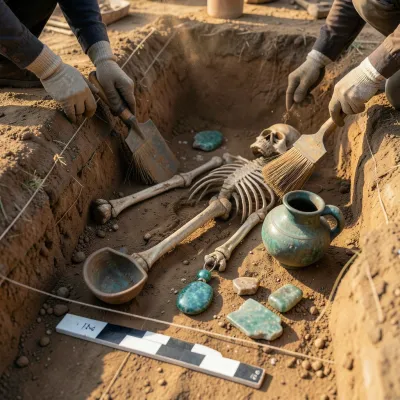
*Unearthed China: Archaeology, Bones, and the Making of the Past* explore how recent archaeological discoveries and advanced scientific methodologies are fundamentally reshaping the narrative of ancient China. Moving beyond traditional text-based histories, the book highlights how remote sensing, ancient DNA analysis, and isotopic studies have revealed a more complex, multi-centered origin for Chinese civilization. By examining Neolithic megasites like Liangzhu and the fortified city of Shimao, the text demonstrates that sophisticated social hierarchies and monumental engineering emerged independently across diverse landscapes, challenging the long-held assumption that the Yellow River was the sole "cradle" of Chinese culture.
The book delves into the material world of the Bronze Age, from the ritualized bureaucracy of the Shang oracle bones to the enigmatic, gold-masked figures of Sanxingdui. It details the intricate social choreography required for mass craft production, such as the terracotta army of the First Emperor and the standardized luxury goods of the Han Dynasty. Through the study of food residues and burial patterns, the author reconstructs the textures of everyday life, revealing how early exchange networks—precursors to the Silk Road—linked coastal estuaries, desert oases, and steppe frontiers in a fluid web of trade and cultural borrowing.
Methodological rigor is a central theme, as the text explains how Bayesian modeling and archaeomagnetism have tightened chronologies, allowing archaeologists to measure ancient events in decades rather than centuries. These scientific tools are shown to be essential in interpreting "silent" archives, such as the Tarim Basin mummies or the environmental records of climate catastrophe. By integrating biological, chemical, and physical data with traditional excavation, the book presents the past not as a static deposit but as a dynamic, evolving reconstruction influenced by environmental shifts and human ingenuity.
Finally, the work situates archaeology within the modern political and ethical landscape of heritage management. It addresses how the "making of the past" is influenced by contemporary national identity, salvage archaeology driven by rapid urban development, and the global circulation of cultural treasures. The book concludes that the history of China is a continuous process of discovery and reinterpretation, where every unearthed fragment serves as an active participant in a shared, ongoing project to understand the complexity of human antiquity.
What You'll Find Inside:
- The book reveals how recent archaeological discoveries challenge the traditional narrative of a single origin for Chinese civilization, demonstrating multiple independent centers of complexity like Liangzhu in the Yangtze basin and Hongshan in the northeast that developed concurrently with Yellow River cultures.
- It showcases how scientific advances—including radiocarbon dating with Bayesian modeling, ancient DNA analysis, and residue studies—have transformed archaeological interpretation, enabling more precise chronologies and unprecedented insights into ancient diets, migration patterns, and population dynamics.
- The work examines how material culture—from jade cong and bi discs to bronze vessels and pottery—serves as a crucial archive of social complexity, ritual practices, and exchange networks that often remain invisible in written records.
- It explores how frontiers and borderlands functioned as dynamic zones of interaction where agricultural and pastoral societies exchanged goods, ideas, and technologies, challenging assumptions about cultural margins and demonstrating the interconnected nature of ancient Chinese development.
- The book emphasizes that archaeological interpretation is an ongoing, revisable process where new evidence constantly reshapes understanding, requiring methodological rigor, openness to multiple interpretations, and careful consideration of how present-day politics and heritage practices influence our reconstruction of the past.
Who's It For:
This book is ideal for curious general readers fascinated by archaeology and ancient China, undergraduate and graduate students in archaeology, anthropology, or history seeking a synthesis of recent discoveries and methodologies, and researchers looking for current perspectives on how scientific advances are reshaping our understanding of China's deep past. It will particularly benefit those interested in the interplay between archaeological evidence, scientific techniques, and evolving interpretations of social complexity, exchange networks, and regional interactions in ancient East Asia.
Author:
Published By:
Date Published:
May 4, 2026
Type:
Nonfiction
Language:
English
Word Count:
67,865 words
Reading Time:
4 hours 45 minutes
Sample:
Order:
Order Unearthed China: Archaeology, Bones, and the Making of the Past (Hardcover) on MixCache.com:
Buy NowPrint copy is made to order and ships worldwide. Includes the ebook free, ready to read instantly.
$5 account credit for all new MixCache.com accounts, usable toward any ebook purchase!*