Browse by Category
Fiction
- Action & Adventure
- African American
- Anthologies
- Children's Fiction
- Classics
- Comics & Graphic Novels
- Coming of Age
- Contemporary
- Cultural & Regional
- Drama
- Erotica
- Fantasy
- General
- Historical Fiction
- Horror
- Humor & Satire
- Literary Fiction
- Mystery, Thriller & Suspense
- Poetry
- Religious & Inspirational
- Romance
- Science Fiction
- Short Stories
- War & Military
- Westerns
- Women's Fiction
- Young Adult
Non-Fiction
- Antiques & Collectibles
- Arts & Photography
- Biographies & Memoirs
- Business & Money
- Children's Non-Fiction
-
Computers & Technology
- Artificial Intelligence
- Computer Science
- Cybersecurity & Cryptography
- Data Science & Analytics
- Databases & Big Data
- Game Development & Design
- General
- Hardware & DIY
- Mobile App Development
- Networking & Cloud Computing
- Operating Systems
- Programming
- Robotics
- Software
- Software Engineering
- User Experience (UX) & Design
- Web Development & Design
- Cooking, Food & Wine
- Crafts, Hobbies & Home
- Education & Teaching
- Engineering
- General
- Health, Fitness & Dieting
-
History
- African History
- African History - North Africa
- African History - Sub-Saharan Africa
- American History
- American History - 20th Century
- American History - Civil War
- American History - Colonial Period
- Ancient History
- Asian History
- Asian History - China
- Asian History - India
- Asian History - Japan
- Asian History - Southeast Asia
- European History
- European History - Ancient Greece
- European History - Ancient Rome
- European History - Medieval
- European History - Modern
- European History - Renaissance
- General
- Middle Eastern History
- Military History
- Military History - Aviation
- Military History - Naval
- Social & Cultural History
- World History
- Humor & Entertainment
- Industrial Technology
- Language Learning
- Law
- LGBTQ+ Non-Fiction
- Literary Criticism
- Medical Books
- Parenting & Relationships
- Philosophy
- Politics & Social Sciences
- Reference
- Religion & Spirituality
-
Science & Math
- Agricultural Sciences
- Astronomy & Space Science
- Behavioral Sciences
- Biological Sciences
- Botany & Plant Science
- Chemistry
- Earth Sciences
- Engineering - Chemical
- Engineering - Civil
- Engineering - Electrical
- Engineering - Mechanical
- Environment
- General
- Geology
- Mathematics
- Nature & Ecology
- Oceanography
- Paleontology
- Physics
- Statistics
- Self-Help
- Sports & Outdoors
- Study Aids
- Sustainability & Green Living
- Textbooks
- Transportation
- Travel
- True Crime
- Urban Planning & Development
- Veterinary Medicine
- Writing & Publishing
Jump to Section

Want unlimited access to all books published by MixCache.com (plus their audiobooks)? Try MixCache.com Total Access. Look for the MTA badge on book covers to identify included titles.
Access to infinite ebooks: Don't see the book you want? Suggest it and we'll create it (free!) for you from scratch with our powerful AI book writer. Then read it with MTA - besides profiting from any sales it makes!
Microbial Oceans: Marine Microbiomes, Biogeochemistry, and Biotechnology
MTA
Exploring the role of microbes in ocean systems, nutrient cycles, and novel bioresources
About this book:
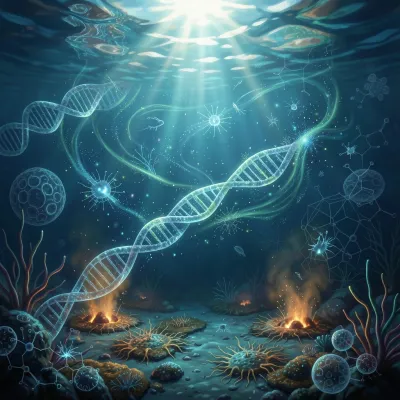
"Microbial Oceans: Marine Microbiomes, Biogeochemistry, and Biotechnology" provides a comprehensive exploration of the indispensable role of marine microbes in shaping Earth's oceans and global processes. The book begins by establishing microbes as the "invisible majority," detailing their immense diversity, evolutionary history, and fundamental ecological functions within planktonic communities (from picoplankton to protists) and benthic environments (biofilms, sediments, and the deep biosphere). It highlights how these tiny organisms drive primary production, form the base of intricate food webs, and are profoundly influenced by pervasive marine viruses and their "viral shunt" mechanism, which significantly impacts nutrient cycling and genetic exchange.
The book then delves into the critical contributions of these microbial communities to global biogeochemical cycles, including the marine carbon pump, transformations of nitrogen (fixation, nitrification, denitrification), and the cycling of phosphorus and sulfur. It explores how these elemental cycles are tightly coupled and modulated by microbial activity, influencing atmospheric CO2, ocean fertility, and the production of climate-active gases. Special attention is given to "frontiers of life" such as hydrothermal vents, cold seeps, and oxygen minimum zones, where unique chemosynthetic microbiomes thrive under extreme conditions, challenging our understanding of life's limits and contributing to global biogeochemistry.
Later chapters focus on the intricate interplay between marine microbiomes and larger environmental contexts, including coastal and estuarine systems—highlighting their vulnerability to anthropogenic pressures like nutrient pollution and climate change—and coral reef microbiomes, examining the delicate balance of symbiosis, dysbiosis, and reef health. The book also addresses harmful algal blooms as a manifestation of microbial imbalance, detailing their ecology, toxins, and mitigation strategies.
Finally, the book showcases the technological advancements revolutionizing marine microbial research, from "omics" approaches (metagenomics, metatranscriptomics, proteomics, metabolomics) that reveal genetic potential and activity, to single-cell and imaging techniques (flow cytometry, FISH, NanoSIMS) that connect molecular insights to individual cell function and spatial organization. It discusses the importance of long-term observatories and autonomous platforms for sustained observation and the critical role of modeling in translating microscopic processes into ecosystem- and Earth-system-scale predictions. The conclusion emphasizes the profound implications of microbial responses to climate change (warming, acidification, deoxygenation) and explores the burgeoning field of "blue biotechnology," including the use of microbes as cleanup crews for pollutants, sources of novel natural products for drug discovery, and "microbial biofactories" for sustainable biofuels and bioplastics, alongside crucial discussions on data science standards, open science, ethics, and policy in marine microbial research.
What You'll Find Inside:
- The fundamental role of marine microbes in driving global biogeochemical cycles (carbon, nitrogen, phosphorus, sulfur) that regulate Earth's climate and productivity
- How advanced methodological approaches (omics, single-cell techniques, autonomous platforms) are revolutionizing our understanding of marine microbial diversity and function
- The critical interactions within microbial food webs and trophic dynamics that govern energy flow from viruses to fisheries
- Applications of marine microbiology in biotechnology, bioremediation, and natural product discovery for sustainable blue economy solutions
- Microbial responses to climate change and their feedback mechanisms that can either amplify or dampen global environmental changes
Who's It For:
This book is designed for graduate students, researchers, and professionals in marine microbiology, oceanography, biogeochemistry, and environmental sciences who seek a comprehensive understanding of marine microbial systems. It will also benefit policymakers and environmental managers looking to apply microbial insights to climate change mitigation, bioremediation strategies, and marine conservation efforts, as well as biotechnologists interested in harnessing marine microbial resources for sustainable innovation.
Author:
Published By:
Date Published:
May 4, 2026
Type:
Nonfiction
Language:
English
Word Count:
65,951 words
Reading Time:
4 hours 37 minutes
Sample:
Order:
Order Microbial Oceans: Marine Microbiomes, Biogeochemistry, and Biotechnology (Hardcover) on MixCache.com:
Buy NowPrint copy is made to order and ships worldwide. Includes the ebook free, ready to read instantly.
$5 account credit for all new MixCache.com accounts, usable toward any ebook purchase!*