Browse by Category
Fiction
- Action & Adventure
- African American
- Anthologies
- Children's Fiction
- Classics
- Comics & Graphic Novels
- Coming of Age
- Contemporary
- Cultural & Regional
- Drama
- Erotica
- Fantasy
- General
- Historical Fiction
- Horror
- Humor & Satire
- Literary Fiction
- Mystery, Thriller & Suspense
- Poetry
- Religious & Inspirational
- Romance
- Science Fiction
- Short Stories
- War & Military
- Westerns
- Women's Fiction
- Young Adult
Non-Fiction
- Antiques & Collectibles
- Arts & Photography
- Biographies & Memoirs
- Business & Money
- Children's Non-Fiction
-
Computers & Technology
- Artificial Intelligence
- Computer Science
- Cybersecurity & Cryptography
- Data Science & Analytics
- Databases & Big Data
- Game Development & Design
- General
- Hardware & DIY
- Mobile App Development
- Networking & Cloud Computing
- Operating Systems
- Programming
- Robotics
- Software
- Software Engineering
- User Experience (UX) & Design
- Web Development & Design
- Cooking, Food & Wine
- Crafts, Hobbies & Home
- Education & Teaching
- Engineering
- General
- Health, Fitness & Dieting
-
History
- African History
- African History - North Africa
- African History - Sub-Saharan Africa
- American History
- American History - 20th Century
- American History - Civil War
- American History - Colonial Period
- Ancient History
- Asian History
- Asian History - China
- Asian History - India
- Asian History - Japan
- Asian History - Southeast Asia
- European History
- European History - Ancient Greece
- European History - Ancient Rome
- European History - Medieval
- European History - Modern
- European History - Renaissance
- General
- Middle Eastern History
- Military History
- Military History - Aviation
- Military History - Naval
- Social & Cultural History
- World History
- Humor & Entertainment
- Industrial Technology
- Language Learning
- Law
- LGBTQ+ Non-Fiction
- Literary Criticism
- Medical Books
- Parenting & Relationships
- Philosophy
- Politics & Social Sciences
- Reference
- Religion & Spirituality
-
Science & Math
- Agricultural Sciences
- Astronomy & Space Science
- Behavioral Sciences
- Biological Sciences
- Botany & Plant Science
- Chemistry
- Earth Sciences
- Engineering - Chemical
- Engineering - Civil
- Engineering - Electrical
- Engineering - Mechanical
- Environment
- General
- Geology
- Mathematics
- Nature & Ecology
- Oceanography
- Paleontology
- Physics
- Statistics
- Self-Help
- Sports & Outdoors
- Study Aids
- Sustainability & Green Living
- Textbooks
- Transportation
- Travel
- True Crime
- Urban Planning & Development
- Veterinary Medicine
- Writing & Publishing
Jump to Section

Want unlimited access to all books published by MixCache.com (plus their audiobooks)? Try MixCache.com Total Access. Look for the MTA badge on book covers to identify included titles.
Access to infinite ebooks: Don't see the book you want? Suggest it and we'll create it (free!) for you from scratch with our powerful AI book writer. Then read it with MTA - besides profiting from any sales it makes!
Oceanography in the Community: Citizen Science, Education, and Coastal Stewardship
MTA
Practical projects and curricula to engage schools, volunteers, and coastal communities in ocean science
About this book:
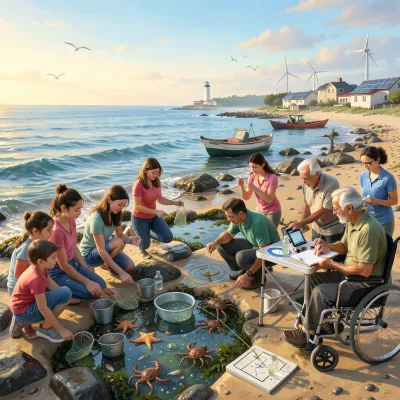
"Oceanography in the Community: Citizen Science, Education, and Coastal Stewardship" provides a comprehensive guide for engaging local communities in marine science through practical projects. The book emphasizes the crucial role of citizen science in collecting localized, long-term data that complements traditional oceanographic research, particularly in dynamic coastal zones where professional monitoring might be limited. It details the "why" behind community oceanography, highlighting its importance for scale, local knowledge integration, and fostering civic engagement and environmental literacy.
The book thoroughly covers the foundational elements necessary for successful community science programs, beginning with careful program design that translates vision into measurable outcomes. It addresses critical operational aspects such as safety protocols, permitting, and risk management in fieldwork, alongside effective strategies for volunteer recruitment and retention. A significant portion is dedicated to ensuring data quality, covering detailed protocols, quality assurance/quality control (QA/QC) procedures, and the use of low-cost tools and digital platforms for efficient data collection and management.
Throughout the text, specific monitoring applications are explored in depth. These include water quality (temperature, salinity, pH, dissolved oxygen), microplastics and marine debris surveys, intertidal biodiversity, coastal vegetation (seagrass, kelp, marshes), beach morphology and erosion tracking, and observations of storms, tides, and sea-level rise. The book also delves into specialized areas like acoustic and visual wildlife monitoring, harmful algal bloom early warning systems, and community-based fisheries data collection. It places a strong emphasis on integrating Indigenous knowledge and fostering co-management approaches, recognizing diverse ways of knowing and ensuring equitable partnerships.
Finally, the book provides essential guidance on data management—from metadata and storage to open science principles and effective data visualization—to ensure that community-collected information is trustworthy, accessible, and impactful. It concludes with strategies for educational integration across K-12 and informal learning settings, fostering sustainable partnerships with agencies, universities, and NGOs, and securing funding for long-term program sustainability. The overarching message is that by empowering communities to actively participate in ocean science, the book aims to build a more resilient, informed, and engaged coastal stewardship for the future.
What You'll Find Inside:
- Practical frameworks for designing community oceanography programs with clear objectives, safety protocols, and quality assurance practices to ensure credible, usable data
- Step-by-step guides for key monitoring activities including water quality testing, marine debris surveys, biodiversity assessments, and beach morphology tracking using low-cost tools and DIY sensors
- Strategies for integrating ocean science into K-12 education and informal learning environments with standards-aligned lesson plans, assessment ideas, and pathways for youth leadership development
- Approaches to building ethical, equitable programs that center Indigenous knowledge, community priorities, and inclusive participation through stipends, accessible scheduling, and co-management agreements
- Guidance on sustaining community science initiatives through diversified funding strategies, partnership development with agencies/universities/NGOs, and data management for long-term impact and stewardship
Who's It For:
Designed for educators, program coordinators, nonprofit leaders, and coastal community members seeking to engage in meaningful ocean science. This book provides practical guidance for teachers wanting to integrate hands-on monitoring into their curriculum, volunteer coordinators building citizen science programs, and residents passionate about coastal stewardship. Readers will find actionable projects suitable for school groups, volunteer teams, and community partnerships that contribute credible data to local management decisions while building scientific literacy and place-based connections.
Author:
Published By:
Date Published:
May 4, 2026
Type:
Nonfiction
Language:
English
Word Count:
60,544 words
Reading Time:
4 hours 14 minutes
Sample:
Order:
Order Oceanography in the Community: Citizen Science, Education, and Coastal Stewardship (Paperback) on MixCache.com:
Buy NowPrint copy is made to order and ships worldwide. Includes the ebook free, ready to read instantly.
$5 account credit for all new MixCache.com accounts, usable toward any ebook purchase!*