Browse by Category
Fiction
- Action & Adventure
- African American
- Anthologies
- Children's Fiction
- Classics
- Comics & Graphic Novels
- Coming of Age
- Contemporary
- Cultural & Regional
- Drama
- Erotica
- Fantasy
- General
- Historical Fiction
- Horror
- Humor & Satire
- Literary Fiction
- Mystery, Thriller & Suspense
- Poetry
- Religious & Inspirational
- Romance
- Science Fiction
- Short Stories
- War & Military
- Westerns
- Women's Fiction
- Young Adult
Non-Fiction
- Antiques & Collectibles
- Arts & Photography
- Biographies & Memoirs
- Business & Money
- Children's Non-Fiction
-
Computers & Technology
- Artificial Intelligence
- Computer Science
- Cybersecurity & Cryptography
- Data Science & Analytics
- Databases & Big Data
- Game Development & Design
- General
- Hardware & DIY
- Mobile App Development
- Networking & Cloud Computing
- Operating Systems
- Programming
- Robotics
- Software
- Software Engineering
- User Experience (UX) & Design
- Web Development & Design
- Cooking, Food & Wine
- Crafts, Hobbies & Home
- Education & Teaching
- Engineering
- General
- Health, Fitness & Dieting
-
History
- African History
- African History - North Africa
- African History - Sub-Saharan Africa
- American History
- American History - 20th Century
- American History - Civil War
- American History - Colonial Period
- Ancient History
- Asian History
- Asian History - China
- Asian History - India
- Asian History - Japan
- Asian History - Southeast Asia
- European History
- European History - Ancient Greece
- European History - Ancient Rome
- European History - Medieval
- European History - Modern
- European History - Renaissance
- General
- Middle Eastern History
- Military History
- Military History - Aviation
- Military History - Naval
- Social & Cultural History
- World History
- Humor & Entertainment
- Industrial Technology
- Language Learning
- Law
- LGBTQ+ Non-Fiction
- Literary Criticism
- Medical Books
- Parenting & Relationships
- Philosophy
- Politics & Social Sciences
- Reference
- Religion & Spirituality
-
Science & Math
- Agricultural Sciences
- Astronomy & Space Science
- Behavioral Sciences
- Biological Sciences
- Botany & Plant Science
- Chemistry
- Earth Sciences
- Engineering - Chemical
- Engineering - Civil
- Engineering - Electrical
- Engineering - Mechanical
- Environment
- General
- Geology
- Mathematics
- Nature & Ecology
- Oceanography
- Paleontology
- Physics
- Statistics
- Self-Help
- Sports & Outdoors
- Study Aids
- Sustainability & Green Living
- Textbooks
- Transportation
- Travel
- True Crime
- Urban Planning & Development
- Veterinary Medicine
- Writing & Publishing
Jump to Section

Want unlimited access to all books published by MixCache.com (plus their audiobooks)? Try MixCache.com Total Access. Look for the MTA badge on book covers to identify included titles.
Access to infinite ebooks: Don't see the book you want? Suggest it and we'll create it (free!) for you from scratch with our powerful AI book writer. Then read it with MTA - besides profiting from any sales it makes!
Mughal Splendor and Succession: Art, Statecraft, and the Fate of an Empire
MTA
The courts, art patronage, and succession crises that shaped Mughal India
About this book:
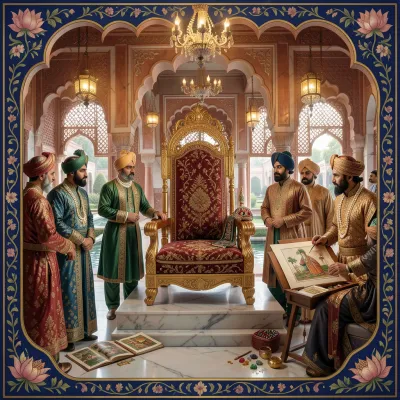
"Mughal Splendor and Succession" explores the paradoxical nature of the Mughal Empire, highlighting how its celebrated artistic achievements and magnificent urban centers coexisted with, and often fed into, intense succession crises. The book argues that cultural patronage was not merely ornamental but a fundamental aspect of statecraft, used to assert, negotiate, and legitimize power through architecture, miniature painting, garden design, and courtly ceremonies. This intertwining of art and politics produced a distinctive imperial grammar, legible in marble, pigment, and ritual, that allowed the empire to project an image of order and divine sanction even amidst political volatility.
The narrative traces the evolution of Mughal culture and governance from Babur's initial conquest and the transplantation of Timurid legacies to the zenith under Jahangir and Shah Jahan, and finally, to the empire's gradual fragmentation after the devastating succession war of 1657-58. It details how each emperor, while building upon inherited traditions, adapted imperial aesthetics and administrative practices to suit changing political landscapes. From Akbar's policy of *sulh-i kull* (universal peace) and the experimental city of Fatehpur Sikri, which integrated diverse cultures, to Jahangir's focus on naturalism and the "politics of seeing," and Shah Jahan's marble ideology epitomized by the Taj Mahal, the book demonstrates how visual and spatial strategies were central to defining and projecting Mughal sovereignty.
A significant portion of the book examines the critical role of succession crises, which were not just disruptions but constitutive elements of Mughal rule. The absence of primogeniture and the emphasis on a victorious prince meant that conflict was almost structural, leaving architectural and artistic traces as contenders vied for legitimacy. The differing visions of sovereignty embodied by Dara Shukoh and Aurangzeb during their fraternal war are explored as a clash between pluralism and puritanism, profoundly impacting the empire's trajectory. The book also highlights the often "invisible architectures" of power wielded by royal women like Nur Jahan, whose influence shaped courtly taste, patronage, and even military strategy, proving that female competence was crucial to the empire's functioning.
Finally, the book analyzes how the empire's cultural and administrative practices adapted to external challenges from the Sikhs, Marathas, and Rajputs, and the growing influence of European trading companies. It shows how Mughal styles and institutions dispersed to provincial courts, creating hybrid aesthetics and new aesthetic economies that allowed the imperial legacy to endure even as central political authority waned. Ultimately, "Mugher Splendor and Succession" concludes that the empire's most lasting legacy is not just its territorial extent but its enduring cultural toolkit for making power visible, comprehensible, and compelling—a shared language of rule that outlived its political unity.
What You'll Find Inside:
- Mughal art and architecture functioned as political instruments where gardens, paintings, and buildings actively shaped imperial authority and territorial control
- Succession crises were structural features of Timurid-Mughal governance, not mere disruptions, often intensifying patronage as contenders raced to materialize legitimacy
- The empire excelled at cultural synthesis, transforming diversity into strength by integrating Persianate, Rajput, Deccani, and European influences into a coherent imperial visual language
- Women like Nur Jahan and Jahanara Begum wielded significant power as patrons, diplomats, and strategists, shaping court culture, architecture, and succession politics
- Mughal aesthetic forms endured beyond political fragmentation, migrating to provincial courts and global networks as a shared cultural inheritance long after central authority waned
Who's It For:
This book is ideal for scholars and advanced students of Mughal history, art history, and South Asian studies who seek to understand the interplay between cultural production and political power. It will particularly benefit readers interested in interdisciplinary approaches that combine visual analysis with political succession dynamics, as well as those studying how empires use art and ceremony to assert authority. Academics researching gender roles in court culture, cross-cultural exchange, or the afterlives of imperial styles will find valuable insights throughout.
Author:
Published By:
Date Published:
May 3, 2026
Type:
Nonfiction
Language:
English
Word Count:
64,870 words
Reading Time:
4 hours 33 minutes
Sample:
Order:
Order Mughal Splendor and Succession: Art, Statecraft, and the Fate of an Empire (Paperback) on MixCache.com:
Buy NowPrint copy is made to order and ships worldwide. Includes the ebook free, ready to read instantly.
$5 account credit for all new MixCache.com accounts, usable toward any ebook purchase!*