
Browse by Category
Fiction
- Action & Adventure
- African American
- Anthologies
- Children's Fiction
- Classics
- Comics & Graphic Novels
- Coming of Age
- Contemporary
- Cultural & Regional
- Drama
- Erotica
- Fantasy
- General
- Historical Fiction
- Horror
- Humor & Satire
- Literary Fiction
- Mystery, Thriller & Suspense
- Poetry
- Religious & Inspirational
- Romance
- Science Fiction
- Short Stories
- War & Military
- Westerns
- Women's Fiction
- Young Adult
Non-Fiction
- Antiques & Collectibles
- Arts & Photography
- Biographies & Memoirs
- Business & Money
- Children's Non-Fiction
-
Computers & Technology
- Artificial Intelligence
- Computer Science
- Cybersecurity & Cryptography
- Data Science & Analytics
- Databases & Big Data
- Game Development & Design
- General
- Hardware & DIY
- Mobile App Development
- Networking & Cloud Computing
- Operating Systems
- Programming
- Robotics
- Software
- Software Engineering
- User Experience (UX) & Design
- Web Development & Design
- Cooking, Food & Wine
- Crafts, Hobbies & Home
- Education & Teaching
- Engineering
- General
- Health, Fitness & Dieting
-
History
- African History
- African History - North Africa
- African History - Sub-Saharan Africa
- American History
- American History - 20th Century
- American History - Civil War
- American History - Colonial Period
- Ancient History
- Asian History
- Asian History - China
- Asian History - India
- Asian History - Japan
- Asian History - Southeast Asia
- European History
- European History - Ancient Greece
- European History - Ancient Rome
- European History - Medieval
- European History - Modern
- European History - Renaissance
- General
- Middle Eastern History
- Military History
- Military History - Aviation
- Military History - Naval
- Social & Cultural History
- World History
- Humor & Entertainment
- Industrial Technology
- Language Learning
- Law
- LGBTQ+ Non-Fiction
- Literary Criticism
- Medical Books
- Parenting & Relationships
- Philosophy
- Politics & Social Sciences
- Reference
- Religion & Spirituality
-
Science & Math
- Agricultural Sciences
- Astronomy & Space Science
- Behavioral Sciences
- Biological Sciences
- Botany & Plant Science
- Chemistry
- Earth Sciences
- Engineering - Chemical
- Engineering - Civil
- Engineering - Electrical
- Engineering - Mechanical
- Environment
- General
- Geology
- Mathematics
- Nature & Ecology
- Oceanography
- Paleontology
- Physics
- Statistics
- Self-Help
- Sports & Outdoors
- Study Aids
- Sustainability & Green Living
- Textbooks
- Transportation
- Travel
- True Crime
- Urban Planning & Development
- Veterinary Medicine
- Writing & Publishing
Jump to Section
MixCache.com Total Access
Unlimited reading and audiobooks for every book published by MixCache.com.
Included titles carry the MTA badge.
Learn more →
Eyes from Orbit: Earth Observation for Climate and Crisis Response
MTA
Using satellite imagery and analytics to monitor climate change, disasters, and humanitarian needs
About this book:
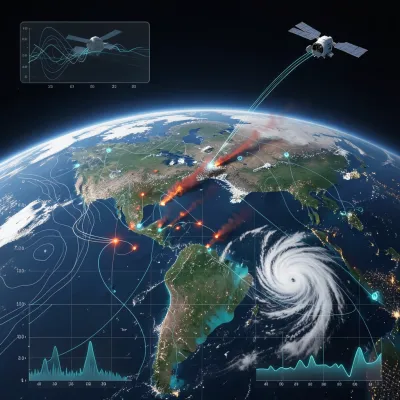
*Eyes from Orbit: Earth Observation for Climate and Crisis Response* serves as a comprehensive manual for utilizing satellite imagery and geospatial analytics to address environmental and humanitarian challenges. The book transitions from the fundamental physics of remote sensing—covering orbits, sensor types (optical, SAR, thermal), and radiometric correction—to the practical engineering required for operational workflows. It emphasizes the importance of "analysis-ready data," detailing the rigorous preprocessing steps of cloud masking, tiling, and harmonization necessary to turn raw pixels into reliable evidence for decision-makers.
The text provides deep technical dives into domain-specific applications, including wildfire detection, flood inundation mapping, and agricultural monitoring. By integrating multispectral indices with Synthetic Aperture Radar (SAR) and thermal sensing, the book illustrates how to maintain persistent surveillance even under adverse weather conditions or during the night. It also explores advanced analytical techniques like time-series breakpoint detection and machine learning to distinguish between natural seasonal cycles and abrupt crisis-driven changes, such as deforestation or infrastructure failure.
Beyond the technical mechanics, the book focuses heavily on the "last mile" of data delivery—product design, dashboards, and early warning triggers. It argues that the value of Earth observation is realized only when information is communicated clearly, ethically, and with transparent uncertainty to those in a position to act. The final chapters address the institutional side of remote sensing, offering guidance on program design, cloud-scale processing, and the ethical safeguards required to protect vulnerable populations while monitoring global crises.
Ultimately, the book frames Earth observation not as a collection of static images, but as a dynamic infrastructure for global resilience. It advocates for a shift toward cloud-native, automated systems that integrate satellite data with field observations and biophysical models. By prioritizing capacity building, sustainability, and responsible use, the text provides a roadmap for NGOs, governments, and the private sector to leverage orbital perspective for timely, life-saving interventions in an increasingly volatile climate.
What You'll Find Inside:
- Comprehensive preprocessing workflows for turning raw satellite data into analysis-ready data, including tiling, cloud masking, mosaicking, and sensor harmonization techniques
- Detailed guidance on selecting and using different satellite platforms (optical, SAR, thermal, nighttime) and understanding their strengths/limitations for various climate and crisis scenarios
- Practical, field-tested methodologies for specific disaster types: wildfire detection and burn severity mapping, flood inundation and depth estimation, and agricultural monitoring for drought and food security
- Advanced change detection techniques ranging from simple differencing to time-series analysis and breakpoint detection for identifying meaningful landscape changes
- Operational implementation strategies including scalable cloud processing, machine learning integration, product design for decision-makers, and ethical frameworks for responsible use
Who's It For:
This book is designed for practitioners in NGOs, government agencies, and private sector organizations who need to implement Earth observation solutions for climate monitoring and crisis response. It is particularly valuable for those designing early warning systems for floods, mapping wildfire impacts for recovery operations, or monitoring agricultural conditions to anticipate food insecurity. The content focuses on actionable methods and workflows that can be applied in real-world conditions with cloudy imagery, inconsistent data quality, and resource constraints, rather than abstract theoretical concepts.
Table of Contents:
- Introduction
- Chapter 1 Why Satellites Matter for Climate and Crisis Response
- Chapter 2 Orbits, Platforms, and Sensor Types
- Chapter 3 Resolution and Scale: Spatial, Spectral, Temporal, Radiometric
- Chapter 4 Radiometry, Atmospheric Correction, and Surface Reflectance
- Chapter 5 Data Sources: Landsat, Sentinel, MODIS, VIIRS, and Commercial Providers
- Chapter 6 Preprocessing: Tiling, Cloud Masking, Mosaicking, Harmonization
- Chapter 7 Spectral Indices and Feature Engineering
- Chapter 8 Time Series Analysis and Phenology
- Chapter 9 Change Detection Workflows: From Differencing to Time-Series Breaks
- Chapter 10 Synthetic Aperture Radar (SAR): Theory and Practice
- Chapter 11 Thermal Infrared and Nighttime Sensing for Hazard Monitoring
- Chapter 12 Accuracy, Uncertainty, and Validation Strategies
- Chapter 13 Integrating EO with GIS, Field Data, and Models
- Chapter 14 Wildfire: Early Detection, Burn Severity, and Post-Fire Recovery
- Chapter 15 Floods: Rapid Inundation Mapping, Depth Estimation, and Impact
- Chapter 16 Agriculture: Crop Monitoring, Drought, and Food Security
- Chapter 17 Land Degradation, Deforestation, and Carbon Accounting
- Chapter 18 Urban Monitoring: Heat, Air-Quality Proxies, and Infrastructure Risk
- Chapter 19 Early Warning Systems, Triggers, and Decision Thresholds
- Chapter 20 Scalable Processing: Cloud Platforms, STAC, and APIs
- Chapter 21 Machine Learning and AI: From Pixels to Operational Products
- Chapter 22 Product Design: Dashboards, Alerts, and Communication
- Chapter 23 Program Design for NGOs, Governments, and the Private Sector
- Chapter 24 Ethics, Privacy, and Responsible Use in Crisis Contexts
- Chapter 25 Building Capacity, Sustainability, and Measuring Impact
Author:
Published By:
Date Published:
May 3, 2026
Type:
Nonfiction
Language:
English
Word Count:
55,792 words
Reading Time:
3 hours 54 minutes
Sample:
MixCache.com Total Access
Get unlimited access to this book + all books published by MixCache.com for $11.99/month
Subscribe to MTAOr purchase this book individually below
Order:
Buy the Eyes from Orbit: Earth Observation for Climate and Crisis Response ebook on MixCache.com:
Buy Now
Full ebook will be available immediately
- read online or download as a PDF file.
$5 account credit for all new MixCache.com accounts, usable toward any ebook purchase!*



Ratings & Reviews
Ask Questions About This Book
Have a question about the content? Ask our AI assistant!
Start by asking a question about "Eyes from Orbit: Earth Observation for Climate and Crisis Response"
Example: "Does this book mention William Shakespeare?"
Thinking...