
Browse by Category
Fiction
- Action & Adventure
- African American
- Anthologies
- Children's Fiction
- Classics
- Comics & Graphic Novels
- Coming of Age
- Contemporary
- Cultural & Regional
- Drama
- Erotica
- Fantasy
- General
- Historical Fiction
- Horror
- Humor & Satire
- Literary Fiction
- Mystery, Thriller & Suspense
- Poetry
- Religious & Inspirational
- Romance
- Science Fiction
- Short Stories
- War & Military
- Westerns
- Women's Fiction
- Young Adult
Non-Fiction
- Antiques & Collectibles
- Arts & Photography
- Biographies & Memoirs
- Business & Money
- Children's Non-Fiction
-
Computers & Technology
- Artificial Intelligence
- Computer Science
- Cybersecurity & Cryptography
- Data Science & Analytics
- Databases & Big Data
- Game Development & Design
- General
- Hardware & DIY
- Mobile App Development
- Networking & Cloud Computing
- Operating Systems
- Programming
- Robotics
- Software
- Software Engineering
- User Experience (UX) & Design
- Web Development & Design
- Cooking, Food & Wine
- Crafts, Hobbies & Home
- Education & Teaching
- Engineering
- General
- Health, Fitness & Dieting
-
History
- African History
- African History - North Africa
- African History - Sub-Saharan Africa
- American History
- American History - 20th Century
- American History - Civil War
- American History - Colonial Period
- Ancient History
- Asian History
- Asian History - China
- Asian History - India
- Asian History - Japan
- Asian History - Southeast Asia
- European History
- European History - Ancient Greece
- European History - Ancient Rome
- European History - Medieval
- European History - Modern
- European History - Renaissance
- General
- Middle Eastern History
- Military History
- Military History - Aviation
- Military History - Naval
- Social & Cultural History
- World History
- Humor & Entertainment
- Industrial Technology
- Language Learning
- Law
- LGBTQ+ Non-Fiction
- Literary Criticism
- Medical Books
- Parenting & Relationships
- Philosophy
- Politics & Social Sciences
- Reference
- Religion & Spirituality
-
Science & Math
- Agricultural Sciences
- Astronomy & Space Science
- Behavioral Sciences
- Biological Sciences
- Botany & Plant Science
- Chemistry
- Earth Sciences
- Engineering - Chemical
- Engineering - Civil
- Engineering - Electrical
- Engineering - Mechanical
- Environment
- General
- Geology
- Mathematics
- Nature & Ecology
- Oceanography
- Paleontology
- Physics
- Statistics
- Self-Help
- Sports & Outdoors
- Study Aids
- Sustainability & Green Living
- Textbooks
- Transportation
- Travel
- True Crime
- Urban Planning & Development
- Veterinary Medicine
- Writing & Publishing
Jump to Section

Want unlimited access to all books published by MixCache.com (plus their audiobooks)? Try MixCache.com Total Access. Look for the MTA badge on book covers to identify included titles.
Access to infinite ebooks: Don't see the book you want? Suggest it and we'll create it (free!) for you from scratch with our powerful AI book writer. Then read it with MTA - besides profiting from any sales it makes!
Dynasties of the Silk Roads: Central Asian Courts and Transcontinental Power
MTA
How steppe polities and sedentary empires forged dynastic rule through trade and conquest
About this book:
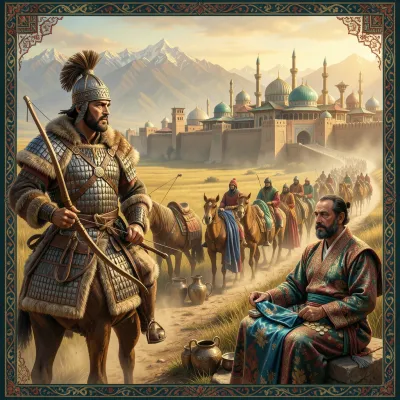
*Dynasties of the Silk Roads: Central Asian Courts and Transcontinental Power* explores how the unique geography of Central Asia—a patchwork of vast steppes, fertile oases, and rugged mountain passes—forged a distinctive model of "caravan kingship." The book argues that successful dynasties, from the Göktürks and Qara Khitai to the Timurids and Mughals, were not merely political entities but sophisticated transportation and fiscal systems. By controlling the "meshed network" of trade routes, these regimes transformed nomadic mobility into durable imperial authority, leveraging transit duties, standardized coinage, and the "yam" postal relay system to sustain transcontinental power.
Central to the narrative is the concept of "frontier ecologies," where rulers had to balance the interests of the "steppe and the sown." The text illustrates how these courts functioned as cosmopolitan hubs of "institutional bricolage," blending Turkic martial prowess with Persian administrative bureaucracy and Chinese fiscal techniques. This hybridity extended to law and faith; rulers practiced a pragmatic pluralism, patronizing Buddhism, Islam, and Christianity simultaneously to ensure that merchant networks remained stable and profitable. Trade is depicted not as an incidental economic activity but as a constitutive element of rule that provisioned armies, rewarded allies, and funded monumental architecture.
The book also highlights the human element of Silk Road governance, emphasizing the strategic roles of elite women in marriage alliances and the mobility of scholars and artisans who moved between courts, carrying technological and cultural innovations. As the narrative progresses from the early Turkic Khaganates to the sophisticated Timurid experiment and its Mughal extension into the Indian subcontinent, it tracks the evolution of military tactics from composite bows to gunpowder. Even as maritime routes began to eclipse overland trade, the book argues that the administrative habits and "arts of rule" perfected by these dynasties created a lasting political grammar of connectivity and mediation.
Ultimately, the work concludes by examining the "afterlives" of these empires, showing how their legacies of genealogy, law, and urban planning continue to shape the political imagination of modern Central Asia. By combining environmental history with economic and cultural analysis, the book reframes the Silk Roads not as a series of romantic routes, but as a rigorous laboratory for transcontinental sovereignty. The authors contend that the durability of these regimes rested on their ability to manage diversity and movement, proving that in this region, the ability to tax and protect distance was the ultimate measure of majesty.
What You'll Find Inside:
- Dynastic power along the Silk Roads was fundamentally about controlling movement and trade routes, turning caravans into mobile treasuries through tolls, protection rents, and customs duties rather than relying solely on territorial conquest.
- Successful dynasties blended steppe mobility with sedentary urban centers, using nomadic cavalry for military power while developing cities like Samarkand and Herat as engines of cultural prestige and fiscal extraction.
- Religious and legal pluralism was strategically employed as a governance tool, allowing rulers to manage diverse populations by permitting multiple faiths and legal systems to coexist while maintaining ultimate authority through pragmatic adaptation.
- Women played crucial roles in dynastic strategy through marriage alliances that created political bridges, managed estates and workshops, and influenced succession, challenging traditional narratives of purely male-dominated steppe societies.
- Administrative innovations like relay systems (yam), credit instruments, and standardized weights/measures created transcontinental networks that outlived individual dynasties and became enduring infrastructure for later empires.
Who's It For:
This book is intended for scholars and students of Central Asian, Eurasian, and world history, particularly those interested in the intersection of nomadic and sedentary societies, pre-modern economic systems, and comparative empire studies. It will also appeal to researchers focusing on trade networks, administrative history, gender dynamics in dynastic rule, and the historical foundations of transcontinental cultural exchange. Advanced undergraduates, graduate students, and specialists in Silk Roads studies will find it especially valuable for its detailed analysis of how mobility, trade, and hybrid governance shaped imperial power across centuries.
Author:
Published By:
Date Published:
May 3, 2026
Type:
Nonfiction
Language:
English
Word Count:
68,030 words
Reading Time:
4 hours 46 minutes
Sample:
Order:
Order Dynasties of the Silk Roads: Central Asian Courts and Transcontinental Power (Paperback) on MixCache.com:
Buy NowPrint copy is made to order and ships worldwide. Includes the ebook free, ready to read instantly.
$5 account credit for all new MixCache.com accounts, usable toward any ebook purchase!*


