Browse by Category
Fiction
- Action & Adventure
- African American
- Anthologies
- Children's Fiction
- Classics
- Comics & Graphic Novels
- Coming of Age
- Contemporary
- Cultural & Regional
- Drama
- Erotica
- Fantasy
- General
- Historical Fiction
- Horror
- Humor & Satire
- Literary Fiction
- Mystery, Thriller & Suspense
- Poetry
- Religious & Inspirational
- Romance
- Science Fiction
- Short Stories
- War & Military
- Westerns
- Women's Fiction
- Young Adult
Non-Fiction
- Antiques & Collectibles
- Arts & Photography
- Biographies & Memoirs
- Business & Money
- Children's Non-Fiction
-
Computers & Technology
- Artificial Intelligence
- Computer Science
- Cybersecurity & Cryptography
- Data Science & Analytics
- Databases & Big Data
- Game Development & Design
- General
- Hardware & DIY
- Mobile App Development
- Networking & Cloud Computing
- Operating Systems
- Programming
- Robotics
- Software
- Software Engineering
- User Experience (UX) & Design
- Web Development & Design
- Cooking, Food & Wine
- Crafts, Hobbies & Home
- Education & Teaching
- Engineering
- General
- Health, Fitness & Dieting
-
History
- African History
- African History - North Africa
- African History - Sub-Saharan Africa
- American History
- American History - 20th Century
- American History - Civil War
- American History - Colonial Period
- Ancient History
- Asian History
- Asian History - China
- Asian History - India
- Asian History - Japan
- Asian History - Southeast Asia
- European History
- European History - Ancient Greece
- European History - Ancient Rome
- European History - Medieval
- European History - Modern
- European History - Renaissance
- General
- Middle Eastern History
- Military History
- Military History - Aviation
- Military History - Naval
- Social & Cultural History
- World History
- Humor & Entertainment
- Industrial Technology
- Language Learning
- Law
- LGBTQ+ Non-Fiction
- Literary Criticism
- Medical Books
- Parenting & Relationships
- Philosophy
- Politics & Social Sciences
- Reference
- Religion & Spirituality
-
Science & Math
- Agricultural Sciences
- Astronomy & Space Science
- Behavioral Sciences
- Biological Sciences
- Botany & Plant Science
- Chemistry
- Earth Sciences
- Engineering - Chemical
- Engineering - Civil
- Engineering - Electrical
- Engineering - Mechanical
- Environment
- General
- Geology
- Mathematics
- Nature & Ecology
- Oceanography
- Paleontology
- Physics
- Statistics
- Self-Help
- Sports & Outdoors
- Study Aids
- Sustainability & Green Living
- Textbooks
- Transportation
- Travel
- True Crime
- Urban Planning & Development
- Veterinary Medicine
- Writing & Publishing
Jump to Section

Want unlimited access to all books published by MixCache.com (plus their audiobooks)? Try MixCache.com Total Access. Look for the MTA badge on book covers to identify included titles.
Access to infinite ebooks: Don't see the book you want? Suggest it and we'll create it (free!) for you from scratch with our powerful AI book writer. Then read it with MTA - besides profiting from any sales it makes!
Green Deal in Action: How Europe is Governing the Low-Carbon Transition
MTA
A comprehensive guide to EU climate policy instruments, green finance and sectoral decarbonization
About this book:
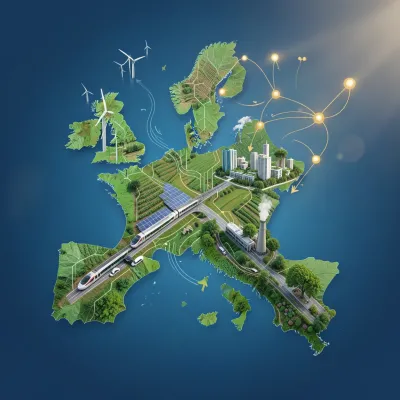
The European Green Deal, launched in 2019, is the EU's comprehensive strategy to achieve climate neutrality by 2050, fundamentally reorienting its economy towards sustainability. This book systematically unpacks the intricate web of policies, funding, and governance mechanisms driving this transition. It begins by outlining the Deal's origins, objectives—decoupling economic growth from resource use, protecting natural capital, and ensuring a just transition—and its architectural cornerstone, the EU Climate Law, which legally binds the 2050 climate neutrality goal and sets an interim 55% emissions reduction target by 2030.
Key instruments include the 'Fit for 55' package and REPowerEU plan, which detail the legislative overhaul. This involves strengthening and expanding the EU Emissions Trading System (ETS) to cover new sectors like buildings and road transport (ETS2), increasing targets for renewable energy (Renewable Energy Directive) and energy efficiency (Energy Efficiency Directive and Energy Performance of Buildings Directive), and revising national emission reduction targets under the Effort Sharing Regulation (ESR). Significant attention is given to sectoral decarbonization, with chapters dedicated to power system transformation (grids, storage, market design), hydrogen and low-carbon gases, industrial decarbonization (CBAM, ETS benchmarks, Innovation Fund), and clean transport (CO2 standards, charging infrastructure for road, and fuel mandates for aviation and shipping).
The book also highlights the crucial role of finance and governance. Sustainable finance initiatives, such as the EU Taxonomy, Sustainable Finance Disclosure Regulation (SFDR), and Corporate Sustainability Reporting Directive (CSRD), aim to redirect private capital towards green investments by enhancing transparency and preventing greenwashing. Public funding streams like the Multi-annual Financial Framework (MFF), Recovery and Resilience Facility (RRF), InvestEU, and the Just Transition Mechanism provide essential financial support and de-risk pioneering projects. Furthermore, the roles of state aid, Contracts for Difference (CfDs), and green public procurement are examined for their market-shaping influence.
Finally, the book addresses the overarching societal and practical aspects of the transition. It covers the transformation of agriculture and food systems through CAP reform, methane reduction, and nature restoration, and the shift towards a circular economy with Ecodesign, Batteries Regulation, and Critical Raw Materials Act. The indispensable role of cities and regions in local climate action, energy communities, and urban planning is emphasized. Business strategies for compliance, transition planning, and supply chain decarbonization are detailed. The critical role of innovation, from research (Horizon Europe) to large-scale deployment (IPCEIs), is explored. The social dimension is addressed through initiatives like the Social Climate Fund, focusing on skills, jobs, and ensuring a just workforce transition. The concluding chapter underscores the paramount importance of robust Monitoring, Reporting, and Verification (MRV) systems, data quality, and anti-greenwashing measures to ensure accountability and the credibility of Europe's ambitious journey to a low-carbon, sustainable future.
What You'll Find Inside:
- How EU climate policies like the European Climate Law, Fit for 55 package, and REPowerEU transform vision into binding obligations across energy, transport, industry and agriculture sectors
- The governance framework including National Energy and Climate Plans (NECPs), progress monitoring, and enforcement mechanisms that ensure accountability for climate targets
- Sector-specific decarbonization strategies with practical case studies showing how cities, companies and financial institutions implement policies in real-world contexts
- Sustainable finance mechanisms like the EU Taxonomy, SFDR and CSRD that are redirecting private capital toward sustainable investments and preventing greenwashing
- The social dimension of the transition through Just Transition Mechanism and Social Climate Fund designed to ensure an equitable low-carbon transition that leaves no one behind
Who's It For:
This book is designed for practitioners including policymakers who need clarity on instrument design and sequencing, investors and lenders seeking insight into policy risk and bankability, corporate leaders building credible transition plans, and local governments looking to leverage procurement and planning levers for tangible climate outcomes. It provides the detailed guidance needed to integrate policy signals into strategy, budgeting, and project pipelines for Europe's low-carbon transition.
Author:
Published By:
Date Published:
April 30, 2026
Type:
Nonfiction
Language:
English
Word Count:
53,679 words
Reading Time:
3 hours 46 minutes
Sample:
Order:
Order Green Deal in Action: How Europe is Governing the Low-Carbon Transition (Paperback) on MixCache.com:
Buy NowPrint copy is made to order and ships worldwide. Includes the ebook free, ready to read instantly.
$5 account credit for all new MixCache.com accounts, usable toward any ebook purchase!*