
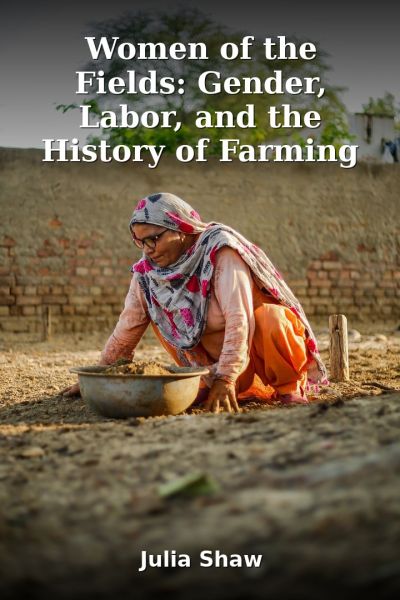
Julia Shaw's Women of the Fields arrives as a corrective to centuries of agricultural storytelling that has centered men, plows, and capital while treating women's labor as invisible "help." The book demonstrates that from the first seed selection to today's data-driven farms, women have been knowledge keepers, laborers, organizers, and leaders whose contributions shaped every food system on earth. What makes this work essential is not just its recovery of lost history but its insistence that gender equity is a strategic prerequisite for solving climate change, food insecurity, and rural poverty.
What the book is about
Women of the Fields spans 25 chapters organized chronologically and thematically, moving from deep history through contemporary transformations. Early chapters trace women's roles at the dawn of cultivation, in subsistence economies, and as "knowledge keepers" of seeds, soils, and agroecologies. Middle sections analyze how colonial plantation orders, mechanization, and the Green Revolution reconfigured gendered labor — often displacing women or exposing them to new hazards like pesticides while extension services ignored their needs. Later chapters examine health risks, climate adaptation, finance, digital agriculture, and intersectional oppression across race, caste, class, and disability. The final chapters argue for an "equity-centered transition" toward just food systems. The book blends archival research, ethnography, agrarian political economy, and feminist analysis, drawing on voices from Indigenous farmers, pastoralists, wage workers, and entrepreneurs across diverse geographies. It is written for readers who want a rigorous, globally scoped understanding of how gender shapes agriculture — scholars, policy makers, development practitioners, and anyone interested in food systems history.
Women as knowledge keepers from the dawn of cultivation
Shaw opens by dismantling the "plow and a man" myth of agricultural origins. Chapter 1 presents evidence that women's patient observation — "recognizing desirable traits, saving seeds, managing germination" — was embedded in daily routines of food preparation and childcare, making domestication "an accumulation of routine expertise." Archaeological findings of grinding stones, mortars, and pestles point to intensive processing labor that likely fell to women, while bioarchaeology reveals skeletal strain patterns consistent with repetitive grinding, carrying, and hoeing. Chapter 3 extends this argument: women's expertise in seed selection, soil assessment by "texture, smell, and behavior," intercropping, fermentation, and medicinal plant knowledge constitutes a "gendered agroecology" shaped by social roles rather than biology. This knowledge, often transmitted matrilineally, remains foundational: "The future of agriculture depends not only on new technologies but also on the careful stewardship of this knowledge. And that stewardship is, and has long been, a profoundly gendered practice."
The invisible load of social reproduction
Chapter 13 makes visible the "invisible scaffolding" of care work that sustains agricultural production. Shaw describes a farm woman's day as "a masterclass in multitasking" — preparing meals, tending children, managing household health, maintaining the home, and performing emotional labor — all while contributing field labor. This "double burden" is not modern but "a long-standing feature of agrarian life." The chapter calculates the replacement cost of this work: "What would it cost to hire a cook, a cleaner, a nanny, a nurse, and a social secretary for the entire farm family?" The financial viability of many family farms is "in effect, subsidized by the unpaid or underpaid labor of women in the domestic sphere." Shaw also shows how the physical farm layout — kitchen garden placement, well location, paths to water — maps women's daily routines, making "the productive and reproductive spheres physically intertwined."
Colonial plantation economies and the exploitation of female labor
Chapters 8 and 9 deliver a searing account of how colonial agrarian orders "re-engineered societies and redefined gender roles." The plantation system imposed European property concepts that registered land in men's names, stripping women of customary use rights. On sugar, coffee, and tea plantations, women performed the same grueling field labor as men while also bearing a "double burden" of domestic work and, under slavery, forced reproduction: "Enslaved women bore the 'double burden' of field labor and the responsibility of raising children, often in the face of horrific conditions. Their reproductive capacity was a direct asset to the plantation owner." Chapter 9 details how indentured women from India faced skewed gender ratios on plantations in Mauritius, Fiji, and the Caribbean, leaving them vulnerable to exploitation. Yet resistance persisted: women maintained secret gardens, preserved cultural practices, organized work slowdowns, and built "informal networks of support that were essential for survival under the brutal conditions of plantation life."
Land rights, legal exclusion, and the gap between law and practice
Chapters 4 and 16 trace how property regimes have systematically denied women ownership. Colonial administrators "frequently registered land in the name of the male 'head of household,' erasing the customary rights that women had long exercised." Postcolonial states often retained these biased systems. Even where constitutions guarantee equality, "customary and statutory law could contradict each other, and local practice often favored men." Chapter 16 documents movements from Kenya's constitutional reforms to India's inheritance campaigns and Brazil's Landless Workers' Movement, showing that legal change alone is insufficient: "A woman might win a favorable judgment in a high court, only to have it overturned by a local court operating under a different legal framework." The chapter emphasizes that land titles unlock credit — "When a woman gains formal title to her land, her economic potential is transformed" — but also notes that joint titling "does not automatically translate into equal decision-making."
Digital agriculture, data power, and the new gender divide
Chapter 21 examines how digital tools — mobile phones, apps, drones, platforms, blockchain — are reshaping farming while often reinforcing existing inequalities. A "significant digital gender divide" means women are less likely to own smartphones, have data plans, or possess digital literacy. Platforms like "Hello Tractor" extract data from women farmers — "her location, the size of her plot, the time of day she plows" — turning it into a corporate asset. Shaw warns that "without strong data ownership and privacy laws, women farmers... could be exposed to new forms of exploitation and risk. They are in danger of providing the raw material for a digital economy that ultimately disadvantages them." The chapter argues for participatory design, offline-first apps, and treating farmer-generated data as "a tradable commodity that they own and control." The stakes are high: "The digital plow is being pulled across the fields, but who will hold the reins?"
Who should read this
This book rewards readers who want a single, deeply researched volume that connects prehistoric seed selection to today's algorithmic farms through the lens of gender. It will particularly serve scholars of agrarian history, gender studies, and development economics; policy makers designing agricultural programs; and advocates working on land rights, climate justice, or food sovereignty. Readers seeking a light overview or a narrow regional study may find the global scope and academic density challenging. But for anyone willing to engage its 25 chapters, Women of the Fields offers an indispensable framework: recognizing women's labor and knowledge is not merely historical correction but "a strategic imperative for addressing pressing global challenges like climate change, food insecurity, and rural poverty."
Read “Women of the Fields: Gender, Labor, and the History of Farming” on MixCache.com →
Please log in or create an account to leave a comment.
No comments yet. Be the first to say something.