
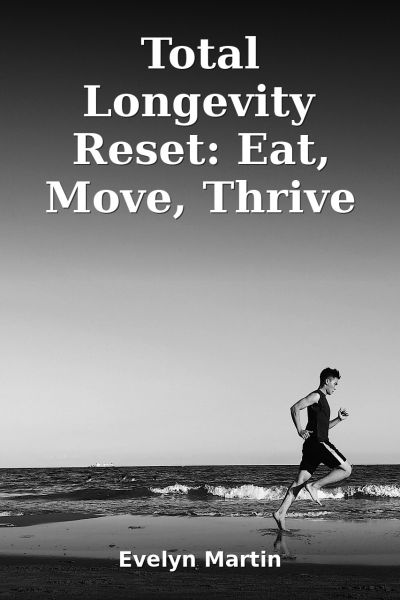
The promise of living longer has never been more seductive, but Evelyn Martin makes a sharper case: the real prize is living well for longer. Total Longevity Reset: Eat, Move, Thrive distinguishes itself from the crowded longevity shelf by refusing to treat aging as a problem to be hacked and instead framing it as a biological process you can influence through consistent, evidence-backed habits. The result is a manual that feels less like a prescription and more like a practical operating system for your thirties, forties, fifties, and beyond.
What the book is about
The book structures a 12-week program around four pillars — nutrition, movement, recovery, and mindset — across 25 chapters that move from biological foundations to daily implementation. Early chapters explain the "hallmarks of aging" (cellular senescence, mitochondrial dysfunction, inflammaging, metabolic decline) and teach readers how to establish a baseline using both clinical biomarkers (fasting insulin, VO2 max, hs-CRP) and subjective measures (energy, sleep quality, mobility). The core is a three-phase plan: Foundations (weeks 1–4) anchors protein intake and sleep consistency; Build (weeks 5–8) adds progressive resistance training, polarized cardio, and time-restricted eating; Personalize & Sustain (weeks 9–12) uses accumulated data to lock in a flexible, lifelong routine. Later chapters tailor interventions to menopause/andropause, evaluate supplements and emerging therapies, and provide lifestyle templates for busy parents, desk workers, shift workers, and retirees. The tone is collaborative, not coercive, with each chapter ending in a Key Points summary, a 7–10 step Action Plan, and a self-check quiz.
Healthspan over lifespan: the organizing principle
Martin opens by reframing the entire conversation: "Lifespan is the simple measure of years from birth to death. Healthspan, on the other hand, is the period of life spent in good health, free from chronic disease and disability, maintaining vitality, cognitive function, and independence." This distinction isn't semantic — it dictates every subsequent recommendation. Rather than chasing longevity biomarkers in isolation, the book treats them as interconnected levers. Chapter 1 explains how mitochondrial dysfunction fuels inflammation, which drives cellular senescence and metabolic dysregulation, so improving one often improves the others. The practical payoff: readers learn to track waist circumference, VO2 max proxies, fasting glucose, and subjective energy as a dashboard, not a report card.
A phased 12-week plan that respects real life
Chapter 5's structure is where the book earns its "practical" subtitle. Phase 1 (Foundations) asks for two full-body strength sessions, daily walking, a 10–12 hour eating window, and protein at every meal — no fasting extremes, no macro counting. Phase 2 (Build) layers in Zone 2 cardio, short intervals, progressive loading, and a narrower eating window if appropriate. Phase 3 (Personalize & Sustain) shifts to "rhythm over rigidity," introducing the "never miss twice" rule and contingency templates for travel, illness, and busy weeks. The plan explicitly bends: "Prefer to go at a different pace? That's fine. Use the plan as scaffolding, not a straitjacket." This flexibility is reinforced in Chapter 24, which offers full weekly schedules for four archetypes — busy parent, desk-bound professional, active retiree, and shift worker — complete with grocery lists and 20-minute meal ideas.
Protein and muscle as the non-negotiable anchor
Chapter 8 makes the case that after 30, "muscle loss is not an accident of aging but an inevitability of neglect." Martin explains anabolic resistance — the reduced sensitivity to protein and training signals — and translates it into a daily target of 1.2–2 g/kg body weight, distributed as 20–30 g per meal to hit the leucine threshold for muscle protein synthesis. The chapter debunks the narrow "anabolic window" myth ("total daily protein and distribution matter most") and compares animal versus plant sources without dogma. Crucially, it pairs nutrition with resistance training: "Protein provides the building blocks, but resistance training provides the blueprint." The beginner template requires just two to three weekly sessions of compound movements, scalable to bodyweight or bands, making the prescription accessible rather than aspirational.
Sleep, stress, and the recovery pillars get equal billing
Chapters 16 and 17 refuse to treat recovery as an afterthought. Chapter 16 details the circadian mechanics — melatonin, core temperature, cortisol — and provides a sleep hygiene checklist (cool room, blackout, wind-down ritual) alongside strategies for shift workers and jet lag. It connects sleep to appetite regulation: "When you are sleep-deprived, leptin… tends to drop, while ghrelin… rises." Chapter 17 frames stress as a nervous-system toggle, not a character flaw, and teaches quick physiological levers: extended-exhale breathing, box breathing, the 5-4-3-2-1 grounding technique, and progressive muscle relaxation. The chapter also addresses the social dimensions of stress — work boundaries, relationship quality, cultural productivity narratives — and includes a sample "stress resilience day" that integrates micro-pauses, nutrition timing, and an evening wind-down.
Supplements and emerging therapies: hype filtered through evidence
Chapter 10 and Chapter 23 form a useful pair. The supplement chapter categorizes compounds by evidence tier: essentials (vitamin D, magnesium, omega-3s), performance aids (creatine, protein powder), and experimental (NAD+ boosters, senolytics). Each gets a mechanism summary, dosing guidance, and safety caveats — e.g., "high doses can cause side effects like flushing, nausea, or sleep disturbances" for NAD+ precursors. Chapter 23 extends this rigor to therapies like rapamycin, metformin, fasting-mimicking diets, and cold/heat exposure, labeling them clearly as experimental and emphasizing that "the most powerful tools we have right now remain the fundamentals." The book's stance: "Experimental therapies may one day augment those foundations, but they are not substitutes for them."
Who should read this
This book serves adults 30–65 who want a structured, science-grounded entry point to longevity practices without the biohacking overwhelm. It's especially valuable for readers who appreciate phased programs, self-assessment tools, and explicit personalization for life stage (menopause/andropause chapters are thorough) and lifestyle (shift work, parenting, desk jobs). People looking for a rigid meal plan, a supplement-first protocol, or cutting-edge peptide stacks will find it too conservative. But for anyone ready to trade "all-or-nothing" perfectionism for a sustainable operating system — protein-anchored meals, progressive strength, protected sleep, and a mindset that expects detours — this reset delivers exactly what its subtitle promises: a practical, evidence-based guide to eating, moving, and thriving longer.
Read “Total Longevity Reset: Eat, Move, Thrive” on MixCache.com →
Please log in or create an account to leave a comment.
No comments yet. Be the first to say something.