
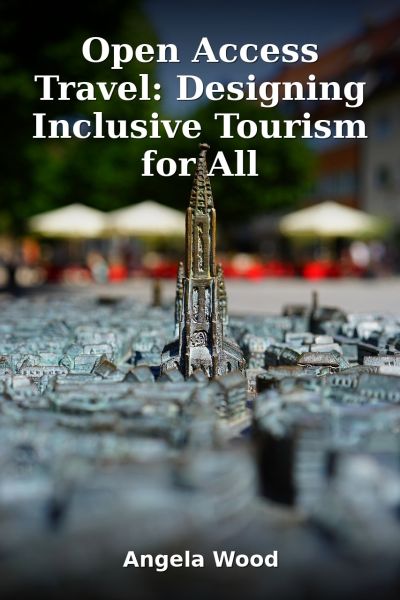
Most travel professionals still treat accessibility as a regulatory burden — a checklist of ramps, grab bars, and alt-text to satisfy legal minimums. Angela Wood's Open Access Travel: Designing Inclusive Tourism for All dismantles that mindset in the first chapter and spends the next 24 chapters building a replacement: a strategic framework where inclusive design drives revenue, reduces operational friction, and creates better experiences for every traveler, not just those with disabilities.
What the book is about
The book functions as both a reference manual and a roadmap for organizations across the tourism ecosystem — hotels, airlines, attractions, destination marketing bodies, technology vendors, and policymakers. Its 25 chapters move logically from foundations to execution: the business and human case (Chapter 1), disability models and language (Chapter 2), global regulations (Chapter 3), universal design principles (Chapter 4), and accessibility audits (Chapter 5). It then walks through every physical and digital touchpoint — streetscapes and wayfinding (Chapter 6), transportation across air, rail, road, and sea (Chapter 7), lodging and short-term rentals (Chapter 8), attractions and outdoor recreation (Chapter 9), and digital platforms including booking engines and kiosks (Chapter 10). Subsequent chapters address assistive technology (Chapter 11), service design and staff training (Chapter 12), customer journey mapping (Chapter 13), communication access (Chapter 14), neurodiversity and sensory-friendly design (Chapter 15), food and events (Chapter 16), safety and emergency planning (Chapter 17), procurement (Chapter 18), data and KPIs (Chapter 19), financing and incentives (Chapter 20), inclusive marketing (Chapter 21), partnerships with disabled persons organizations (Chapter 22), cross-border complexities (Chapter 23), case studies from Barcelona, the Smithsonian, and others (Chapter 24), and a final implementation roadmap (Chapter 25). The tone is practical and evidence-based, with checklists, templates, and decision criteria throughout.
The business case reframed as market expansion, not charity
Wood opens with data that should grab any revenue leader's attention: adults with disabilities spend an estimated $17.3 billion annually on travel in the United States alone, while European travelers with disabilities contribute €166 billion each year. These travelers rarely go alone — they bring family, friends, and caregivers, creating a multiplier effect. They also tend to travel off-peak, stay longer, and spend more per trip. But the argument goes beyond direct spend. Wood introduces the "curb-cut effect" — the phenomenon where features designed for disabled users (curb cuts, captions, clear signage) benefit parents with strollers, travelers with luggage, international visitors navigating language barriers, and anyone in a hurry. As she puts it, "Investing in accessibility is, in essence, an investment in a better overall guest experience. It reduces friction, improves navigation, enhances safety, and ultimately leads to higher guest satisfaction for everyone."
The social model as operating philosophy
Chapter 2 establishes the intellectual backbone of the entire book: the social model of disability, which "argues that people are disabled by society, not by their impairments. The problem isn't the wheelchair user; it's the lack of a ramp." This shift — from fixing the person to fixing the environment — changes every downstream decision. It explains why the book treats a missing tactile map, a confusing booking flow, or an untrained front-desk agent as design failures rather than inevitable limitations. The chapter also provides a rigorous taxonomy of disability types (mobility, sensory, cognitive, neurological, mental health, chronic conditions, speech) and emphasizes intersectionality and the aging population, noting that "designing for disability often means designing for an aging population, and vice versa." Person-first language is mandated throughout, and the author warns against euphemisms like "differently abled" that "minimize or obscure the reality of the barriers people face."
Universal Design's seven principles applied to every touchpoint
Chapter 4 translates the classic seven principles of Universal Design — Equitable Use, Flexibility in Use, Simple and Intuitive Use, Perceivable Information, Tolerance for Error, Low Physical Effort, and Size and Space for Approach and Use — into tourism-specific guidance. The principle of Equitable Use, for instance, means "a hotel check-in kiosk should be designed so that someone standing, someone in a wheelchair, and someone with a visual impairment can all operate it effectively and independently," not relegated to a separate accessible machine. Low Physical Effort translates to automatic doors, push-button faucets, and easy-to-grasp luggage handles. Size and Space demands circulation paths wide enough for two wheelchair users to pass and clear floor space in hotel rooms for power wheelchair maneuvering. Wood emphasizes that these principles are "not a checklist to be mechanically applied" but "a creative process, an iterative approach that demands empathy, foresight, and a willingness to engage with diverse user perspectives."
Digital accessibility as the new front door
Chapter 10 makes a blunt observation: "a traveler's journey often begins not at a bustling airport or a grand hotel lobby, but with a click, a tap, or a voice command." If that digital gateway fails WCAG 2.1 Level AA — missing alt-text, insufficient color contrast, keyboard traps, inaccessible booking flows — the guest is lost before arrival. The chapter details requirements for websites, mobile apps, self-service kiosks, and booking engines, stressing that accessibility must be "baked in from the start" via a "shift-left" development approach. It also highlights a critical gap: most booking engines treat "accessible room" as a binary checkbox, when travelers need granular detail — "roll-in shower (36-inch wide opening), grab bars by the toilet and shower, a bed height of 22 inches, and a 60-inch clear turning radius." Wood argues that transparent, detailed digital information is itself an accessibility feature, reducing the "invisible labor" of pre-trip research that disabled travelers disproportionately bear.
Co-design with disabled persons organizations as non-negotiable
Chapter 22 elevates partnership from a nice-to-have to a strategic imperative. Disabled Persons Organizations (DPOs) — "community-controlled organizations run by and for people with disabilities" — are positioned as essential collaborators for consultation, auditing, training, and true co-design. The distinction matters: consultation asks for feedback on a finished plan; co-design "involves having autistic users test preliminary navigation flows, or visually impaired users testing screen reader compatibility during the wireframing stage." The chapter describes participatory budgeting, citizen juries, and pilot programs with DPOs before full-scale launches. It also addresses the pragmatic side: DPOs often operate on tight budgets, so "simply asking for free consultation is often unsustainable and disrespectful of the DPO's valuable intellectual capital. A professionalized, compensated partnership model is often the most sustainable." This extends to care networks and family caregivers, whose logistical expertise around medical equipment, transfer protocols, and multi-generational needs can transform a viable trip into an impossible one.
Who should read this
This book is essential for tourism executives, destination managers, hospitality operators, transportation planners, digital product teams, and accessibility consultants who need a single, authoritative reference that connects policy to practice. Urban planners and government officials overseeing public infrastructure will find the chapters on streetscapes, transportation, and cross-border coordination directly applicable. Academic researchers in inclusive design or tourism management will appreciate the structured frameworks and extensive citations. Casual travelers or general readers looking for travel narratives should look elsewhere — this is a professional toolkit, not a travelogue. For anyone responsible for designing, funding, marketing, or operating travel experiences, it provides the most thorough blueprint currently available for moving from compliance to competitive advantage.
Read “Open Access Travel: Designing Inclusive Tourism for All” on MixCache.com →
Please log in or create an account to leave a comment.
No comments yet. Be the first to say something.