
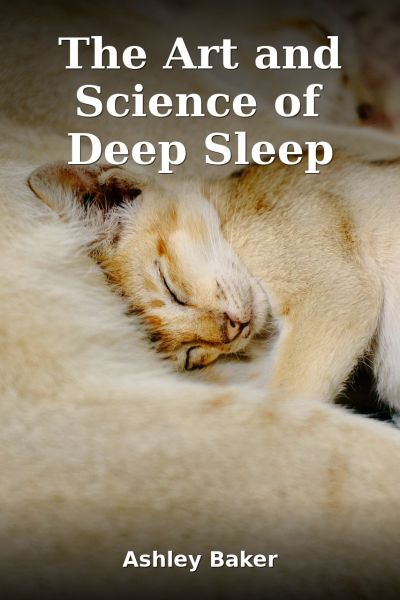
Sleep gets treated like a lifestyle luxury — something to optimize after you've handled the "real" priorities. Ashley Baker's The Art and Science of Deep Sleep flips that assumption entirely, arguing that deep sleep is the biological foundation everything else rests on. The book doesn't just explain why sleep matters; it maps exactly what happens in your brain and body each night and hands you a toolkit for protecting that process.
What the book is about
The book spans 25 chapters, moving from sleep architecture (NREM stages, REM, the glymphatic system) through common disorders (insomnia, apnea, restless legs, circadian misalignment) into lifestyle levers (diet, exercise, caffeine, alcohol, screens, stress), environmental design, behavioral routines, relaxation techniques, tracking methods, and integrative approaches. It's written for anyone who suspects their sleep could be better — whether they're battling a diagnosed disorder or just waking up groggy — and it assumes no prior medical knowledge. Case studies, expert interviews, and a look at emerging tech (targeted auditory stimulation, AI coaching) round out the practical scope.
The architecture of a night's sleep
Baker spends three full chapters (2–4) walking through the sleep cycle as a "nightly odyssey." She distinguishes N1 (the drowsy on-ramp), N2 (the bulk of the night, marked by sleep spindles and K-complexes that protect sleep and consolidate memory), and N3 — deep, slow-wave sleep — where delta waves dominate and the brain is "profoundly detached from the external world." REM arrives as a paradox: brain activity mirrors wakefulness while voluntary muscles paralyze. Crucially, she notes the night shifts: deep sleep clusters early, REM lengthens toward morning. This staging matters because "disruptions to any part of this delicate cycle can have ripple effects, impacting overall sleep quality."
Deep sleep as biological maintenance
The book's core argument is that N3 isn't passive downtime — it's "the body's ultimate reset button." Chapter 5 details three mechanisms that struck me as especially concrete. First, synaptic pruning: the brain strengthens important connections and discards weak ones, "much like decluttering a workspace to improve productivity." Second, the glymphatic system flushes metabolic waste — including beta-amyloid proteins linked to Alzheimer's — and it's "significantly more active and efficient during sleep, especially deep sleep." Third, hormonal recalibration: growth hormone surges for tissue repair, cortisol drops to baseline, and appetite regulators leptin and ghrelin rebalance. As Baker puts it, "This harmony between brain and body during deep sleep is not merely beneficial; it is absolutely essential."
Modern disruptors: screens, substances, stress
Chapters 13–15 form a practical triage for modern life. On caffeine: its five-hour half-life means a 2 p.m. coffee leaves 100 mg in your system at 7 p.m., and "even if you can fall asleep, the quality of your sleep, particularly deep sleep, may still be compromised." On alcohol: it fragments the second half of the night and "dramatically reducing REM sleep," leaving you unrefreshed. On blue light: "even dim light in the evening can significantly suppress melatonin and delay sleep onset." Stress gets its own chapter — cortisol's evening elevation keeps the body in "fight or flight" — with mindfulness, 4-7-8 breathing, and a designated "worry time" offered as counters. The throughline: these aren't moral failings; they're physiological signals you can reroute.
Practical toolkit: environment, routines, relaxation
The middle chapters (16–18) read like a build-out guide. Temperature: 60–67 °F (15.6–19.4 °C). Light: total darkness, red nightlights only. Sound: white noise to mask micro-arousals. Bedding: matched to sleep position (side sleepers need higher-loft pillows; back sleepers, medium). The pre-sleep ritual gets a timeline: dim lights 60–90 minutes out, screens off, then a warm shower (the post-shower core-temperature drop "mimics the natural physiological process that occurs as you prepare for sleep"), journaling or a "brain dump," and optionally a caffeine-free herbal tea. Relaxation techniques — 4-7-8 breathing, progressive muscle relaxation, guided visualization — are framed as skills, not quick fixes: "relaxation is a skill, and like any skill, it gets better with practice."
Beyond the basics: tracking, integrative care, and what's next
Chapter 19 demystifies wearables versus polysomnography (PSG). Consumer devices track trends well but "should not be used as a substitute for a clinical diagnosis" — they can misclassify quiet wakefulness as deep sleep. Chapter 21 surveys acupuncture, Ayurveda, valerian, lavender, yoga, tai chi, biofeedback, and aromatherapy, with the caveat to "always consult with a healthcare professional." Chapter 24 looks ahead: targeted auditory stimulation timed to slow waves, transcranial electrical stimulation, AI sleep coaches, contactless radar monitoring, and sleep genomics. The tone stays grounded — these are "promising," not miracle cures.
Who should read this
This book serves best as a reference you return to, not a single-sitting read. People with diagnosed or suspected sleep disorders will appreciate the clinical depth (PSG breakdowns, CPAP details, CBT-I protocol). Bio-hackers and data-oriented readers get clear metrics (sleep efficiency targets, deep-sleep percentages by age). Anyone building a wind-down routine gets a modular menu of evidence-backed options. Readers wanting a quick "10 tips for better sleep" listicle will find this too dense; the value is in the connective tissue between mechanisms and interventions. If you're willing to treat sleep as a system worth understanding — not just a symptom to manage — this is the most thorough layperson's guide I've seen on the shelf.
Read “The Art and Science of Deep Sleep” on MixCache.com →
Please log in or create an account to leave a comment.
No comments yet. Be the first to say something.