
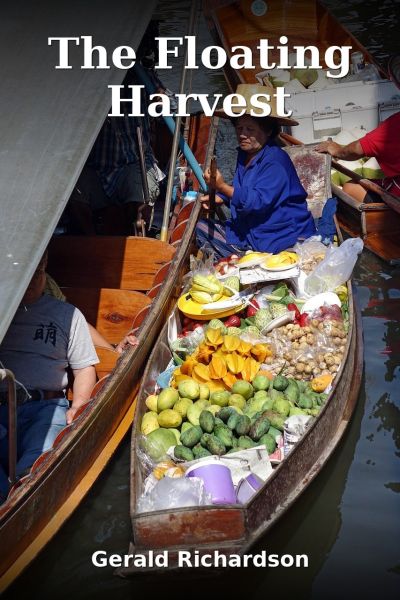
The Mekong Delta doesn't just feed Vietnam; it feeds on rhythm. In The Floating Harvest, Gerald Richardson follows the river's pulse through floating markets, stilt-house kitchens, and multigenerational recipes to show how a cuisine emerges from tide, migration, and necessity. The result is less a cookbook than a cultural portrait served one bowl at a time.
What the Book Is About
Organized across 25 chapters, the book moves from geology to diaspora. Early chapters explain how the Mekong's nine distributaries — the "River of Nine Dragons" — deposited the alluvial soil that made the region Vietnam's rice bowl. Middle sections immerse readers in daily life: the predawn rituals of Cai Rang and Phong Dien floating markets, the "cay beo" bamboo poles that advertise each boat's wares, the home kitchens where wood-fired stoves and clay pots shape flavor. Later chapters trace how festivals, weddings, funerals, and ancestor worship encode identity in dishes like bánh tét and thịt kho trứng. The final third confronts saltwater intrusion, land subsidence, and the young chefs and farmers rewriting the region's food future. The intended reader is curious but not specialist — someone who wants to understand a place through its food, not just collect its recipes.
The Market as Morning Ritual
Chapters 6 through 10 reconstruct the floating market not as tourist spectacle but as a logistics system refined over centuries. Richardson describes the "cay beo" — a bamboo pole hung with a single sample fruit — as a "centuries-old 'floating menu' system, simple yet remarkably effective." At Cai Rang, wholesale boats anchor before dawn while smaller sampans weave between them selling coffee, noodle soup, and hardware. The author notes the market's "distinctive camaraderie": "Unlike the aggressive competition often found in land-based markets, vendors here often help one another, fostering a strong sense of community." Chapter 10 gives this system faces: Madame Tu, who has piloted her watermelon boat for fifty years; Uncle Bay, whose hủ tiếu broth simmers from 2 a.m.; Linh, a tourism graduate who returned to sell pineapple and practice English with visitors. Their voices turn commerce into continuity.
Seasonality as Survival Strategy
Chapter 15, "Meals for All Seasons," reveals how the flood-dry cycle dictates the menu. During the wet season (May–November), rising water brings Linh fish and sesbania flowers — key to lẩu cá linh bông điên điển, a hotpot that appears only when the fields inundate. The dry season shifts reliance to fermented fish (mắm) and salt-tolerant crops. Richardson documents a pragmatic pivot: "In areas heavily affected by saltwater intrusion, some rice farmers have diversified their crops, shifting to vegetables that require less water and are more resistant to drought." The rice-shrimp rotation model — rice in wet months, shrimp in dry — exemplifies what the book calls "actively living with nature" rather than engineering against it. This isn't nostalgia; it's adaptive cuisine documented in real time.
Recipes as Oral Archive
Chapter 12 makes the case that family recipes function as unwritten history. Cá kho tộ (caramelized braised fish in clay pot) appears in every home, yet "each family boasts its own nuanced version" — one matriarch's preferred fish sauce, another's extra palm sugar, a third's ginger variation passed from a great-aunt. The clay pot itself, "seasoned by years of use, believed to impart a unique flavor," becomes an heirloom. Hủ tiếu My Tho noodles derive their texture from rice grown in the Go Cat area; bún mắm broth depends on a family's fermented fish paste technique. Richardson emphasizes transmission by proximity: "A daughter learns to grind rice for batter by observing her mother, absorbing the rhythm and pressure needed." When he notes that "these recipes are not static; they subtly evolve over time," he frames adaptation as preservation, not loss.
Climate Pressure Rewriting the Larder
Chapter 21 lays out the data: the Delta sinks 1.1 centimeters per year; over 160 upstream dams trap sediment; salinity reaches four grams per liter in places, "far exceeding the tolerance thresholds for major crops." Nguyen Thi Phung, fishing nearly 20 years, reports "a significant drop in their daily catches during low flood seasons." Resolution 120 (2017) marks the policy pivot toward "actively living with nature" — encouraging flood-based aquaculture over a third rice crop, developing salt-resistant rice, restoring mangroves. Chapter 23 shows chefs like Trụ Lang and Nguyễn Thị Phương Uyên designing menus around "nature-based solutions" ingredients: rice, shrimp, lotus seeds, freshwater prawns sourced from farmers using those methods. The culinary vanguard is explicitly tied to ecological repair.
Diaspora Carries the Flavor Forward
Chapter 24 tracks how Mekong Delta dishes migrated with Vietnamese communities. Canh chua (tamarind sour soup) and hủ tiếu appear on menus from Houston to Paris, sometimes softened for local palates but retaining their "signature balance of flavors." The author notes a practical philosophy: "Where certain tropical fruits or specific types of river fish might be unavailable, chefs find creative substitutions or import specialty items to maintain authenticity." Second-generation cooks blend Delta flavors with adopted-home ingredients, creating what Richardson calls "an exciting, evolving food landscape that reflects both the strong roots of Southern Vietnamese cuisine and the dynamic influences of global gastronomy." The diaspora becomes another current in the river's flow.
Who Should Read This
Readers who approach food as a lens for geography, history, and climate adaptation will find the book rich and structured. It rewards patience — the first five chapters build environmental and historical context before the first market scene — but pays off in specificity. Cooks seeking recipe collections should look elsewhere; the handful of dishes described serve as case studies, not instructions. Specialists in Vietnamese studies may find familiar ground in the historical chapters, but the vendor portraits and contemporary chef interviews add fresh primary material. For the general reader, the book answers a deceptively simple question: what does it taste like when a river raises you?
Read “The Floating Harvest” on MixCache.com →
Please log in or create an account to leave a comment.
No comments yet. Be the first to say something.