
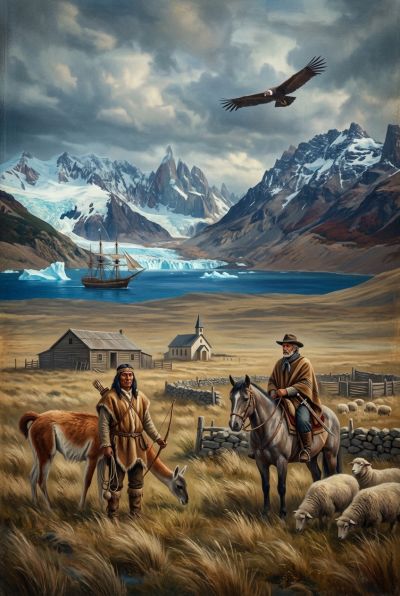
Patagonia has always been two places at once: a physical territory of wind, ice, and steppe, and a mental landscape where Europeans projected giants, golden cities, and their own wildest fears. Felipe Díaz’s Een geschiedenis van Patagonië refuses to separate them, showing how myth and material force have braided together from the first human handprints in Cueva de las Manos to the wind turbines now rising over the same plains.
What the book is about
The book runs chronologically across 25 chapters, plus a detailed timeline and glossary. It opens with the Pleistocene hunters who coexisted with giant ground sloths and Mylodon, moves through Magellan’s naming of the “Patagónes” and the centuries-long obsession with the Ciudad de los Césares, then follows the scientific reframing led by Darwin’s Beagle voyage. The middle sections cover the violent incorporation of the region into Argentina and Chile — the Conquista del Desierto, the Chilean “Pacification of Araucanía,” the Welsh colony in Chubut, the sheep boom, the Tierra del Fuego gold rush, and the outlaw era of Butch Cassidy. Later chapters trace the rise of oil, the Falklands War, the creation of national parks, the tourism boom, and the 21st-century struggles over fracking in Vaca Muerta, salmon farming in Chilean fjords, indigenous land reclamation, and green hydrogen megaprojects. The intended reader is anyone who wants a single, rigorous narrative that treats Patagonia as a shared, contested region rather than two national backwaters.
The giant that wasn’t: how a literary monster named a continent
Díaz devotes Chapter 2 and 3 to the origin and persistence of the Patagonian giant myth. Magellan’s chronicler Pigafetta described Tehuelche men “so tall that we reached only to their waist,” but the name Patagón likely comes not from “big foot” (pata gau) but from the chivalric romance Primaleón, whose villain is a giant named Patagón. Díaz writes: “By naming the inhabitants Patagónes, Magellan placed them in a literary, almost mythical framework. He did not merely describe them; he cast them as characters in the grand adventure tale he was living.” The myth survived 250 years, reinforced by engravers like Theodor de Bry who depicted towering natives looming over sailors, until Bougainville’s naturalist Commerçon measured actual heights at ~1.90 m — impressive, but not monstrous. The episode sets the book’s central thesis: Patagonia was “a canvas on which the outside world projected its wildest dreams and darkest fears.”
Indigenous worlds before the conquest, and the machinery of erasure
Chapter 1 reconstructs the lifeways of the Tehuelche, Selk’nam, Yaghan, and Kawésqar from archaeology and early ethnography. The Yaghan, “the southernmost people on earth,” kept fires burning in bark canoes while diving naked in freezing water for shellfish. The Selk’nam staged the elaborate Hain initiation, with men embodying spirits in towering bark masks. Chapters 7, 8, and 12 then detail the twin engines of destruction: state armies and private capital. Roca’s Conquista del Desierto used Remington repeating rifles to kill thousands and march 15,000 captives to concentration camps on Martín García island, where children were advertised for domestic service. Across the Andes, the Sociedad Explotadora de Tierra del Fuego paid bounties — first ears, then whole heads — for dead Selk’nam. Díaz notes the grim symmetry: “The land had to be emptied of its original inhabitants to make way for the more profitable sheep.” By the 1920s the Selk’nam were “effectively extinct as a functioning tribal group,” their last Hain performed for visiting ethnographers.
Sheep, wire, and the making of a pastoral oligarchy
Chapter 9 shows how the “white gold” rush restructured the steppe. Falkland Islands shepherds drove flocks a thousand kilometres south in “The Great Drive.” The Argentine state financed the conquest by selling bonds redeemable in newly seized land, creating estancias larger than European principalities. The Chilean side saw the rise of the Braun-Menéndez-Nogueira combine, the Sociedad Explotadora de Tierra del Fuego, which at its peak controlled three million hectares and a million sheep. Barbed wire — “the taming of the pampas” — sliced guanaco migration routes and ended the open range. The social order hardened: absentee British managers lived in Buenos Aires palaces while peones paid in company scrip shopped at the pulpería. Chapter 15 recounts the 1920–21 strikes in Santa Cruz, where anarchist organizers won a brief agreement before Lieutenant Colonel Varela’s troops executed an estimated 1,500 strikers — La Patagonia Rebelde. The chapter closes: “The wool boom had created a society of extremes, and when that society was challenged, the reaction was swift and merciless.”
Borders drawn in fog: the century-long fight over the Andes
Chapter 14 turns the 1881 Boundary Treaty into a geopolitical thriller. The treaty’s phrase “highest peaks dividing the waters” assumed watershed and orographic lines coincided; in the glacier-carved Andes they often don’t. Argentina argued for peaks, Chile for watershed, and both bought British dreadnoughts. The 1902 British arbitration under Sir Thomas Holdich split lakes and valleys pragmatically — even polling Welsh settlers in Trevelin, who chose Argentina. The Beagle Channel dispute flared again in 1978, when Argentina’s junta launched Operation Soberanía, only to abort hours before invasion under papal mediation. The 1984 Peace and Friendship Treaty finally settled the islands, but Laguna del Desierto lingered until a 1994 tribunal awarded it to Argentina. Díaz frames the conflict as “a struggle born from a single ambiguous phrasing in an old treaty,” illustrating how cartographic fiction hardens into military reality.
Rewilding, fracking, and the wind that may power Europe
The final chapters bring the story to the present. Chapter 22 profiles the Tompkins Conservation project: Douglas and Kristine Tompkins bought degraded estancias, tore out hundreds of kilometres of fence, removed sheep, and donated over a million acres to Chile, creating the 1,700-mile “Route of Parks.” Their rewilding model — active species reintroduction, not passive protection — now guides Rewilding Chile and Rewilding Argentina’s work on huemul deer and puma corridors. Simultaneously, Chapter 20 and 25 detail the Vaca Muerta shale boom (“a carbon bomb” that supplies half of Argentina’s oil and gas), the salmon farms polluting Chilean fjords with antibiotics and escaped fish, and the multi-billion-dollar green hydrogen projects that would carpet the steppe with wind turbines to make export ammonia for Europe. Díaz calls this “green colonialism”: “The scale of the required infrastructure — new ports, desalination plants, pipelines — raises profound questions about the true environmental cost of this so-called green revolution.” The book ends with the region at a “profound historical crossroads,” contested by indigenous revival, extractive capital, conservation philanthropy, and climate physics.
Who should read this
Readers who want a single volume that treats Patagonia as a coherent transnational space — not an Argentine or Chilean annex — will find the book indispensable. It rewards anyone interested in environmental history, borderlands studies, or the afterlives of colonialism. Specialists may quibble with compression in the later economic chapters, but the synthesis is unprecedented in Dutch. Skip it if you prefer narrative-driven travelogues or narrowly focused monographs; Díaz writes as a historian, not a tour guide. For everyone else, this is the definitive modern history of a place that still lives in the world’s imagination as much as in its glaciers.
Read “Een geschiedenis van Patagonia” on MixCache.com →
Please log in or create an account to leave a comment.
No comments yet. Be the first to say something.