
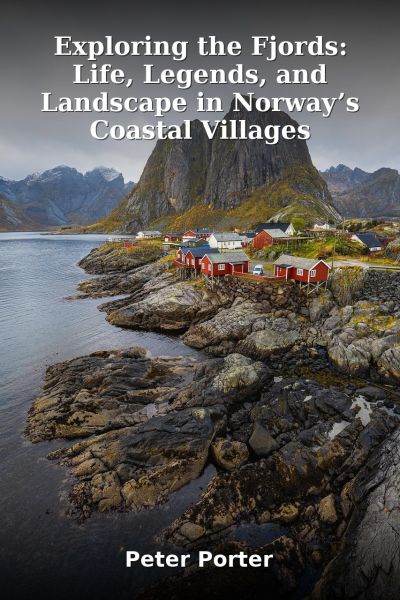
Norway's fjords are often reduced to postcard backdrops — sheer cliffs, glassy water, the occasional waterfall. Peter Porter's Exploring the Fjords refuses that flattening. Across 25 chapters, the book traces how ice-age geology, Norse cosmology, centuries of fish-farmer ingenuity, and a new generation of digital entrepreneurs all converge in the villages clinging to these inlets.
What the book is about
The book moves chronologically and thematically from bedrock to browser history. Chapters 1–4 lay out the glacial sculpting of U-shaped valleys, the isostatic rebound still lifting ancient shorelines, the radical swing of daylight across seasons, and the stratified marine ecosystems that support everything from cold-water coral reefs to orca pods. Chapters 5–10 shift to human settlement: Stone Age migrants, Viking-age chieftains, the log-and-stave building traditions that produced 28 surviving stave churches, the dual livelihood of fishing and farming on less than 3 % arable land, and the social glue of dugnad (communal work parties) and Janteloven (the cultural norm against self-promotion). Chapters 11–15 explore how Norse myths — creation from the giant Ymir's body, the world tree Yggdrasil, the sea god Njörd — map directly onto fjord landmarks, while trolls, the Nøkken water spirit, and the Huldra forest woman turn waterfalls and rock formations into narrative characters. Chapters 16–20 serve up the edible result: brunost caramelized from whey, tørrfisk air-dried on wooden racks, the rise of New Nordic cuisine at Michelin-starred spots like Iris (floating in Hardangerfjord) and RE-NAA in Stavanger, plus four home-kitchen recipes with commentary from a farmer, a retired butcher, and a café owner. The final five chapters confront climate-driven oxygen loss in deep basins, mining-tailings controversies, a 2026 tourist tax, electric-cruise mandates for UNESCO fjords by 2032, and the young coders and cheesemakers choosing to stay.
Geology as destiny, not scenery
Porter opens with a fact that reframes every subsequent chapter: glaciers "possess the remarkable ability to carve well below" sea level, which is why Sognefjord plunges 1,300 meters while its mouth sits behind a shallow moraine sill. That sill governs water circulation, oxygen levels, and therefore which fish thrive where — directly shaping which villages became fishing hubs versus farming pockets. The hard gneiss and granite bedrock "stood firm against the grinding power of the glaciers, allowing for the deep, narrow carving that defines the fjord landscape." Later, Chapter 2 notes that isostatic uplift means "ancient coastlines, and thus ancient settlements, can now be found significantly higher above current sea levels," giving archaeologists a vertical timeline most coastlines lack. The landscape, in short, is not a stage set; it is the script.
Myth as map
Chapters 11–15 argue that Norse mythology functioned as a cognitive GPS. The creation myth places the fjords' origin in the dismembered giant Ymir: "the deep, winding inlets were carved from his very bones and teeth." Jotunheimen — "home of the Giants" — is both a mountain range and a mythic zone where "rockslides, avalanches, and blizzards" are the Jötnar's breath. Specific landmarks carry folk narratives that encode practical warnings: Trolltunga ("Troll's Tongue") and Trollveggen ("Troll Wall") mark sheer drops; the Nøkken legend "served as grim warnings against the dangers of deep, still waters"; the Fossegrim behind a waterfall trades fiddle mastery for a food offering. Even the Geirangerfjord's "Seven Sisters" and "Suitor" waterfalls become a romantic farce that makes the topography memorable. As Chapter 15 summarizes, "The landscape itself became a living repository of these narratives… transforming inert geological features into characters or settings in a grand, ongoing drama."
Food as archive
The cuisine chapters treat every preservation method as a survival technology written in flavor. Tørrfisk (stockfish) dried "from winter to spring" on wooden racks became a Viking-age export commodity; klippfisk adds salt before drying, yielding the base for bacalao, a stew reflecting "centuries of trade and cultural exchange with Southern Europe." Fenalår — salted, air-dried lamb leg — mirrors Mediterranean hams but emerges from "the importance of preserved meat in the farming diet." Chapter 18 notes that before refrigeration arrived in the 1950s, "food waste was practically unheard of" because "each household had to ensure its own food supply would last through the winter." The New Nordic movement (Chapter 19) doesn't discard these techniques; it recontextualizes them. Chef Christopher Haatuft coins "Neo-Fjordic cuisine" at Lysverket, while Iris restaurant floats on Hardangerfjord "built like a salmon eye" — a literal immersion in the source. Chapter 20 then grounds the abstraction: Else's lefse dough must use "really cold" potatoes; Lars insists the kjøttkaker" roux "needs to get a good color, that's where the depth comes from." The recipes are not decoration; they are the book's most tactile evidence of continuity.
The dugnad mindset meets the gig economy
Chapter 9 defines dugnad as "a voluntary community work effort… deeply rooted in Norwegian heritage and history, dating back to the Viking Age" where "participation is technically voluntary, [but] there's a strong social expectation that if invited, you will contribute." Chapter 23 shows that ethic adapting: high-speed internet lets young developers build catch-tracking apps for fishermen and augmented-reality folklore tours, while remote-work professionals "live in their home villages… while working for companies based in larger cities or even internationally." The same communal infrastructure that once raised barns now funds coworking spaces in converted boathouses. Meanwhile, Chapter 24's tourist tax (3 % on overnight stays from 2026) and the 2032 zero-emission cruise mandate for UNESCO fjords are policy-scale dugnad — collective investment in shared infrastructure. Porter captures the tension: Geiranger's 250–300 winter residents hosted 400,000 cruise passengers in 2019, "creating a significant imbalance between visitors and locals." The question threading the final chapters is whether the dugnad logic can scale without dissolving the trust that made it work.
Who should read this
Readers who want a single volume that connects deep time (3.5-billion-year bedrock) to next quarter (2026 tourist tax) will find the synthesis rewarding. Armchair travelers get enough sensory detail — the "distinctive turquoise" of glacial meltwater, the "sweet, nutty flavor and fudge-like texture" of brunost — to feel present without leaving the chair. Planners will appreciate the practical asides: layered packing lists, Leave No Trace reminders, and the note that Nærøyfjord kayaking peaks May–September. Specialists in food history, maritime archaeology, or sustainable tourism may find individual chapters overview-level rather than citation-dense. If you prefer tight narrative arcs or character-driven storytelling, this is not that book; its protagonist is the fjord system itself, and its voice is measured, cumulative, and determinedly unromantic about the pressures these villages face.
Please log in or create an account to leave a comment.
No comments yet. Be the first to say something.