
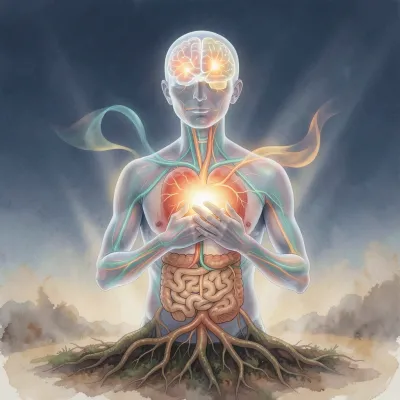
Most of us know the feeling: a tight jaw during a difficult conversation, a stomach that knots before a presentation, a migraine that arrives right after the deadline passes. Gloria Harris’s The Emotional Body argues these aren’t coincidences — they’re the nervous system doing exactly what it evolved to do, only with outdated information. The book translates decades of neuroscience, stress physiology, and somatic practice into a coherent framework for understanding why chronic symptoms persist and what actually helps.
What the book is about
Spanning 25 chapters, the book moves systematically from foundational science — autonomic nervous system dynamics, the HPA axis, interoception, predictive processing, allostatic load, psychoneuroimmunology — to applied techniques: mindfulness, cognitive restructuring, acceptance and commitment therapy (ACT), somatic practices (breath, posture, movement), tension release, Emotional Freedom Techniques (EFT), Somatic Experiencing, EMDR, heart-rate-variability biofeedback, and lifestyle pillars like sleep and nutrition. Case studies in Chapter 24 illustrate how the pieces fit together for conditions like migraine, fibromyalgia, and IBS. The intended reader is anyone living with persistent physical symptoms that standard medical workups haven’t fully explained, as well as clinicians and curious laypeople who want a rigorous yet accessible map of the mind–body connection.
The mind–body bridge is a two-way highway, not a metaphor
Chapter 1 opens by dismantling the Cartesian split that still haunts medicine. Harris writes, "The emotional body is not a metaphor; it is a living system where meaning, physiology, and behavior continuously shape each other." She traces how the autonomic nervous system, endocrine signaling, and immune cells form bidirectional loops: emotions tune the ANS and calibrate inflammatory responses, while bodily states — gut sensations, muscle tension, heart rhythms — feed back into how we feel and think. This reframing moves the conversation from "mind over matter" to "mind with matter," where psychological skills and somatic practices cooperate to restore balance.
Predictive processing explains why symptoms outlast injury
Chapter 4 introduces the brain as a prediction machine. Rather than passively receiving sensory data, the brain constantly generates expectations about bodily sensations and compares incoming signals against them. When prediction and input mismatch, a "prediction error" drives learning — but when the brain predicts threat in safe contexts, innocuous sensations get amplified into pain or panic. Harris notes, "The brain’s prediction then amplifies incoming sensory signals through a process called ‘gain modulation,’ effectively turning up the volume on certain inputs while turning down others." This mechanism underpins central sensitization (Chapter 7) and helps explain why two people with identical structural findings can have vastly different pain experiences.
Polyvagal Theory gives a roadmap from threat to safety
Chapter 9 centers on Stephen Porges’s Polyvagal Theory, which reimagines the ANS as a three-tier hierarchy: the ventral vagal complex (social engagement, safety), the sympathetic system (mobilization), and the dorsal vagal complex (shutdown). The key concept is neuroception — the nervous system’s subconscious scanning of environment, body, and other people for cues of safety or danger. Harris emphasizes, "Trying to reason someone out of a threat response… is often ineffective because the threat detection system is not accessible through conscious cognition alone." What does shift neuroception are genuine safety cues: a calm face, prosodic voice, slow exhalation — the very signals the ventral vagal system evolved to send and receive.
Trauma lives in the body as interrupted survival responses
Chapter 8 distinguishes narrative memory from the body’s memory. Overwhelming experiences suppress hippocampal contextualization, leaving fragmented sensory imprints — a tightening throat, a collapsed posture — that reactivate without conscious recall. Peter Levine’s Somatic Experiencing (detailed in Chapter 16) works by titration (small doses of activation), pendulation (oscillating between activation and calm), and completion of self-protective responses — letting the body finish the fight, flight, or protective movement it couldn’t complete at the time. Harris writes, "The nervous system has received the signal that the threat is over, the survival response can stand down, and the body can return to regulation."
Healing is a skill built from integrated, measurable practices
The book’s second half assembles a toolkit where each modality targets a different layer of the system. Mindfulness (Chapter 11) sharpens interoceptive accuracy and quiets the default mode network; cognitive restructuring (Chapter 12) challenges catastrophic appraisals; ACT (Chapter 13) swaps struggle for values-driven action; breathwork and posture (Chapter 14) directly stimulate the vagus nerve; progressive relaxation (Chapter 15) interrupts chronic bracing; EFT and Somatic Experiencing (Chapter 16) and EMDR (Chapter 17) process stored threat memories; HRV biofeedback (Chapter 19) provides objective feedback on autonomic flexibility. Chapter 23 insists on sequencing: meet the nervous system where it is — grounding for shutdown, movement for sympathetic overdrive — and track progress with diaries, questionnaires, and wearables (Chapter 22) so subtle gains don’t go unnoticed.
Who should read this
Readers who experience medically unexplained or stress-sensitive symptoms — IBS, migraine, fibromyalgia, chronic pain, fatigue — will find the most direct relevance. Clinicians seeking a unified language for mind–body integration will appreciate the breadth and citations. People looking for quick fixes or purely psychological explanations may be frustrated; the book demands patience, repetition, and willingness to engage bodily sensation. For those ready to treat wellbeing as a practice rather than a destination, The Emotional Body offers one of the most thorough, science-grounded, and practically organized guides currently available.
Read “The Emotional Body: How Emotions Affect Physiological Health and Healing” on MixCache.com →
Please log in or create an account to leave a comment.
No comments yet. Be the first to say something.