
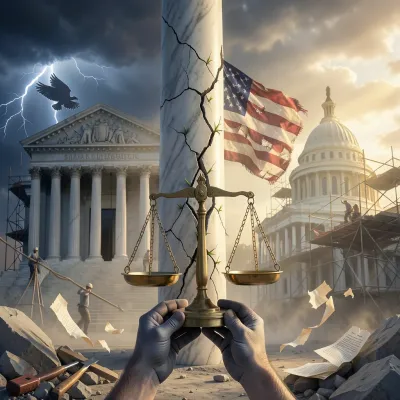
Constitutional crises don't always announce themselves with fanfare. Sometimes they arrive as a slow erosion of norms — a senator blocking a routine nomination, an agency ignoring a subpoena, a president testing the edges of emergency authority. Henry Porter's Constitutional Crises treats these moments not as aberrations but as recurring stress tests that reveal the structural fault lines of the American system.
What the book is about
Organized across 25 chapters, the book moves from diagnosis to design. Early chapters establish a framework distinguishing three crisis types: crises of ambiguity (when the text runs out), crises of brinkmanship (when lawful tools are pushed beyond their intended purpose), and crises of defiance (when officials reject lawful outcomes). The middle sections examine recurring arenas of stress — impeachment, executive power, emergency governance, congressional oversight, the judiciary, federalism, civil liberties, elections, and the information environment — drawing on cases from Andrew Johnson's impeachment to the COVID-19 pandemic. Later chapters widen the lens to informal norms, partisan polarization, the military's role, private tech power, and comparative lessons from other democracies. The final section offers a practical "reform toolkit" and a preparedness agenda built around simulations and civic culture. The intended reader is anyone who wants a systematic, historically grounded account of how American institutions hold — or fail — under pressure, written without partisan axe-grinding.
A taxonomy of crisis that clarifies the noise
Porter's most useful contribution may be his three-part typology, introduced in the Introduction and refined in Chapter 1. He writes: "Crises come in at least three varieties. First are crises of ambiguity, when the Constitution's text runs out and institutions must improvise. Second are crises of brinkmanship, when actors push lawful tools — like impeachment, pardons, or emergency authorities — toward purposes the Framers would not recognize. Third are crises of defiance, when officials or masses reject lawful outcomes, from court orders to certified elections." This framework lets readers sort contemporary fights: a dispute over the meaning of "high Crimes and Misdemeanors" is a crisis of ambiguity; using the debt ceiling as leverage is brinkmanship; refusing to certify an election is defiance. The taxonomy appears again in Chapter 18, where Porter links the rise of "constitutional hardball" to the normalization of brinkmanship tactics that once would have been unthinkable.
The shadow constitution of unwritten norms
Chapter 17 argues that the written Constitution is only half the system. The other half is what Porter calls "law's shadow" — informal rules like judicial deference to precedent, the peaceful transfer of power, and the expectation that career civil servants operate free from political interference. He illustrates the point with George Washington's two-term precedent, which held for nearly 150 years before Franklin Roosevelt broke it, prompting the 22nd Amendment. The chapter also details how norms of forbearance — consciously not using a formal power even when you legally could — keep the machinery from seizing up. When those norms erode, Porter warns, "Each time a norm is shattered without consequence, it creates a new, lower bar for future behavior, gradually normalizing actions that would once have been considered unthinkable." The January 6 attack and the preceding refusal to concede are presented as the culmination of a long norm-breakdown, not its start.
Emergency powers and the ratchet effect
Chapter 6 traces how crises — war, terror, pandemic — repeatedly expand executive authority in ways that rarely fully retract. Lincoln's suspension of habeas corpus, FDR's internment of Japanese Americans, the post-9/11 PATRIOT Act, and COVID-era eviction moratoriums all follow a pattern: "powers granted or assumed during a crisis are rarely fully relinquished. Instead, they often become embedded in the legal and administrative landscape, forming precedents for future executive action." The chapter also highlights the judiciary's tendency toward deference in emergencies, citing Korematsu v. United States as a warning. Porter's reform suggestion is statutory: Congress should write emergency frameworks with "clear limits on executive authority during such periods, and includes robust sunset provisions and oversight requirements" to prevent the ratchet from clicking forward again.
Election administration as constitutional infrastructure
Chapter 16 reframes the nuts-and-bolts of voting — poll workers, voter-roll maintenance, provisional ballots, certification deadlines — as a frontline constitutional institution. The 2020 post-election period showed how fragile this machinery is when partisan pressure targets local officials. Porter notes that "the resilience of these often-overlooked administrative bodies, and their adherence to established legal procedures, proved to be a critical defense against attempts to subvert the electoral outcome." He advocates for federal baseline standards (automatic registration, early voting, paper trails), stronger protections for election workers, and depoliticized election boards. The chapter connects to Chapter 13's analysis of gerrymandering and the Shelby County decision, showing how access and representation disputes are two sides of the same structural vulnerability.
Preparing for the next shock with simulations
Chapter 24 proposes an unconventional readiness tool: constitutional stress tests. Modeled on military war-games and financial-sector exercises, these tabletop simulations would gather former officials, lawyers, and journalists to role-play scenarios — a president refusing to leave office, a state decertifying electors, the military ordered into domestic policing. The goal is to expose gaps between formal powers and the political will to use them. Porter writes: "They frequently expose that the greatest vulnerabilities aren't necessarily obscure legal ambiguities, but rather the erosion of informal norms and the willingness of political actors to exploit those norms for partisan gain." The chapter also suggests publishing "crisis playbooks" — pre-scripted, flexible guides for certification disputes, judicial defiance, and emergency transitions — so decision-makers aren't improvising in real time.
Who should read this
Readers who want a single-volume, historically dense map of where American institutions bend will find this book indispensable. It rewards policymakers, journalists, civics teachers, and engaged citizens who need a shared vocabulary for diagnosing current stresses. Readers looking for a polemic, a quick-fix reform agenda, or a narrative-driven popular history may find the tone too analytical and the chapter-by-chapter case studies too detailed. But for anyone willing to sit with the structural realities — and the uncomfortable fact that "the Constitution is not a self-executing document but a living system animated by the people who inhabit it" — Porter delivers a rigorous, nonpartisan reference that clarifies more than it alarms.
Read “Constitutional Crises” on MixCache.com →
Please log in or create an account to leave a comment.
No comments yet. Be the first to say something.