
Browse by Category
Fiction
- Action & Adventure
- African American
- Anthologies
- Children's Fiction
- Classics
- Comics & Graphic Novels
- Coming of Age
- Contemporary
- Cultural & Regional
- Drama
- Erotica
- Fantasy
- General
- Historical Fiction
- Horror
- Humor & Satire
- Literary Fiction
- Mystery, Thriller & Suspense
- Poetry
- Religious & Inspirational
- Romance
- Science Fiction
- Short Stories
- War & Military
- Westerns
- Women's Fiction
- Young Adult
Non-Fiction
- Antiques & Collectibles
- Arts & Photography
- Biographies & Memoirs
- Business & Money
- Children's Non-Fiction
-
Computers & Technology
- Artificial Intelligence
- Computer Science
- Cybersecurity & Cryptography
- Data Science & Analytics
- Databases & Big Data
- Game Development & Design
- General
- Hardware & DIY
- Mobile App Development
- Networking & Cloud Computing
- Operating Systems
- Programming
- Robotics
- Software
- Software Engineering
- User Experience (UX) & Design
- Web Development & Design
- Cooking, Food & Wine
- Crafts, Hobbies & Home
- Education & Teaching
- Engineering
- General
- Health, Fitness & Dieting
-
History
- African History
- African History - North Africa
- African History - Sub-Saharan Africa
- American History
- American History - 20th Century
- American History - Civil War
- American History - Colonial Period
- Ancient History
- Asian History
- Asian History - China
- Asian History - India
- Asian History - Japan
- Asian History - Southeast Asia
- European History
- European History - Ancient Greece
- European History - Ancient Rome
- European History - Medieval
- European History - Modern
- European History - Renaissance
- General
- Middle Eastern History
- Military History
- Military History - Aviation
- Military History - Naval
- Social & Cultural History
- World History
- Humor & Entertainment
- Industrial Technology
- Language Learning
- Law
- LGBTQ+ Non-Fiction
- Literary Criticism
- Medical Books
- Parenting & Relationships
- Philosophy
- Politics & Social Sciences
- Reference
- Religion & Spirituality
-
Science & Math
- Agricultural Sciences
- Astronomy & Space Science
- Behavioral Sciences
- Biological Sciences
- Botany & Plant Science
- Chemistry
- Earth Sciences
- Engineering - Chemical
- Engineering - Civil
- Engineering - Electrical
- Engineering - Mechanical
- Environment
- General
- Geology
- Mathematics
- Nature & Ecology
- Oceanography
- Paleontology
- Physics
- Statistics
- Self-Help
- Sports & Outdoors
- Study Aids
- Sustainability & Green Living
- Textbooks
- Transportation
- Travel
- True Crime
- Urban Planning & Development
- Veterinary Medicine
- Writing & Publishing
Jump to Section
MixCache.com Total Access
Unlimited reading and audiobooks for every book published by MixCache.com.
Included titles carry the MTA badge.
Learn more →
Constitutional Crises
MTA
How American Institutions Bend, Break, and Rebound Under Political Stress
About this book:
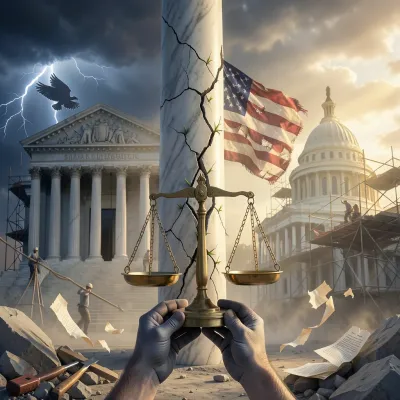
*Constitutional Crises* explores the inherent tensions within the American political system, examining how institutions respond when the framework of separated powers, federalism, and the rule of law is pushed to its limits. The book categorizes crises into three types: those arising from constitutional ambiguity, those born of political brinkmanship, and those resulting from direct defiance of lawful authority. By tracing historical stress tests—from the Civil War and the Great Depression to the Watergate scandal and recent contested elections—it demonstrates that the survival of the Republic has historically depended on a combination of formal institutional checks and the informal "shadow" of democratic norms.
The text provides a detailed analysis of various "fault lines" where the system frequently bends, including executive overreach, the expansion of emergency powers during national crises, and the increasing politicization of the bureaucracy and judiciary. It highlights how modern pressures, such as hyper-polarization, the weaponization of congressional oversight, and the rise of "information disorder" in the digital age, have accelerated the erosion of traditional guardrails. The book emphasizes that while the Framers designed a system to channel human ambition through checks and balances, the rise of "constitutional hardball" and the decline of partisan forbearance now threaten the structural integrity of these designs.
Beyond diagnosis, the book offers a proactive "reform toolkit" aimed at strengthening institutional resilience. Proposed solutions include statutory refinements to clarify executive and emergency authorities, the implementation of independent redistricting commissions to combat gerrymandering, and the strengthening of non-partisan professionalism within the Department of Justice and election machinery. It advocates for the use of simulations and "stress tests" to identify vulnerabilities before they manifest as acute crises, arguing that proactive preparation is essential for maintaining the peaceful transfer of power and the legitimacy of democratic outcomes.
Ultimately, the book concludes that institutional reform alone is insufficient without a robust civic culture. It underscores that the Constitution is not a self-executing document but a living system animated by the people who inhabit it. True resilience requires an informed citizenry, a commitment to civic education, and a shared adherence to the norms of mutual toleration and the rule of law. The author argues that while American institutions have a remarkable capacity to rebound from political shocks, their long-term health depends on rebuilding public trust and ensuring that the human substrate of democracy—its leaders and its voters—remains committed to the spirit of the constitutional order.
What You'll Find Inside:
- Constitutional crises manifest in three forms: ambiguity (when the Constitution's text runs out), brinkmanship (when lawful tools are pushed to extremes), and defiance (when officials or masses reject lawful outcomes like court orders or election results).
- Informal norms and mutual forbearance act as essential 'law's shadow' that keeps the constitutional system functioning, and their erosion poses a greater threat than formal rule violations alone.
- Partisan polarization has fueled 'constitutional hardball'—the aggressive, novel use of formal powers to achieve partisan goals while shattering long-standing democratic norms and institutional guardrails.
- Emergency powers exhibit a 'ratchet effect' where authorities assumed during crises (war, terror, pandemics) rarely get fully relinquished, leading to permanent expansions of executive authority that erode civil liberties.
- Information disorder—fueled by social media algorithms, foreign interference, and domestic disinformation campaigns—undermines shared reality and trust in institutions, representing a slow-burning crisis of democratic decision-making.
Who's It For:
This book is intended for policymakers, legal scholars, political scientists, and civically engaged citizens who seek to understand the vulnerabilities of American democratic institutions and explore practical strategies for strengthening constitutional resilience. It will particularly benefit those involved in government reform, election administration, or civil society work focused on safeguarding democratic norms against polarization, executive overreach, and information disorder.
Table of Contents:
- Introduction
- Chapter 1 Foundations and Fault Lines: A Framework for Constitutional Stress
- Chapter 2 The Framers’ Guardrails: Fears, Ambitions, and Design
- Chapter 3 Impeachment on Trial: From Johnson to the Present
- Chapter 4 The Peaceful Transfer at Risk: Contested Elections and Succession
- Chapter 5 Executive Overreach: Energetic Presidents and Elastic Powers
- Chapter 6 Emergency Powers: War, Terror, and Pandemic Governance
- Chapter 7 Bureaucracy and the Boundaries of Delegation
- Chapter 8 Congress in Gridlock: Oversight, Subpoenas, and Shutdowns
- Chapter 9 The Courts in the Storm: Judicial Review and Compliance
- Chapter 10 Federalism Under Strain: States Versus Washington
- Chapter 11 Rights Under Pressure: Speech, Protest, and Surveillance
- Chapter 12 Information Disorder: Media, Platforms, and Propaganda
- Chapter 13 Ballots and Barriers: Representation, Districts, and Access
- Chapter 14 Money and Influence: Corruption, Ethics, and Capture
- Chapter 15 The Military and the Constitution: Norms of Restraint
- Chapter 16 Administering Democracy: States, Localities, and Election Machinery
- Chapter 17 Norms as Law’s Shadow: Informal Rules that Keep the Peace
- Chapter 18 Parties and Polarization: The Rise of Constitutional Hardball
- Chapter 19 Lawyers in the Crucible: OLC, DOJ, and the Rule of Law
- Chapter 20 Orders, Injunctions, and Defiance: The Edge of Enforcement
- Chapter 21 Private Power, Public Impact: Tech, Business, and the Constitution
- Chapter 22 Lessons Abroad: How Other Democracies Weather Crises
- Chapter 23 The Reform Toolkit: Statutes, Rules, and Institutional Design
- Chapter 24 Preparing for the Next Shock: Simulations and Stress Tests
- Chapter 25 Rebuilding Trust: Civic Culture, Education, and Service
Author:
Published By:
Date Published:
April 29, 2026
Type:
Nonfiction
Language:
English
Word Count:
55,499 words
Reading Time:
3 hours 53 minutes
Sample:
MixCache.com Total Access
Get unlimited access to this book + all books published by MixCache.com for $11.99/month
Subscribe to MTAOr purchase this book individually below
Order:
Buy the Constitutional Crises ebook on MixCache.com:
Buy Now
Full ebook will be available immediately
- read online or download as a PDF file.
$5 account credit for all new MixCache.com accounts, usable toward any ebook purchase!*





Ratings & Reviews
Ask Questions About This Book
Have a question about the content? Ask our AI assistant!
Start by asking a question about "Constitutional Crises"
Example: "Does this book mention William Shakespeare?"
Thinking...