
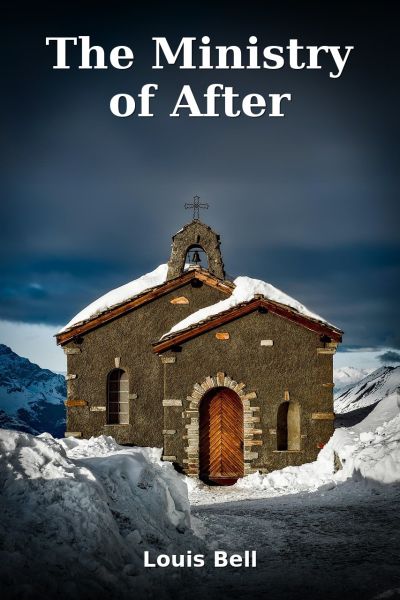
In a genre crowded with action-hero survivors and civilizational collapse fantasies, The Ministry of After offers something quieter and stranger: a novel about the bureaucratic, spiritual, and emotional work of keeping people alive together. Louis Bell's chaplain protagonist doesn't fight zombies — he negotiates air filtration schedules, writes quarantine liturgies, and wonders whether a negative test result has become a sacrament.
What the Book Is About
The novel follows Chaplain Thomas Morrow at the Middleton Community Health and Sanctuary Complex, a former hospital repurposed as a fortress against the undead. Across twenty-five chapters, the narrative tracks the Ministry's evolution from Morrow's solitary Thursday services in a storage room to a formalized Covenant signed by hundreds across three settlements — the compound, a refugee depot, and an outer quarantine quarry. The story operates at the intersection of pastoral care, epidemiological protocol, and improvised governance. Bell writes for readers who want speculative fiction grounded in institutional detail: how a community allocates rapid-test kits, whether a funeral can be held without touch, what happens when prophecy challenges public health. The tone is deliberate, occasionally wry, and allergic to easy transcendence.
The Gospel of Chlorine: Ritual as Biosecurity
Early in the novel, Morrow realizes the decontamination line has become a liturgy: "The queue was the procession. The tablet was the sacrament. The decon station was the altar" (Chapter 12). Bell develops this metaphor systematically. Handwashing songs become call-and-response. The thirty-second scrub becomes a daily examen. When a woman named Adisa converts despite perfect protocol compliance, the community confronts the gap between ritual and guarantee. Calloway, the medical lead, insists: "The point of the protocols is to give you better odds than you would have without them. In the Before, if you caught influenza, your odds of survival were determined by your age, your health, and your proximity to a hospital. In the After, your odds are determined by the same factors, plus the discipline of the community around you" (Chapter 16). The novel refuses to resolve whether this discipline is faith or science — it suggests the distinction may not matter.
A Doctrine of Distance: Touch as Transgression
Chapter 3 introduces the "Doctrine of Distance," Morrow's theological framework for a world where proximity spreads death. The doctrine redefines separation as reverence: "We honor each other's bodies by keeping our distance. We honor each other's breath by filtering our own. This is not separation, but a new kind of communion." This tension drives the novel's most affecting sequences. Arthur Briggs's funeral (Chapter 10) requires a "liturgy of preparation" — gloves, face shields, a thirty-second silent commendation with gloved hands hovering over the body. Martha Delacroix, a chemist whose consistent negative tests make her an unwilling saint, tells Morrow: "I just don't have it. That's not a gift. It's just luck" (Chapter 8). The novel explores how a community maintains intimacy when touch is a vector, and what happens when the protocols that protect them also isolate them.
Competing Authorities: The Council, the Prophet, and the Engineer
Power in the After is never neutral, and Bell maps its fractures through three rival centers. The Council of Turnstiles (Chapter 7) — Morrow, Calloway, Osei, Petra — operates by consensus and transparent procedure. Renata, the stadium prophet (Chapter 13), speaks names of the dead in a voice that "comes as fully formed as scripture — as if someone is reading into my mind a text I have never seen but somehow recognize." Corwin, the radical engineer (Chapter 19), builds a "living altar" of human bones to bypass sterile safety: "Names are just labels on a signal. You'll see. When the wind picks up and the frost settles in, those names won't keep you warm" (Chapter 22). The novel's central conflict isn't zombie vs. human but structure vs. charisma, protocol vs. prophecy, the slow work of committee vs. the seductive certainty of revelation.
The Boy Who Remembers: Emeka as Witness
Emeka, a teenager who appears first at the loading dock services, becomes the Ministry's unofficial archivist. His notebook — "a memory like a steel trap" (Chapter 6) — records radiator squeaks, dog names, the exact phrasing of hallway conversations. By Chapter 17 he's drafting his own catechism questions: "Why does the HEPA unit hum in B-flat? Is that intentional? Who decided that? And — this one I have been thinking about for a long time — when we say 'we remember the dead,' who is the 'we'?" Morrow gives him the chlorine tablet jar: "Not as a relic. Not as a symbol. As a reminder that the smallest thing, the most ordinary thing, can hold the weight of something larger than itself." Emeka represents the novel's argument that survival depends not on heroes but on the quiet, specific labor of attention.
The Covenant as Practice, Not Monument
The Covenant of After (Chapter 23) compiles twenty-one principles — from "We do not pretend the world is not broken" to "Joy is not a luxury. It is a practice." Crucially, it's signed voluntarily, revised by committee, and treated as habit rather than law. When Renata signs, she contributes a single word she heard repeated in a dream: "Remember." The final chapter, "Epistle to the Living," is Morrow's letter to an unknown future reader: "The Ministry of After is not my ministry. It belonged to no one from the beginning. It was a question that asked itself through a thousand different mouths." The novel ends not with victory but with the siren sounding for another shift, bread rising, a child being born — the stubborn, unglamorous persistence of showing up.
Who Should Read This
Readers who appreciate speculative fiction focused on social infrastructure over action — think Station Eleven meets The Power and the Glory — will find rich material here. The novel rewards patience with procedural detail: water bladder logistics, rapid-test supply chains, the mechanics of a plague court. Those wanting fast-paced survival thriller or clear theological answers should look elsewhere. Bell's interest lies in the friction between systems and souls, in how communities improvise meaning from bleach, broadcast radio, and the names of the dead. It's a book for anyone who has wondered what pastoral care looks like when the parish is a perimeter and the sacraments come with expiration dates.
Read “The Ministry of After” on MixCache.com →
Please log in or create an account to leave a comment.
No comments yet. Be the first to say something.