
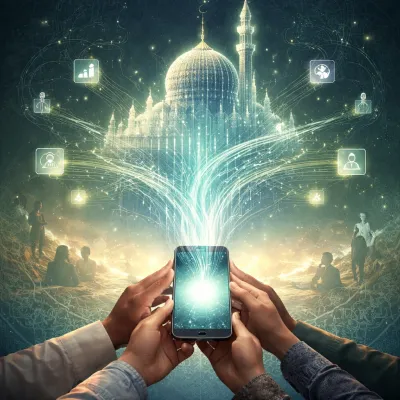
The adhan still rang out, but the mosques were empty. In March 2020, as lockdowns swept the globe, the Friday congregational prayer — Jum‘a, a pillar of Muslim communal life — vanished from physical spaces. The minbars stood silent. Hajj and Umrah were halted. Eid celebrations were reduced to household affairs. Millions of Muslims, suddenly cut off from the institutions that structured their spiritual rhythms, turned to the only place still open: the internet.
The Silence of the Minbars
The crisis was not merely logistical; it was theological. Islamic law (fiqh) had long insisted on physical assembly for Jum‘a, on ritual washing (ghusl) for the deceased, on the prohibition of intoxicants — even in trace amounts. Now, a Muslim in New York needed to know instantly: could she pray Friday alone at home? Could a volunteer in London use alcohol-based hand sanitizer before handling a COVID-19 body? Could a family in Jakarta perform a symbolic burial wash in full PPE? These were not abstract debates. They were life-and-death questions arriving in real time, demanding answers before the next prayer time.
The Fatwa Sprint
Traditional fatwa issuance is a deliberative craft: research, consultation, peer review, often taking weeks. The pandemic collapsed that timeline. Scholars and institutions — from Al-Azhar in Cairo to national fatwa councils in Kuala Lumpur and Jakarta — moved their operations onto websites, WhatsApp lines, and social media. They issued rulings at the speed of the news cycle. A question about vaccine permissibility (porcine gelatin, mRNA technology) might be answered in a Facebook Live session; a ruling on dry ablution (tayammum) for a contagious corpse might appear as a PDF on a government portal before the burial.
The pressure was immense. One scholar described the pace as "issuing guidance while the ground shakes." The methodology of ijtihad (independent legal reasoning), usually reserved for specialized jurists, was effectively crowdsourced across digital networks. Fatwas were published, debated, retracted, and refined in public view. The reasoning — once confined to scholarly circles — was laid bare in comment threads and livestream Q&As, exposing the machinery of religious authority to unprecedented scrutiny.
Virtual Congregations and Contested Rulings
The most visible fracture came over virtual Jum‘a. With mosques shuttered, could a congregation exist on Zoom? The answers split along familiar fault lines. Conservative bodies insisted on physical presence: the worshipper must stand shoulder-to-shoulder, hear the imam’s voice unaided, occupy the same geographic space. They advised praying Dhuhr (the noon prayer) individually instead. Others, citing the principle of necessity (darura), permitted a broadcast Jum‘a — provided a minimum quorum gathered at the broadcasting mosque, and remote followers were within its traditional travel radius. Some went further, validating a fully dispersed digital congregation.
The disagreement was not merely academic. In WhatsApp groups and mosque mailing lists, families argued over which fatwa to follow. The algorithmic amplification of the most engaging clips — a 60-second reel of a charismatic imam saying "yes," a threaded tweet from a council saying "no" — meant the laity often encountered the ruling before the reasoning. The digital fatwa had become a commodity of attention, not just a product of scholarship.
Rituals Reimagined: Burial, Vaccines, and Virtual Iftars
If Jum‘a was the weekly crisis, burial was the daily one. Traditional ghusl requires direct skin contact with water. For COVID-19 victims, that contact risked infection. Fatwas rapidly authorized modifications: full PPE for washers, reduced water usage, even tayammum (dry ablution with clean earth) as a substitute. In some regions, authorities permitted a symbolic wiping over the body bag. The rulings were practical, compassionate, and issued with a speed that would have been unthinkable a decade earlier.
Vaccines brought a second wave of urgency. When mRNA vaccines arrived, questions exploded: were they halal? Did they contain porcine derivatives? Could states mandate them? Fatwa councils convened emergency sessions with virologists, then broadcast their conclusions in multiple languages. The Muslim World League and the International Islamic Fiqh Academy issued coordinated statements to preempt a cacophony of contradictory local rulings.
Meanwhile, the communal fabric migrated online. Virtual iftar gatherings became a nightly ritual: families across continents breaking fast together on video calls, the screen glowing beside the dates and water. Influencer imams, previously known for lifestyle content, pivoted to spiritual triage — short videos on anxiety, live dhikr sessions, one-on-one counseling via DM. Digital zakat and sadaqa platforms saw record donations; crowdfunding campaigns for oxygen cylinders in Delhi or food parcels in Gaza closed in hours.
The New Normal
When mosques reopened, the digital infrastructure did not retract. The pandemic had normalized a parallel religious public square: fatwas on demand, scholars on speed dial, congregations assembled by algorithm. Expectations shifted. A worshipper who once waited weeks for a mailed response now expects a tweet-thread answer before Maghrib. Institutions that hesitated to go online found themselves irrelevant; those that invested in robust digital presences — multilingual websites, verified social accounts, searchable fatwa databases — became the new gatekeepers.
The crisis also exposed the digital divide. Muslims in regions with poor connectivity or low literacy were excluded from the real-time guidance loop, reliant on delayed printouts or word of mouth. And the "infodemic" of false fatwas — fabricated screenshots, decontextualized clips — forced scholars into a perpetual game of whack-a-mole, correcting misinformation that spread faster than the virus.
Yet the pandemic did more than accelerate adoption; it rewrote the social contract between authority and community. The minbar is no longer the sole source of guidance. The fatwa is no longer a sealed scroll. Religious knowledge now flows through the same pipes as memes and markets — instantaneous, contested, and permanently archived. The scholars who once guarded the tradition from innovation now curate it in real time, their reasoning visible, their authority negotiated in the open. The mosque has reopened, but the digital minbar remains lit, and the faithful have learned they can pray in two places at once.
This is one episode in a much longer story. For the full account of Islam's digital pivot during the pandemic, read “Digital Islam: Online Communities, Religious Authority, and Tech-Enabled Practice” by Lisa Gutierrez on MixCache.com.
Please log in or create an account to leave a comment.
No comments yet. Be the first to say something.