
The morning of 758 CE did not dawn quietly over Guangzhou. By the time the Pearl River's tide had turned, the city's foreign quarter — a dense warren of warehouses, mosques, and courtyard homes that had grown up around the wharves — was burning. The attackers were not steppe raiders or rebel peasants but the very merchants who had lived there for generations: Arab and Persian traders, their crews, and their bodyguards, moving with the grim coordination of men who knew every alley and gate. They killed the governor, looted the customs warehouses, and withdrew to their ships before the Tang garrisons could respond. The port that had been the empire's main gateway to the Indian Ocean fell silent for years afterward, its cosmopolitan experiment shattered by the people who had sustained it.
A City Built on Monsoon Winds
Guangzhou had not been planned like Chang'an, with its rigid grid and walled wards. It had grown organically around the Pearl River delta, its streets following the contours of canals and low hills. By the mid-eighth century it was one of the largest cities in the Tang realm, its population swelled by the seasonal rhythm of the monsoon trade. Each summer the southwest winds blew fleets from the Persian Gulf, India, and Southeast Asia into its harbor; each winter the northeast winds carried them home again, their holds packed with silk, ceramics, and tea.
The Tang court had recognized the city's importance early. In 713 it established a Maritime Customs Office — the first dedicated bureaucracy for overseas trade in Chinese history — to register ships, inspect cargoes, and collect tariffs. Foreign merchants were organized into fanfang, designated quarters where they governed themselves under their own headmen, settled disputes by their own laws, and worshipped in their own temples. Arab Muslims prayed at the Huaisheng Mosque; Persian Zoroastrians tended their fire temples; Hindu and Buddhist shrines served Indian traders. The system was pragmatic: the state extracted revenue and maintained order while largely leaving the communities to manage their own affairs.
For decades it worked. Guangzhou's wharves handled aromatics, spices, precious stones, and textiles from across the Indian Ocean, while Changsha ceramics and Yue celadon flowed out in staggering quantities. The foreign population numbered in the tens of thousands — a substantial fraction of the city. They were not transient visitors; they had families, property, and deep commercial roots. Their headmen negotiated directly with Chinese officials. Their contracts were written in Arabic, Persian, or Sanskrit. They were, in every practical sense, part of the city.
The Rebellion That Changed Everything
Then came 755. An Lushan, a general of Sogdian and Turkic descent commanding the empire's finest frontier armies, revolted against the Tang court. Within months the rebellion had swallowed the north. Chang'an and Luoyang fell. The Grand Canal, the artery supplying the capitals with southern grain, was cut. The Tang court fled to Sichuan. In the south, the rebellion's shockwaves destabilized the provincial administration. Local officials, cut off from central authority, grew more predatory. Tax demands intensified. Corruption, always present, became extortionate.
The Arab and Persian merchants of Guangzhou — men who had built their lives on the predictability of imperial law — found themselves squeezed between a collapsing central government and rapacious local officials. The Maritime Customs Office, designed to facilitate trade, became an instrument of exploitation. Merchants who had once been partners in the city's prosperity were now treated as a resource to be milked. Tensions mounted. Petitions went unanswered. Bribes bought only temporary relief.
By 758 the situation had become untenable. The An Lushan Rebellion was entering its third year. In the north, Tang loyalists were struggling to regroup with Uighur cavalry support. In Guangzhou, the merchants decided they would not wait for rescue.
The Raid
The attack was not a spontaneous riot. It was a coordinated operation. Merchant ships in the harbor — Arab dhows with their distinctive sewn-plank hulls and Persian vessels — had been quietly preparing. Crews were armed. Shore parties organized. When the signal came, they moved from the waterfront into the foreign quarter with deadly efficiency.
They targeted the symbols of Tang authority: the governor's compound, the customs warehouses, the offices where taxes were assessed and bribes demanded. The governor himself was killed — a staggering blow to imperial prestige. The foreign quarter, paradoxically, suffered the heaviest damage: the very community that launched the attack saw its own homes and businesses burned, either in the fighting or as a deliberate sacrifice to deny the Tang a base for retaliation.
Then, as swiftly as they had struck, the raiders withdrew to their ships. They did not attempt to hold the city. They had no territorial ambition. This was a protest written in fire and blood, a statement that the compact between the Tang state and its foreign merchants had been broken.
The Aftermath and the Long Shadow
The Tang response was predictable and counterproductive. The court ordered the port closed. Foreign merchants were expelled or fled voluntarily. The Maritime Customs Office ceased functioning. For years Guangzhou's wharves stood empty, the monsoon fleets diverting to quieter ports along the coast.
The closure was a fiscal wound. Guangzhou's customs revenue had been a pillar of the southern economy. Its loss forced the already strained Tang treasury to rely even more heavily on the salt monopoly and new commercial taxes. But the deeper damage was to the trust that had made the fanfang system work. The myth of the cosmopolitan port — that merchants of all nations could thrive under Tang protection — had been exposed as conditional.
When trade eventually revived, it did so on altered terms. Merchants who returned demanded greater autonomy. Many established secondary bases in smaller ports like Quanzhou and Fuzhou, where official scrutiny was lighter. The fanfang quarters lost their distinctiveness as foreign families intermarried with Chinese locals and bilingual children grew up bridging the communities. The next major explosion of violence — the Yangzhou massacre of 760, where Chinese forces killed thousands of Arab and Persian merchants — confirmed that the old equilibrium was gone.
A Fracture in the Cosmopolitan Dream
The Guangzhou raid is usually a footnote in the annals of the An Lushan Rebellion, overshadowed by the fall of capitals and the death of emperors. But it reveals something essential about the Tang world: its cosmopolitanism was not a stable achievement but a negotiated truce, maintained only so long as the state could deliver order and the merchants could deliver profit. When the state failed its side of the bargain, the merchants — those quintessential intermediaries of the Dragon Roads — proved they could be its most dangerous challengers.
The raid also foreshadowed the future. As the overland Silk Roads contracted under Tibetan and Uighur pressure, maritime trade became the empire's lifeline. The lessons of 758 — that foreign communities could not be taken for granted, that port cities needed governance more flexible than the capital's ward system, that commerce would find new routes when old ones were blocked — shaped the Song dynasty's maritime revolution a century later. The port that burned in 758 would rise again, larger and more resilient, its cosmopolitanism hardened by the memory of fire.
Today, the Huaisheng Mosque still stands in Guangzhou, rebuilt many times over the centuries. Its minaret catches the same Pearl River light that fell on the burning warehouses of 758. The merchants who attacked the city are nameless in the records — known only as "Arab and Persian merchants" — but their desperate gamble reminds us that the Dragon Roads were never just routes on a map. They were relationships, sustained by mutual interest and broken by betrayal, paved not with silk but with trust.
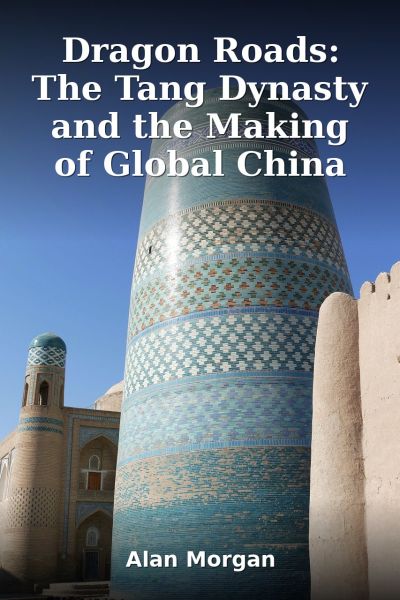
This is one episode in a much longer story. For the full account of the Tang Dynasty and early Chinese globalization, read “Dragon Roads: The Tang Dynasty and the Making of Global China” by Alan Morgan on MixCache.com.
Please log in or create an account to leave a comment.
No comments yet. Be the first to say something.