
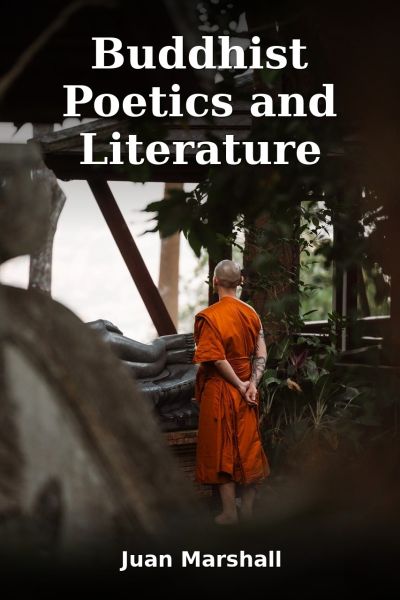
Most anthologies of Buddhist literature treat texts as artifacts to admire from a distance. Juan Marshall's Buddhist Poetics and Literature does something different: it argues that a line break can quiet the mind, a parable can unsettle habitual perception, and a chant can calibrate attention to breath — making the page itself a field of practice.
What the book is about
The book spans 25 chapters, moving chronologically and thematically from early Pali compositions — the Dhammapada's aphoristic verses and the personal testimonies of the Theragatha/Therigatha — through narrative cycles like the Jataka Tales and Avadanas, into Mahayana innovations such as the Lotus Sutra's parables of skillful means, Prajnaparamita's paradoxical explorations of emptiness, and the confrontational rhetoric of Chan/Zen koans. The survey continues through hermit poetry (Hanshan, Ryōkan), Tang Dynasty landscape aesthetics, Bashō's haiku, Tibetan Songs of Realization (Milarepa), devotional liturgy, and into modern expressions (Thich Nhat Hanh, Ko Un), diaspora writings, ecological applications, and narratives of healing. Each chapter pairs analysis with "contemplative invitations" — prompts for reading with the body, listening with the breath, and writing from compassionate attention. The intended reader is anyone willing to engage Buddhist texts not just intellectually but as companions on the path, whether a practitioner, teacher, or curious literary reader.
Literature as vehicle, not illustration
The book's organizing thesis appears in the Introduction and Chapter 1: Buddhist poetry, parable, and narrative "do not merely illustrate teachings; they perform them." A koan confronts certainty; a Jataka tale rehearses karmic consequence; a modern poem helps inhabit fragility without despair. Chapter 1 elaborates that the structure of a poem can mirror the truth it conveys — a verse on impermanence might itself feel fleeting — and that chanting embeds teachings in the body through rhythm and repetition. The Dhammapada chapter shows this in action: its aphorisms function as "portable contemplations," each verse a "mini-meditation prompt" that can be memorized and carried like a "pocket-sized dharma teacher." The Theragatha/Therigatha chapter reinforces the point: these are not abstract treatises but "raw, deeply felt accounts of struggle, insight, and ultimately, liberation" that invite readers into "the lived experience of awakening."
A historical sweep that respects literary form
Rather than flattening diverse traditions into a single narrative, the book lets each form speak on its own terms. Chapter 3 examines the Dhammapada's art of aphorism — "to convey maximum meaning with minimal words" — and how its similes (mind as wild elephant, craving as creeper) transform intellectual understanding into intuitive insight. Chapter 5 reads the Jataka Tales as ethical imagination: "They translate complex philosophical concepts... into relatable, often dramatic stories" where the Bodhisattva "sometimes errs, learns from his mistakes, and demonstrates a continuous process of growth." Chapter 6 unpacks the Lotus Sutra's parables as narrative enactments of doctrine — the Burning House parable justifies "deception" as compassionate skillful means, while the Prodigal Son illustrates gradual awakening. Chapter 9 treats koans not as riddles but as "catalytic agents" that "exhaust the rational mind" through paradox and shock. Chapter 12 shows how haiku's kire (cutting) and kigo (season word) create a "satori moment captured in seventeen syllables." Chapter 13 presents Milarepa's gur songs as "visceral outpourings of awakened mind" arising from solitary retreat. Each form cultivates distinct aspects of the path.
Emptiness, metaphor, and interbeing as literary architecture
Chapters 7, 18, and 22 trace how Buddhist philosophies shape literary expression. The Prajnaparamita chapter demonstrates how texts like the Heart Sutra use negation and paradox — "Form is emptiness, emptiness is form" — as "a carefully crafted poetic assault on our conceptual cages." Chapter 18 argues that metaphor in Buddhism "isn't simply a rhetorical device; it's a reflection of reality itself" because "all phenomena are interconnected and arise dependently." The raft, the wheel of Dharma, Indra's Net, the physician — each image "points to a deeper, relational truth" without reifying it. Chapter 22 extends this to ecology through Thich Nhat Hanh's term interbeing: "A flower 'inter-is' with the sun, the rain, the soil, and the gardener." The chapter reads Wang Wei's "Deer Park" and Bashō's haiku as ecological meditations where "nature, in its quiet dignity, is constantly revealing the suchness of things." The literary effect is to dissolve the boundary between human and non-human, making environmental destruction "ultimately self-harm."
Expanding the chorus: women, diaspora, and contemporary voices
The book deliberately widens the canon. Chapter 16 moves from the Therigatha's "fierce sense of spiritual autonomy" — nuns like Patacara transforming grief into awakening — through medieval figures like the Zen nun Rengetsu to contemporary writers such as Jane Hirshfield and Joan Halifax Roshi. Chapter 21 explores diaspora as creative hybridity: Tibetan exile poetry (Tenzin Tsundue), Jewish-Buddhist dialogues, and the "JuBus" phenomenon, showing how "writing itself becomes a form of 'home-leaving.'" Chapter 20 surveys modern engaged voices — Thich Nhat Hanh's "Please Call Me by My True Names" merging persecutor and persecuted, Ko Un's Maninbo ("Ten Thousand Lives") poems honoring every person he's encountered — demonstrating how "the Dharma is a living tradition, constantly revitalized." Chapter 23 traces healing narratives from Kisagotami's mustard-seed parable through Milarepa's purification to Pema Chödrön's tonglen practice, showing suffering "not denied but embraced as a catalyst for awakening."
Contemplative writing as method
The final two chapters turn analysis into praxis. Chapter 24 offers concrete methods: journaling with Buddhist prompts, free writing as "stream of consciousness" observation, haiku and gatha composition, narrative reframing of personal ethical dilemmas as parables, writing from non-human perspectives to cultivate interbeing, and revision as purification. Chapter 25 issues a direct invitation: craft your own parables from lived conflict, distill nature observations into haiku, write "personal Jatakas" identifying cultivated paramis, narrate diaspora or ecological experience. The goal throughout is not literary polish but "deepening one's spiritual practice" — the page as "a mirror, reflecting our thoughts, emotions, and unfolding understanding of the Dharma."
Who should read this
Readers who want a reference anthology of translated texts should look elsewhere — this book quotes selectively to illustrate its arguments, not to provide full source material. It will most reward practitioners who already have some familiarity with Buddhist concepts and want to explore how literary form encodes and enacts those concepts across traditions. Teachers of Buddhist studies or contemplative writing will find ready-to-adapt prompts in every chapter. Scholars of comparative literature or religious studies will appreciate the theoretical framework linking poetics to philosophy. Casual readers seeking an introduction to Buddhist thought may find the scope overwhelming; the book assumes willingness to move between close reading, historical context, and personal practice. For those ready to meet it on its own terms, it delivers on its promise: "literature becomes more than commentary — it becomes companionship on the path."
Read “Buddhist Poetics and Literature” on MixCache.com →
Please log in or create an account to leave a comment.
No comments yet. Be the first to say something.