
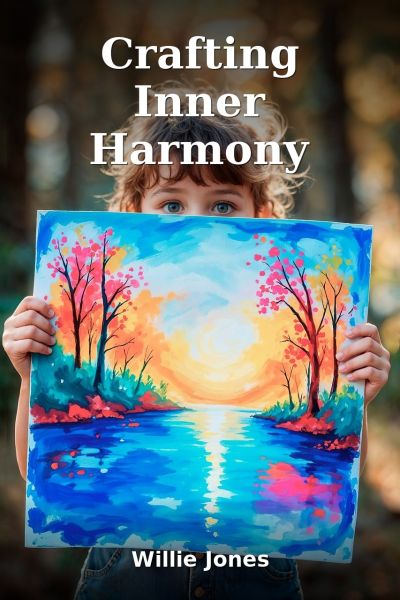
Most of us treat creativity as a luxury — something to pursue after the real work is done, if there's time. Willie Jones's Crafting Inner Harmony flips that assumption on its head, arguing from both research and lived experience that creative expression is as essential to mental health as sleep or nutrition. The book doesn't ask you to become an artist; it asks you to notice that you already are one, and to use that fact on purpose.
What the book is about
Crafting Inner Harmony spans 25 chapters that move from neuroscience foundations to daily micro-practices, then outward to group and community creativity. The first half (Chapters 1–10) builds the scientific and psychological case: how art-making lowers cortisol, triggers dopamine, engages the parasympathetic nervous system, and promotes neuroplasticity. The middle section (Chapters 11–15) introduces formal art-therapy modalities — drawing, painting, sculpting, music, movement — with specific techniques used in clinical settings. The final third (Chapters 16–25) explores shared creativity, real-life transformation stories, a toolbox of everyday exercises, and guidance for sustaining a lifelong practice. The tone is practical and non-judgmental; exercises assume no prior skill and often take five minutes or less. The intended reader is anyone who feels stressed, stuck, or emotionally opaque and wants evidence-based, low-barrier ways to change that.
Creativity as a biological stress reset
Chapter 2, "The Neuroscience of Art," lays out the physiological mechanics: focused creative activity shifts the nervous system from sympathetic (fight-or-flight) to parasympathetic (rest-and-digest) dominance, measurably lowering cortisol. The book cites a study in the Journal of the American Art Therapy Association showing that 45 minutes of art-making reduced cortisol "regardless of artistic experience or talent." Chapter 4 reinforces this with the concept of flow — the state where "time seems to melt away and you're fully present" — and notes that even doodling during a meeting can "prevent the mind from wandering completely" while regulating physiological arousal. The takeaway is concrete: you don't need a weekend retreat; a ten-minute sketch can function as a neurochemical reset button.
Externalizing emotion without words
Chapters 3 and 12 make the case that emotions too complex for language — "the swirling confusion of anxiety or the dull ache of grief" — can be safely externalized through visual marks. The "Draw Your Emotions" exercise (Chapter 12) invites readers to choose colors and shapes for feelings, creating "a tangible representation of what's going on inside you" that can then be observed rather than merely endured. The "Feeling Flow" exercise (Chapter 22) goes further: close your eyes, locate the emotion in your body, then "allow your hands to move, translating those sensations and colors onto the paper" without lifting the hand until a release occurs. Both practices reframe emotion from an internal flood to an external object you can study, reshape, or even destroy — a process the book calls "symbolic transformation."
Micro-moments and rituals over marathon sessions
Rather than prescribing hour-long studio time, Chapters 6, 8, and 10 advocate for "micro-moments of art" — doodling while coffee brews, humming in the car, a five-minute dot mandala before bed. Chapter 8 frames these as "nutritional snacks for your soul" that accumulate into "creative momentum." Chapter 10 elevates repetition into ritual: linking a creative act to an existing habit (morning tea, evening wind-down) and setting a gentle intention — "I intend to release any stress I'm holding" — so the practice becomes "a sacred time for my well-being" rather than another to-do item. The book argues that consistency, not duration, rewires the brain's reward pathways and builds self-trust.
Shared creation as empathy infrastructure
Chapters 16–20 shift from solo to collective creativity. Chapter 16 describes "Round-Robin Art Making," where a drawing circulates and each person adds to it, fostering "improvisation and flexibility" and a "shared sense of ownership." Chapter 19 notes that collaborative murals or sculptures require real-time negotiation — "blend their ideas, adapt their approaches, and sometimes let go of their own creative impulses for the sake of the collective whole" — which translates directly into stronger relationship skills. Chapter 20 extends this to public spaces: community murals, yarn-bombed lampposts, and neighborhood gardens become "tangible symbols of who they are, what they value, and what they have achieved together," turning creative acts into civic cohesion.
Finding your medium, not mastering one
Chapter 23, "Finding Your Medium," rejects the idea that you must pick a single art form. It suggests tracing childhood absorption — "Did you love to draw, sing, build with blocks, dance, or tell stories?" — and matching medium to temperament: tactile processors may prefer clay; visual thinkers, paint or collage; auditory processors, rhythm or songwriting; kinesthetic feelers, movement. The chapter emphasizes accessibility: "The best medium for you is often the one that you can easily integrate into your daily life without significant barriers." Experimentation is encouraged; cross-pollination between forms keeps the practice fresh. The goal is never mastery but "a more harmonious human being."
Who should read this
Readers who want a science-grounded, permission-giving guide to using creativity for emotional regulation will find this book immediately usable. It's especially suited to people who feel "not artistic" but are curious about why doodling, humming, or arranging objects feels calming — the book validates those instincts with data. Clinicians, educators, and community organizers will appreciate the clear summaries of art-therapy techniques and group frameworks. Readers seeking advanced technical instruction in a specific medium, or a memoir-style narrative, should look elsewhere; this is a practical manual, not a mastery course or personal story collection. For anyone ready to treat five minutes of mark-making as legitimate self-care, Crafting Inner Harmony is a compact, compassionate toolkit.
Read “Crafting Inner Harmony” on MixCache.com →
Please log in or create an account to leave a comment.
No comments yet. Be the first to say something.