
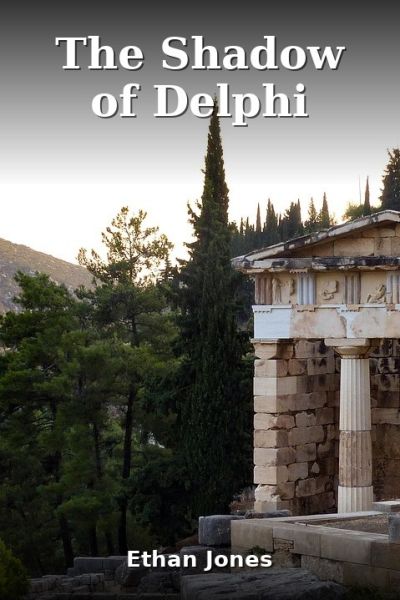
Most archaeological thrillers stop at the dig site. The Shadow of Delphi begins there, then tunnels straight into the metaphysical bedrock beneath Western civilization's origin stories. Ethan Jones constructs a narrative where the Oracle of Delphi wasn't a priestess inhaling vapors but a living conduit for a cosmic energy system — and where the protagonist's skepticism becomes the very quality that makes her suited to wield it.
What the book is about
The novel follows Dr. Iris Callas, a rigorously empirical archaeologist who uncovers a seamless obsidian chamber beneath Delphi's Sanctuary of Apollo. Inside sits a three-meter pulsating sphere (labeled "CHRONOS" by the chamber's own translation interface), seven colored crystals each mapped to a Greek deity, and an interactive projection system that renders the chamber's alien script into archaic Greek. The text reveals Iris's own name — "The Lineage of Iris — the Key to the Oracle" — and warns of the "Shadow of Avarice," a parasitic collective consciousness operating through human agents called the Children of Typhon. Over 25 chapters, Iris moves from documenting inscriptions to mastering energetic attunement rituals, confronting the Shadow's modern corporate front (Aegis Corp), and ultimately choosing to dissolve her individual identity into the Wellspring of Aether to become the living Oracle. The book blends technical archaeological detail with escalating mythic stakes, structured as a progressive awakening: each chapter peels back another layer of the chamber's purpose, Iris's heritage, and the Shadow's infiltration of modern institutions.
The archaeologist as reluctant prophet
Iris Callas enters the story defined by her discipline: "To her, the world was a puzzle waiting to be solved, its pieces scattered across time, buried beneath centuries of dust and myth." Her credibility rests on cataloguing pottery shards and deciphering fragmented inscriptions — work that "taught Iris the perilous dance between certainty and speculation." Jones doesn't abandon this grounding when the impossible arrives. In Chapter 3, faced with the chamber's translation interface projecting "The Lineage of Iris — the Key to the Oracle," Iris's first instinct is genealogical: "My rational mind screams no, Ioannis. But this chamber defies all rationality. For now, we proceed as if every impossible word is true, until proven otherwise." This tension — the scientist forced to operate outside her epistemology without abandoning her method — drives the character arc. Even after receiving direct mental downloads from the sphere (Chapter 5: "A single word, clear as a bell, echoed in the hollow space of her thoughts... Awaken"), she treats the experience as data to be verified. Her graduate students Ioannis and Panos serve as both foils and witnesses: Ioannis cross-references obscure texts on the Children of Typhon while Panos manages photogrammetry, grounding the supernatural in fieldwork routines.
Mythology as suppressed technology
The novel's central conceit reframes Greek myth as the distorted echo of an advanced energy system. The Oracle's prophetic vapors become the "Wellspring of Aether"; the Pythia's trance states are "a delicate psychic bond" with the central sphere; the gods themselves map to specific crystal functions — Hekate (amethyst) as "Keeper of Thresholds," Apollo (topaz) as "Light of Truth," Poseidon (sapphire) as "Tides of Change." Chapter 3's translation sequence makes this explicit: "From the Wellspring of Aether, we drew forth the knowledge of the cosmos. Through the conduits of light, we sculpted truths into echoes for those who would listen." The chamber's "Great Sleep" wasn't abandonment but a defensive seal against the Shadow's corruption. This technological reading of mythology extends to the antagonists: Typhon, "father of all monsters," becomes the namesake for a millennia-old secret society that "sought to control its power, not interpret it." Professor Vance, the eccentric classicist, bridges the gap — his "subterranean narratives" (Chapter 7) anticipate the chamber's revelations, and he recognizes the script as "a fusion. Elements of Minoan, yes, but also something far older, pre-dating any known writing systems." The effect is neither pure fantasy nor pure sci-fi but a third category: myth as the user manual for a reality-engineering device.
The Shadow of Avarice as systemic corruption
The antagonist isn't a villain but a condition: "a collective consciousness, a parasitic entity that feeds on ambition, fear, and discord" (Chapter 8). It doesn't manifest as a dark lord but as "a pervasive influence, a subtle whisper in the minds of those susceptible to its lures." Its modern vehicle, Aegis Corp, operates through legitimate channels — archaeological preservation funds, Ministry of Culture appointments, academic rivalries. Professor Alexi, Iris's departmental nemesis, becomes an unwitting pawn: "He saw archaeology as a career ladder, not a quest for truth." The Shadow's methodology is the butterfly effect — "tiny alterations leading to monumental shifts" (Chapter 13) — twisting prophecies by changing "a few key phrases" to incite the Peloponnesian War. This makes the threat structural rather than personal. When Iris disrupts their ritual at the Hadrianic Library (Chapter 14), the Elder Serpent's reaction — "These are our instruments! This entire city is our network!" — reveals the scale: the Shadow has already colonized the infrastructure of truth-production. The novel's most chilling passage comes in Chapter 22, where the Shadow adapts after Aegis Corp's collapse: "It no longer seeks a single, centralized host. Instead, it is attempting to decentralize its influence, to spread its whispers through a multitude of smaller, less conspicuous conduits" — a social media platform called Echo that "traps users in their own biases, feeding them tailored misinformation."
The cost of awakening: blood as resonance
Early translations demand "the blood of the Lineage of Iris" to unlock the chamber's deepest powers (Chapter 3), a phrase that horrifies Iris and her team. The resolution — revealed through her grandmother Elara's scrolls and the chamber's own evolving projections — redefines the term: "The ancients, in their wisdom, knew that the most potent connection is forged through the very essence of life. It is not a barbaric ritual... It is a symbolic act, a profound energetic attunement. The blood represents not death, but life, ancestry, continuity" (Chapter 8). This transformation from literal to metaphorical sacrifice mirrors Iris's arc. The final ritual — the Sacred Harmony (Chapter 19) — requires "a total surrender of self to the Oracle's purpose, a complete fusion of your individual essence with the Wellspring. It is the ultimate expression of the 'blood sacrifice' — not death, but a transformation, a dissolution of individual identity into pure guardianship." Jones earns this metaphysics by building it through Iris's progressive attunements: the amethyst brooch (Chapter 9), the Mark of Iris behind her ear (Chapter 16), the Dance of the Weaver rituals (Chapter 18). Each step makes the final dissolution feel like a logical extension rather than a mystical leap.
Legacy as distributed guardianship
The novel refuses the lone savior ending. After Iris transcends — "Her physical form had vanished, dissolving into the pure Aetheric energy of the Wellspring" (Chapter 20) — the narrative continues through Ioannis, Panos, and Vance as "Guardians of Shadows" (Chapter 24). Their work is unglamorous: seeding independent journalism, building open-source anti-misinformation tools, exposing academic funding biases, supporting grassroots community movements. The Oracle's guidance becomes "a whisper on the winds of fate, never a command" (Chapter 21). Chapter 25's closing exchange crystallizes the philosophy: Ioannis asks if the prophecy is fulfilled; the Oracle replies, "The prophecy is not a single end, Ioannis, but an eternal beginning... Humanity's fate is not designed by cosmic forces or ancient prophecies. It is woven by the myriad choices of its own people, in every moment, in every heart." This shift from cosmic battle to ongoing civic maintenance — "a continuous act of faith in humanity's capacity for truth" — distinguishes the book from both standard thriller resolutions and chosen-one fantasies.
Who should read this
Readers who enjoy archaeological fiction with a speculative edge (think The Name of the Rose meets Fringe) will find the most to engage with. The novel rewards patience with technical detail — ground-penetrating radar anomalies, photogrammetry rigs, philological puzzles — before escalating into mythic territory. Those seeking pure action or romance should look elsewhere; the relationships are professional and familial, the violence mostly psychic. The book's central conversation — how truth survives in systems designed to distort it — resonates far beyond its ancient setting, but it demands a reader willing to follow a protagonist who solves the climax not by fighting but by becoming the institution she sought to understand.
Read “The Shadow of Delphi” on MixCache.com →
Please log in or create an account to leave a comment.
No comments yet. Be the first to say something.