
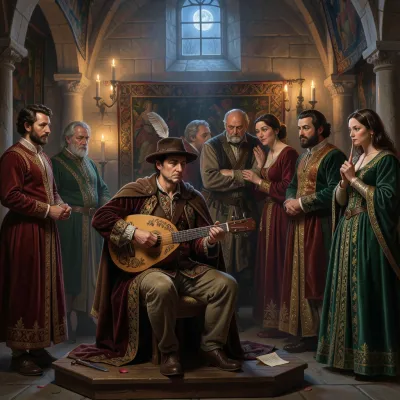
In the courts of medieval Occitania, a well-turned stanza could lift a man from dust or cast him into exile—and in Song of the Troubadour, it does both. Thomas Garcia builds his novel around a premise that feels both startling and inevitable: the troubadours' intricate verse forms weren't just entertainment but a covert communications network, their refrains encoding troop movements and supply routes beneath a veneer of courtly love. What begins as a poet's return from exile becomes a layered thriller about who controls the meaning of art when power decides to weaponize it.
What the Book Is About
The novel follows Guilhem de Montanhagol, a renowned troubadour returning to Toulouse after three years' exile, just as the Albigensian Crusade threatens to consume the Languedoc. He discovers that the traditional song forms—the alba, the canso, the sirventes—have been subverted into a cipher system devised by the trobairitz Domna Celestina to coordinate southern defense. That system has been corrupted by the steward Esteve de Saint-Flour, who now feeds tactical intelligence to northern crusaders through the performances of the vain troubadour Gaucelm Faidit. Guilhem, aided by the scholar-scribe Aèda and the strategic noblewoman Beatriz, races to expose the betrayal before the northern army exploits the compromised codes. The narrative moves from candlelit halls to scriptoria, from a mountain monastery's hidden neumes to the besieged walls of Montpellier, where Guilhem's climactic "harmonic overlay" turns collective song into a defensive weapon. The book concludes as a meditation on art's capacity to outlast the empires that seek to co-opt it.
The Architecture of a Sung Cipher
Garcia's most inventive achievement is making the mechanics of the cipher palpable. The system operates on multiple layers: musical intervals map to a base-twelve merchant counting system; refrain rhythms encode coordinates and dates; marginal notations in manuscript copies provide a written backup. In Chapter Two, Aèda demonstrates the precision to Guilhem: "The third note... if you sing it a half-tone lower than written, it creates a Phrygian inflection that concedes doubt. If you sing it true, it asserts certainty." The novel treats these technical details not as exposition dumps but as plot-critical revelations—each decoded refrain reshapes Guilhem's understanding of the conspiracy. Readers who enjoy puzzles embedded in narrative will appreciate how the cipher's grammar becomes a character in its own right, with its own rules, vulnerabilities, and history.
Women Who Write the War
The novel refuses the easy marginalization of women in medieval settings. Domna Celestina, the cipher's architect, is introduced in Chapter Ten not as a muse but as a strategist: "I built this system to protect the south. Someone has turned it into a weapon against the south." Beatriz de Turenne, delivered to the court as a political pawn, transforms her falconry-honed observation into intelligence work, tracking Gaucelm's performances and the clerk Pierre de Lunel's movements. Aèda, the scribe, brings analytical rigor that equals Guilhem's intuitive musicianship. In Chapter Three, Beatriz tells Guilhem: "I am trained in the hunt, not in the scriptorium. I can follow a trail through a forest by the bend of a broken twig, but I cannot follow a trail through a melody by the bend of a note. That, I suspect, is where you and I become useful to each other." Their collaboration rests on complementary expertise, not romance, and the novel consistently positions their knowledge as decisive.
Performance as Political Act
Every public song in this novel carries double weight. The tenso in Chapter Six—Guilhem's debate with Gaucelm—functions simultaneously as courtly entertainment, a public accusation, and a broadcast of decoded intelligence. Guilhem sings the familiar canso melody but embeds a countermelody that spells out supply routes: "The first refrain identified the route from Lyon to Narbonne. The second placed the date of the first supply caravan. The third named the garrison at Carcassonne as the intended target." The audience hears beauty; the initiated hear treason. This tension between surface and depth drives the narrative. The climactic "heretic's harmony" in Chapter Eighteen escalates the principle: Guilhem sings from Montpellier's battlements a harmonic overlay that "uses resonance to dissolve the northern army's intelligence in real-time," turning the populace's collective voice into a shield. The novel argues that in a world where letters are intercepted and messengers turned, the public performance becomes the only channel that cannot be fully controlled.
The Weight of an Inherited Tradition
Guilhem's craft is framed as a lineage. He learned the ghost countermelody from Bernart de Ventadorn, who taught him: "The song is not the words, and the words are not the notes, and the notes are not the silence between them. But a man who hears all three at once will understand what a chancellor cannot read in a hundred letters." Domna Celestina built her cipher on that foundation, adding the neumatic notation recovered from the Saint-Pons monastery—tenth-century marks that "encode relationships" rather than words, a "meta-code" describing the system's own architecture. The novel respects the depth of this tradition: the blind minstrel in Narbonne, the parrot that repeats original refrains, the hermit who transmits messages through trained memory. Each represents a node in a network older than any living conspirator. When Guilhem finally composes on The Resonance—a lute crafted to the neumes' specifications—he is not inventing but completing a centuries-long conversation.
Tone and Narrative Voice
The prose moves between lyrical density and procedural clarity. Court scenes carry the sensory immediacy of "beeswax and cooking from the kitchens" and "the faintest trace of the river below," while cipher-breaking sequences read like analytic journalism. The narrative voice maintains a historian's distance—"This is a novel of stages large and small"—yet grants intimate access to Guilhem's compositional process: the physical sensation of a refrain forming, the cold clarity of a finished song. Violence is present but never gratuitous; the siege of Montpellier is rendered through the rhythm of mangonels and the calculus of starvation. The emotional core lies in quiet moments: Guilhem and Beatriz watching a falcon stoop, Aèda tracing intervals by candlelight, Domna Celestina recognizing in Guilhem's public song "the sound of a man who had decided that the music was more important than the message." The ending refuses triumph, offering instead the somber recognition that "while empires may fall, the song remains an irreducible vessel of truth."
Who Should Read This
Readers who enjoy historical fiction where intellectual work drives plot—cryptography, manuscript studies, musical analysis—will find the novel's mechanics deeply integrated into its stakes. Those drawn to the Albigensian Crusade period will appreciate the political granularity: the tension between Raymond of Toulouse and the northern barons, the Church's shifting calculations, the merchant networks that move both cloth and intelligence. The book demands patience with technical detail; the cipher's logic is explained repeatedly because it matters. Readers seeking conventional romance or battlefield action may find the pace deliberate. But for anyone who has ever wondered how a melody survives the war that tried to silence it, Song of the Troubadour offers a rigorous, resonant answer.
Read “Song of the Troubadour” on MixCache.com →
Please log in or create an account to leave a comment.
No comments yet. Be the first to say something.