
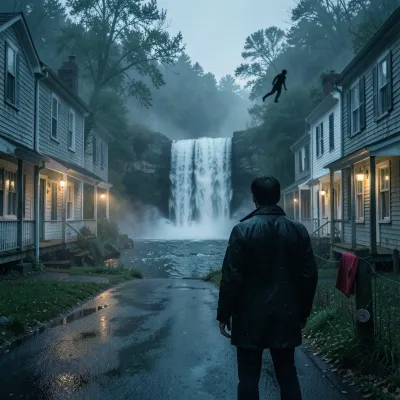
The past in Silver Falls doesn't stay buried—it seeps through floorboards, hides in matchbooks, and waits in the current of a river that never stops talking. When Nora Bennett comes home for her father's funeral, she finds a tarnished tin containing a matchbook from the Harborlight Fund Gala and a Polaroid of a silver leaf charm that belonged to Marybeth Keller, the teenager who vanished the same night. What follows is not just a cold-case thriller but a meticulous dismantling of the architecture of silence that lets a town survive on lies.
What the Book Is About
The Silence in Silver Falls is a psychological thriller structured as a layered investigation. Over twenty-five chapters, the narrative follows Nora, a former investigative journalist, as she pieces together the events of July 20, 2004—the night of the annual gala and the night Marybeth disappeared. The book operates on two timelines: the present-day dig through archives, witness statements, and physical evidence, and the reconstructed past revealed through a hidden cassette tape, a suppressed police file, and her father's secret journal. The scope expands from a personal quest into a systemic exposé of a land-development fraud, insurance scams, and a cover-up orchestrated by the mayor, the pastor, and the town's business elite. It is written for readers who appreciate procedural detail, small-town atmospherics, and the moral complexity of characters who are neither wholly villain nor wholly victim.
The Weight of What Isn't Said
Silence in this novel is not absence; it is an active, maintained force. The introduction establishes the premise: "In Silver Falls, silence wasn't absence; it was a presence, a thing people fed." That line sets the tone for every interaction. Witnesses recant, librarians hesitate, and the sheriff warns Nora that "the truth is a weapon, and everyone's holding one." The town's collective muteness is enforced through social pressure, veiled threats, and the strategic use of institutions—the church, the fundraiser committee, the sheriff's office. Chapter Three shows how Grace, Nora's sister, was told by their father: "Some things aren't yours to carry." That phrase becomes a generational inheritance, illustrating how complicity is passed down as protection.
A Detective Story Built on Paper Trails
The investigation advances through documents, not just interviews. Nora spends hours at the library scrolling microfiche (Chapter Two), files a FOIA request for the county police file (Chapter Four), and cross-references council minutes with land deeds (Chapter Nine). The book rewards readers who enjoy the texture of archival work: a missing-persons report reduced to a single page, a budget increase passed weeks after the disappearance, a matchbook with a phone number and the initial "D." The discovery of a hidden room in the mill (Chapter Eight) yields a cassette tape labeled "FOR THE RECORD — JULY 19, 2004," a locket with Marybeth's photo, and photographs of the gala's power players. Each piece of paper or magnetic tape shifts the timeline and forces a reevaluation of who knew what and when.
Family as Both Shield and Weapon
The Bennett sisters embody the central tension: Nora, who left and became a truth-teller, and Grace, who stayed and became a keeper of peace. Their divergent memories of the night Marybeth vanished—Grace saw her by the river, Nora heard a sharp voice from the tree line—show how trauma fragments and redistributes itself within a family. Their father, Richard Bennett, occupies the morally gray center: a mechanic coerced into signing land deeds for a fraction of their value, who hid evidence in a neighbor's tin and carved his initials into a church pew. Chapter Nineteen reveals the journal's missing page: "...not the brother. The son. He was the one who pushed." That single line reframes the entire conspiracy, making the cover-up a family project rather than merely a civic one.
Institutions as Engines of Erasure
The church, the sheriff's department, the fundraiser committee, and the mayor's office each function as mechanisms that convert a crime into a managed narrative. Pastor Daniel Crowe visits witnesses and tells them "the Lord would not want me to cause trouble for good people" (Chapter Thirteen). The council holds an executive session recorded only as "Discussion held regarding ongoing municipal matters. No action taken" (Chapter Four). The sheriff, Marcus Hale, admits he found a supplemental witness statement placing Marybeth alive in Gerald Oakes's car but filed it away because the mayor told him "some things were bigger than any one person's sense of justice" (Chapter Seventeen). The novel exposes how procedural language—"irregularities," "preliminary findings," "no further action required"—sanitizes atrocity.
The River as Witness and Archive
Water is the book's most persistent motif. The falls "thundered their patient, indifferent song" in the opening pages; the river carries away evidence, hides a body, and eventually delivers the master ledger in a waterlogged satchel (Chapter Twenty-Three). The cassette tape captures church bells chiming in the background, placing the recording near the sanctuary. A diver recovers Marybeth's remains with the silver leaf charm still on her wrist. The final message scratched into the mill's stone reads: "THE WATER REMEMBERS. LOOK THERE." The river does not judge, but it does not forget—making it the only entity in Silver Falls that cannot be silenced.
Who Should Read This
Readers who value atmospheric, character-driven mysteries with a strong sense of place will find much to admire. The novel's pacing rewards patience—its first half builds through documents and conversations rather than action—and its resolution is unflinching about the collateral damage of truth. Those looking for a fast-paced procedural or a tidy redemption arc may find the ending sobering rather than cathartic. But for anyone interested in how communities manufacture innocence and what it costs to break that contract, The Silence in Silver Falls offers a precise, haunting blueprint.
Read “The Silence in Silver Falls” on MixCache.com →
Please log in or create an account to leave a comment.
No comments yet. Be the first to say something.