
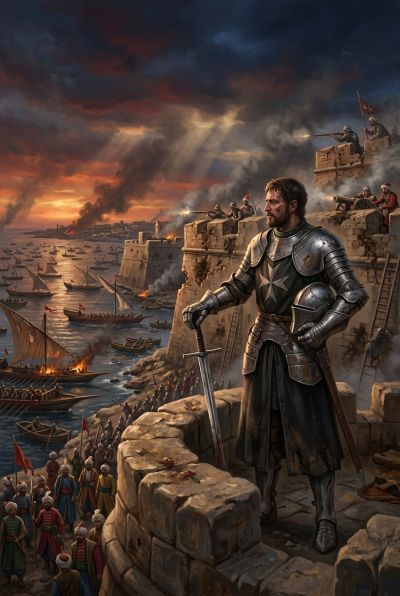
In May 1565, nearly two hundred Ottoman ships appeared off Malta carrying an invasion force of up to forty thousand men. They faced a garrison of perhaps six thousand — Knights, Spanish arquebusiers, German mercenaries, and Maltese farmers — on an island so resource-poor that its annual rent to the Holy Roman Emperor had been a single falcon. Dr Alex Bugeja's The Great Siege does not merely recount this mismatch; it places the reader inside the four-month crucible where artillery, mining, disease, and raw will decided whether the Mediterranean would become an Ottoman lake.
What the book is about
The Great Siege is a 25-chapter narrative history that moves chronologically from Suleiman's decision to invade through the landing, the month-long sacrifice of Fort St. Elmo, the sustained bombardment of Birgu and Senglea, the underground war of miners and counter-miners, the arrival of the Gran Soccorso, and the final Ottoman rout. Bugeja structures each chapter around a distinct phase or perspective — Suleiman's ambition (Chapter 1), the Knights as an institution (Chapter 2), Valette's leadership (Chapter 3), the civilian experience (Chapter 12), the Maltese militia (Chapter 13), the women of Malta (Chapter 16), and the Ottoman camp's collapse (Chapter 18). The prose is built on primary sources and contemporary accounts, yet reads with the pacing of a novel. It assumes no prior expertise but rewards readers who know early modern military history; the book explains trace-italienne fortification, galley warfare, and Janissary organization without ever feeling like a textbook.
The siege as a clash of command cultures
Bugeja makes the Ottoman command structure a character in its own right. The Sultan appointed two rivals — the cautious land general Mustafa Pasha and the ambitious admiral Piali Pasha — then ordered both to defer to the 80-year-old corsair Dragut Reis upon his arrival. Chapter 1 describes this as "a three-headed leadership structure, born of the Sultan's pragmatism but offensive to military pride, a critical flaw that the Knights would later exploit to its fullest." The friction plays out in real time: Piali wants St. Elmo taken quickly to shelter his fleet; Mustafa prefers a methodical reduction of Mdina first. When Dragut arrives, he immediately upends Mustafa's plan, ordering batteries to cut St. Elmo's sea link — a move that works but costs Dragut his life. The book shows how personal rivalry, unclear authority, and the Sultan's remote micromanagement turned a massive force into a hesitant one.
Valette's leadership as a study in applied resolve
Jean Parisot de Valette dominates the narrative without becoming a myth. Chapter 3 traces his life — Rhodes veteran, galley slave under Dragut, governor of Tripoli, Captain-General of the galleys — and argues that every reversal "tempered, but did not break" him. The defining moment comes in Chapter 6 when a delegation of knights begs permission to abandon the crumbling Fort St. Elmo. Valette refuses, shames them, and declares: "I myself will go, and I will take up the command of St. Elmo and die there with my soldiers, if need be." He then sends a commission to assess the fort honestly; when they confirm it cannot hold much longer, he keeps feeding men into it anyway, buying time with their lives. The book portrays this not as fanaticism but as cold calculation: every day St. Elmo held was a day the main defences strengthened and the relief force drew closer.
The war underground and the limits of engineering
Chapter 14 gives the mining war its due, a facet often glossed over in popular accounts. The Ottoman Lagımcılar (military engineers) drove a gallery beneath the Bastion of Castile, packed it with "dozens upon dozens of barrels of the finest black gunpowder," and detonated it on August 18. The explosion lifted the bastion's corner "bodily into the air" and opened a breach the Janissaries poured into. Bugeja's account of the counter-mining — defenders pressing ears to rock, using peas on drumheads to detect vibration, then fighting hand-to-hand in lightless tunnels when galleries met — is visceral. Valette's personal charge into the crater, "his head bare, charging into the deadliest point of the battle," turned a potential catastrophe into a four-hour melee that resealed the line. The episode illustrates a central argument: 16th-century artillery could shatter walls, but it could not break men who refused to leave the rubble.
Civilians as combatants, not bystanders
Chapters 12 and 16 dismantle the soldier/civilian binary. When the bombardment began, Maltese women formed ammunition chains, tended the wounded in the overflowing Sacra Infermeria, and — during the August 7 assault — "poured cauldrons of boiling water and melted pitch" onto Janissaries scaling the walls. Chapter 12 notes that "the vast majority of Maltese women flatly refused to go" when Valette ordered evacuation, transforming the siege from a military contest into a struggle for communal survival. The Maltese militia (Chapter 13), drawn from the ancient Dejma levy, fought with improvised grenades, flaming hoops, and a primitive flamethrower called the "Trump." Their knowledge of terrain produced spies like Toni Bajada, who swam through Turkish lines carrying messages to Sicily. The book argues that the Knights' initial condescension evaporated in the breaches: "On the smoking ruins of the bastions, all distinctions of class and nationality were burned away."
The relief force and the psychology of panic
Bugeja devotes equal care to the Christian side's delays. Chapter 17 reconstructs the agonizing summer in Syracuse, where Viceroy Don García de Toledo balanced Philip II's orders not to risk the fleet against Valette's increasingly desperate dispatches. A small "piccolo soccorso" failed in June; a storm halted the main fleet in August. Only in September did Don García land at Mellieħa Bay with eight to ten thousand men — a fraction of the Ottoman army but fresh and well-supplied. Chapter 18 reveals the Ottoman camp's internal collapse: dysentery, unburied dead, Janissary mutiny whispers, and Mustafa's fatal panic at exaggerated reports of the relief force's size. The final irony, detailed in Chapter 20, is that Mustafa — realizing he had fled a phantom — re-landed nine thousand men to salvage his honour, only to be routed on the beaches of St. Paul's Bay. The book treats this not as inevitable triumph but as a convergence of Ottoman exhaustion, Christian audacity, and sheer chance.
Who should read this
Readers who want a single-volume narrative that integrates high strategy, operational detail, and ground-level experience will find The Great Siege exceptionally complete. Military history enthusiasts will appreciate the attention to siegecraft — mining, counter-battery fire, trace-italienne geometry — while those drawn to social history will value the chapters on women, militia, and civilian logistics. The book assumes no specialist knowledge but does not oversimplify; its 25 chapters demand sustained attention. Casual readers looking for a quick overview may find the density of names, fortifications, and tactical movements challenging. For anyone willing to inhabit the smoke, dust, and calculation of a 16th-century siege, Bugeja delivers a work that feels both scholarly and alive — a history that explains not just what happened, but why it felt like the world hung in the balance.
Read “The Great Siege” on MixCache.com →
Please log in or create an account to leave a comment.
No comments yet. Be the first to say something.