
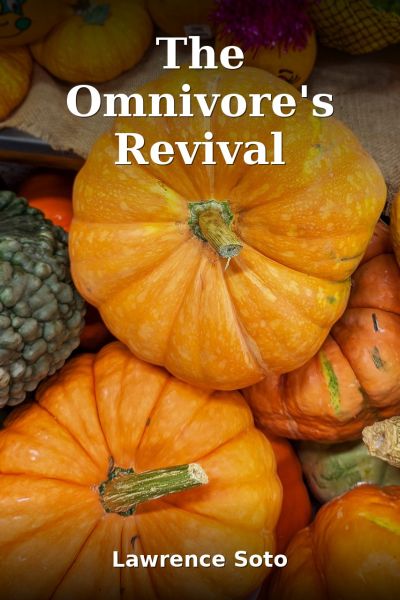
Walk into a modern supermarket and you'll find thousands of products, yet the genetic diversity behind them has collapsed to a handful of commodity crops. Lawrence Soto's The Omnivore's Revival documents how this happened and, more importantly, shows readers how to reverse it in their own kitchens and gardens. The book moves fluidly between food history, nutritional science, and hands-on guidance without ever feeling like a lecture.
What the book is about
The Omnivore's Revival spans 25 chapters that follow a loose chronology: how traditional diets built civilization (Chapters 1–2), how industrial agriculture and cultural amnesia erased that diversity (Chapters 3–4), and how oral histories and seed savers kept fragments alive (Chapter 5). The middle sections survey specific forgotten foods — millets, amaranth, teff, fonio, taro, sunchokes, purslane, pawpaws, heritage legumes, ancient fruits, traditional cheeses, heritage meats, and foraged fish — with each chapter blending origin stories, nutritional data, and environmental benefits. The final third turns practical: growing and sourcing (Chapters 10, 21–22), cooking techniques from fermentation to nose-to-tail butchery (Chapters 15, 18–20, 23), portraits of contemporary revivalists (Chapter 24), and a closing vision for a resilient food system (Chapter 25). The intended reader is curious but not necessarily expert; Soto assumes no prior knowledge of agriculture or nutrition, defining terms like pseudocereal and bletting when they appear.
The historical arc is not just backdrop — it's the argument
Soto structures the first four chapters as a causal chain. Chapter 1 describes polycultural systems where "a single field might host several varieties of corn, beans climbing cornstalks, and squash sprawling beneath, each contributing unique nutrients and pest resistance." Chapter 3 then traces how the Haber-Bosch process, hybrid seeds, and mechanical harvesting forced farmers toward monocultures that "couldn't handle the diverse heights and ripening times of traditional polycultures." Chapter 4 adds the cultural dimension: advertising framed white bread as progress while "hearty, whole grain loaves made from diverse grains were sometimes relegated to the 'poor man's table.'" The result, cited from FAO data, is that "about 75% of plant genetic diversity was lost from agricultural systems between 1900 and 2000." This loss isn't presented as nostalgia; it's framed as a vulnerability — "relying on a narrow genetic base makes our entire food system incredibly vulnerable" to disease and climate shocks.
Forgotten foods as climate adaptation, not just culinary curiosity
One of the book's strongest through-lines is the idea that these foods aren't relics but tools for an unstable future. Chapter 9, "Climate Champions," makes this explicit: "These climate-resilient grains are not a new invention. They are, in many cases, the very crops that sustained communities for millennia in regions now most affected by climate change." Pearl millet needs "200–300 liters of water" per kilogram versus "8,000–12,000 liters for rice and wheat." Fonio "thrives in poor, acidic soils with high aluminum content, requiring minimal water and no chemical fertilizers or pesticides." Kernza, a perennial grain bred from intermediate wheatgrass, "establishes deep roots that not only capture carbon but also prevent soil erosion and reduce the need for frequent tillage, fertilizers, and herbicides." Soto pairs these claims with nutritional data — amaranth's complete protein, teff's iron and calcium, purslane's omega-3s — so the climate argument never drifts into abstraction.
Practical knowledge is distributed across chapters, not siloed
Readers looking for a single "how-to" chapter will instead find guidance woven throughout. Chapter 10 details spacing for amaranth ("two inches apart in rows roughly a foot apart"), teff seeding depth ("no deeper than a quarter-inch"), and home threshing methods. Chapter 15 walks through cooking sunchokes ("roast at 400°F… until tender and lightly caramelized"), purslane ("best eaten raw to preserve their crisp texture and high Omega-3 content"), and medlars (the multi-week "bletting" process). Chapter 18 gives a fermentation checklist: "Cleanliness, not Sterility," non-iodized salt, anaerobic conditions. Chapter 20 explains why salt toughens bean skins if added early. Chapter 22 lists seed companies (Baker Creek, Seed Savers Exchange) and describes companion planting via the Three Sisters method. Chapter 23 condenses ratios: millet 1:2 for pilaf, 1:3 for porridge; amaranth 1:3; fonio toasted then 1:2 water, three-minute simmer. The effect is that a reader can dip in at any point and leave with an actionable detail.
The revivalists are specific people, not archetypes
Chapter 24 grounds the movement in named individuals with distinct constraints. Ben Mackinnon in Suffolk grows heritage wheat that "grow tall and possess deep root systems" but acknowledges the economic friction: heritage grains represent "about eight percent of his crops" and "breaking even on them is difficult." Nathan Ashcroft in Idaho spent "nearly three years just to find the seeds" for einkorn, spelt, and Khorasan wheat. In France, chef Liran Tal chars kohlrabi "thinly sliced like carpaccio" to reposition wartime vegetables. In Hyderabad, Sri Ram left IT to open Ahaar Kuteer, an all-millet restaurant. Taylor Keen of the Omaha and Cherokee Nations runs the Sacred Seed project, growing Cherokee White corn "ground for flour, a stark contrast to the typical yellow corn grown in the Midwest." These portraits avoid hero worship; they show the labor, the financial risk, and the cultural weight behind each effort.
Animal foods get the same diversity treatment as plants
It would have been easy to stop at grains and vegetables, but Chapters 16–20 extend the revival logic to dairy, meat, and fish. Chapter 16 contrasts raw-milk Appenzeller washed in a "centuries-old secret herbal brine" with industrial Swiss cheese that "might pale in comparison to a true Emmentaler." Chapter 17 profiles Berkshire pork ("rich marbling, juiciness, and deep, reddish color"), heritage chickens that take "12–20 weeks" versus six for Cornish Cross, and wild salmon whose "natural diet of smaller fish and krill" yields "vibrant color, firm texture, and a high concentration of beneficial omega-3 fatty acids." Chapter 19 details dry-curing guanciale at home and the difference between dry-aged and wet-aged beef. Chapter 20 makes the nose-to-tail case nutritionally: liver as "nature's multi-vitamin," oxtail for collagen, bone broth for "gut health, joint health, skin elasticity." The consistent thread is that diversity in animal husbandry mirrors diversity in crops — both buffer against systemic fragility.
Who should read this
The Omnivore's Revival will reward home cooks who want to move beyond quinoa and kale, gardeners ready to try amaranth or fonio, and anyone who likes food writing that respects both science and tradition. Readers looking for a purely narrative journey — think The Omnivore's Dilemma — may find the middle chapters reference-heavy. Conversely, readers who want a strict cookbook will need to supplement; Soto gives ratios and techniques but few full recipes. For the curious omnivore willing to toggle between history, ecology, and the kitchen, the book delivers a coherent framework and enough entry points to start experimenting immediately.
Read “The Omnivore's Revival” on MixCache.com →
Please log in or create an account to leave a comment.
No comments yet. Be the first to say something.