
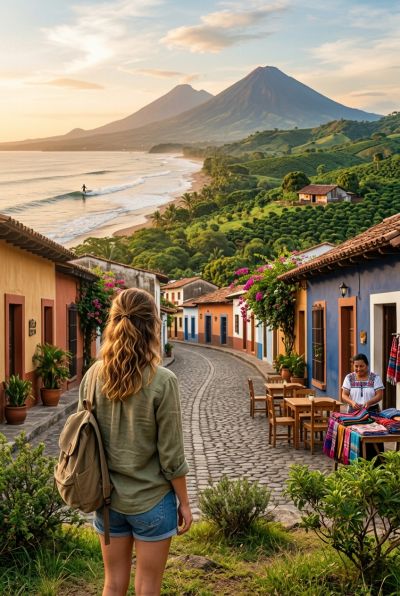
El Salvador has gone from headlines about gang violence to the world's first Bitcoin nation in barely a decade, and the expat curiosity has followed. But moving there isn't a lifestyle upgrade you can book like a vacation rental. Alex Bugeja's Moving to El Salvador: A Guide for Prospective Expatriates treats the move as a complex, often absurd undertaking that rewards preparation and a sense of humor in equal measure.
What the book is about
The book spans 25 chapters organized as a chronological journey: from the initial reality check through visas, housing, shipping belongings, banking, healthcare, language, transportation, safety, grocery shopping, utilities, and the long arc of cultural integration. It assumes the reader has moved before — no explanations of bubble wrap or forwarding mail — and focuses entirely on El Salvador-specific challenges. The tone is conversational and slightly sarcastic, explicitly framed as "your friend on the ground" who has already made the mistakes. Each chapter ends with practical checklists or mental frameworks rather than inspirational fluff.
The visa tango is a dance you cannot lead alone
Chapter Two makes clear that residency is a bureaucratic performance requiring a professional partner. The author details the main visa categories — Pensionado (retiree, ~$1,095/month income), Rentista (passive income, ~$1,460/month), Digital Nomad (remote work, same income floor), and Investor (over $1.4M) — and emphasizes that every document from your home country must be apostilled before you leave. "Trying to get a document from your home state apostilled while you are sitting in San Salvador is a logistical nightmare of international couriers, expensive favors from relatives, and hair-pulling frustration." A lawyer is non-negotiable; the process takes months and costs thousands in fees.
Housing decisions are lifestyle decisions
Chapter Three breaks the country into three distinct living modes: urban (San Benito, Escalón, Santa Tecla, Antiguo Cuscatlán), coastal (El Tunco, El Zonte, Playa San Diego), and highland (Ruta de las Flores, Lago de Coatepeque). Each has radically different costs, amenities, and social rhythms. The author warns that "furnished" can mean anything from turnkey to just a bed and fridge, and that a cisterna (water storage tank) is a deal-breaker: "A property without a cisterna is a deal-breaker for any long-term resident. It's the difference between shrugging off a water outage and having your day completely ruined." Hunting happens through expat Facebook groups, Encuentra24, agents, and driving around looking for "Se Alquila" signs.
Mastering caliche is the real language requirement
Chapter Six argues that textbook Spanish won't get you past the surface. The book introduces voseo (using vos instead of tú with distinct conjugations: vos hablás, vos comés, vos vivís), the aspirated 's' that makes gracias sound like graciah, and a core slang vocabulary: cabal (exactly/agreed), chivo (cool), vaya pues (okay then), pisto (money), bolado (thingy), and púchica (the all-purpose mild oath). It cautions against using maje (dude/idiot depending on tone) until you truly understand the social context. "Mastering it is not just about impressing the locals (though it will); it's about understanding them."
The financial system runs on dollars, cash, and patience
Chapter Five explains that while Bitcoin is legal tender, "the U.S. dollar is still the undisputed king for buying groceries, paying rent, and conducting most of daily life." Small bills are essential — "waving a $50 or $100 bill to pay for a two-dollar purchase will, at best, be met with an exasperated sigh." Opening a bank account requires the residency card and DUI (national ID), creating a chicken-and-egg problem for new arrivals. The territorial tax system means foreign-source income (pensions, remote work, investments) is generally untaxed locally, but U.S. citizens must still file IRS returns. International transfer services like Wise beat traditional wires for cost and speed.
Integration happens through food, family, and the "mañana" mindset
The book's second half shifts from logistics to cultural fluency. Chapter Sixteen dissects the pupusa ritual: revuelta (beans, cheese, pork), curtido (fermented cabbage slaw), thin tomato salsa, eaten with hands. Chapter Thirteen details how friendship escalates through home invitations — arrive 15-30 minutes late, never empty-handed, expect to meet the entire extended family. Chapter Twenty-Two reframes "mañana" not as laziness but as a relationship-first philosophy: "In many Western cultures, the schedule is the skeleton upon which life is built. In El Salvador, the skeleton is the network of human relationships." The author suggests under-scheduling, building buffers, and finding "your guy" for every service to make the system work for you.
Who should read this
This guide is built for people who are seriously planning a move — digital nomads evaluating the new visa, retirees comparing Pensionado requirements, families researching schools and pediatric care, entrepreneurs considering a local business. It's less useful for short-term tourists or anyone expecting a turnkey expat experience like parts of Costa Rica or Panama. The humor and candor make the dense bureaucratic material readable, but the book's value is its specificity: exact income thresholds, document checklists, neighborhood trade-offs, and the unspoken social rules that determine whether you'll eventually feel like a "local foreigner" or remain permanently stuck in the expat bubble.
Read “Moving to El Salvador” on MixCache.com →
Please log in or create an account to leave a comment.
No comments yet. Be the first to say something.