
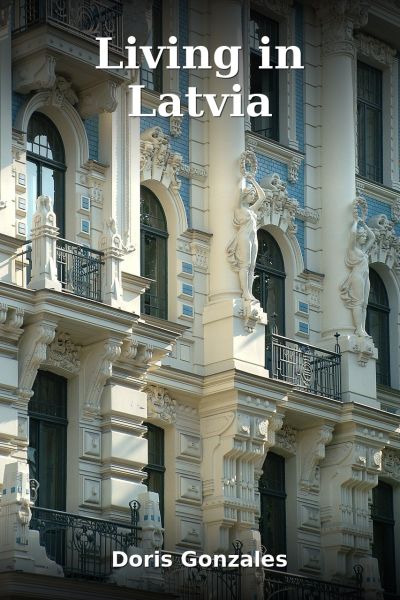
Latvia doesn't announce itself the way Paris or Barcelona do. It's a country of pine forests, Art Nouveau facades, and winters that shrink daylight to two hours — and that quietness is exactly why the expats who land there tend to stay. Doris Gonzales's "Living in Latvia: A Guide for Expats" doesn't sell the dream; it hands you the manual for making it work, one bureaucratic form and cultural cue at a time.
What the book is about
The guide spans 25 chapters, moving chronologically from the "Latvia at a Glance" primer through visas, housing, jobs, healthcare, taxes, banking, driving, language, and niche concerns like retirement, entrepreneurship, and raising a family. It's written for the person who has already decided — or is seriously weighing — a move, and who needs to know exactly how much a one-bedroom in central Riga costs (€496), what the minimum wage is (€740), and which emergency number to dial (112). The tone is methodical but not dry; Gonzales repeatedly flags where official rules diverge from lived reality, such as the gap between "English is widely spoken" and the pharmacy counter where no one understands your prescription.
The numbers that make the case — and the ones that complicate it
Chapter 4 lays out the financial argument with specificity: a single person can live comfortably on €1,250 a month excluding rent; a family needs roughly €2,900. Groceries are cheap (bread at €0.94, milk at €0.83), a monthly transit pass costs €30, and high-speed internet averages €16.77. But the book doesn't hide the trade-offs. Chapter 2 notes that "overall wages in Latvia may be lower than those in many Western European countries," with the average salary ranging from €900–€1,100 nationally and €1,941 in Riga. For non-EU citizens, the work permit process adds months of lead time and employer sponsorship requirements. The math works — but only if your income isn't tied to local pay scales.
Bureaucracy as a contact sport
If you've never dealt with the Office of Citizenship and Migration Affairs (PMLP), Chapter 3 is your orientation. It walks through every permit type — work, study, family reunification, the €250,000 Golden Visa — and emphasizes that "meticulous attention to detail is essential" because "even minor omissions or errors can lead to delays or outright rejections." The book doesn't sugarcoat the timeline: processing can take 10–15 days or stretch to 60. Later, Chapter 12 breaks down the progressive income tax (25.5% up to €105,300; 33% above), the 34.09% social security split, and the "183-day rule" that determines tax residency. Chapter 13 adds that opening a bank account requires both a passport and a residence permit, and that "some banks may also request additional documents, such as proof of your income or a tax identification number (TIN) from your home country." The cumulative message: bring a folder, not a suitcase.
The reserved welcome — and how to get past it
Latvians are "often described as reserved at first acquaintance, but once a connection is made, they are known for their warmth, hospitality, and deep pride in their country and culture" (Chapter 1). Chapter 10 expands on this: "This isn't a sign of unfriendliness, but rather a cultural preference for quiet observation and a slower, more deliberate path to building relationships." Chapter 16 advises that integration means showing up — at Jāņi bonfires, at neighborhood markets, at the local choir or hiking club — and learning to say "Labdien" and "Paldies" without irony. Chapter 18 is blunt about the payoff: "A simple 'Labdien' (Good day), 'Paldies' (Thank you), or 'Lūdzu' (Please/You're welcome) can instantly soften interactions, convey respect, and often elicit a warmer response from locals." The book treats language not as a checkbox but as a social lubricant; even employers sometimes cover lessons as a benefit.
Winter as a lifestyle, not a hardship
The climate gets its own pros-and-cons section in Chapter 2: "The short daylight hours during these months can be a significant adjustment for those accustomed to milder climates, potentially impacting mood and energy levels." But Chapter 15 reframes it. Sigulda becomes a ski hub; cross-country trails appear in Riga's parks; the bobsleigh track offers tourist rides. The book lists "ice karting and even horse skijoring, where a person on skis is pulled by a horse or snowmobile" as real options. Chapter 19 adds the domestic rhythm: "Locals are well-prepared, bundling up in layers, and life continues, albeit with a greater focus on indoor activities. Cozy cafes, cultural events, and winter sports become central to the social calendar." The message isn't "endure it" — it's "equip for it, then participate."
Safety that shows up in the details
Chapter 11 cites Latvia's low crime rate and "absence of major natural disasters, large-scale terrorism, or widespread gun violence" as underrated advantages. But it also names specific risks: pickpocketing in Old Town and Central Market, drink-spiking in nightlife zones, card-skimming at street ATMs, and a rising tide of cyberattacks targeting "public institutions, the financial sector, and critical infrastructure." The practical advice is granular: "never leave your drinks unattended," "use ATMs inside banks where possible," and "be cautious when using public Wi-Fi or shared computers." The emergency numbers — 112 for everything, 113 for ambulance, 110 for police — appear in bold. For tourists, a dedicated municipal police line (+371 67181818) offers English and Russian support. It's the kind of specificity that separates a guide from a brochure.
Who should read this
This book is for the planner who wants every variable visible before they book a one-way ticket — the remote worker calculating runway, the family comparing international school fees (€11,900–€32,000 at Exupery), the retiree weighing private health insurance premiums (€250–€800 annually) against public wait times. It's less useful for the casual traveler or the digital nomad staying under 90 days on a tourist visa, since the depth on residence permits, tax residency, and school enrollment assumes a long-term horizon. If you're serious about Latvia, this is the reference you'll keep open on your desk for the first year.
Read “Living in Latvia” on MixCache.com →
Please log in or create an account to leave a comment.
No comments yet. Be the first to say something.