
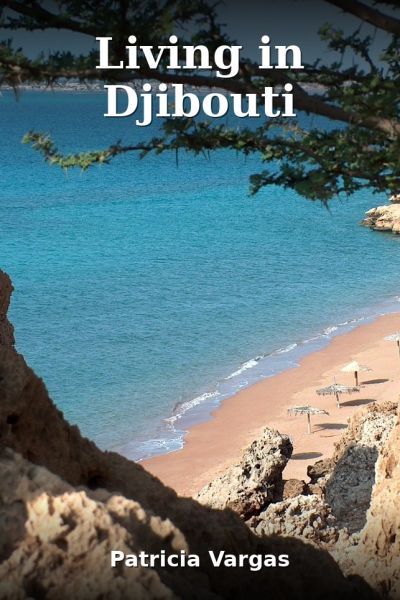
Most expat guides lean either toward glossy brochure or bureaucratic manual. Patricia Vargas's Living in Djibouti: A Guide for Expats sits in a more useful place: it treats the reader like an adult making a serious life decision. Across 25 chapters, the book walks through the full arc of relocation — entry permits, housing hunts, utility contracts, school searches, medical evacuations — while devoting equal weight to the cultural fluency that determines whether you merely survive or actually belong.
What the book is about
The guide targets anyone considering a move to Djibouti — whether for a two-year NGO contract, a military posting, a diplomatic assignment, or a family relocation. Its structure mirrors the chronological logic of a move: Chapters 1–6 cover the physical and administrative foundations (climate, visas, housing, cost of living, utilities, transport). Chapters 7–11 tackle professional and health infrastructure (work sectors, business etiquette, banking, healthcare, insurance). Chapters 12–15 address family life and legal standing (schooling, raising kids, safety, laws). The final ten chapters immerse the reader in society: culture, religion, food, markets, leisure, community-building, language, gender norms, culture shock, and a closing synthesis of habits for thriving. The tone is calm and specific; numbers appear where they matter (rent ranges, internet speeds, vaccination rules), and cultural observations are grounded in daily ritual rather than abstraction.
The climate shapes everything — and the book knows it
Chapter 1 doesn't just list temperatures; it explains how the environment dictates daily rhythm. The year splits into a "winter" (October–April) with daytime highs around 29°C (84°F) and a brutal summer (May–September) where 40°C+ (104°F+) is routine and the Khamsin wind blows sand for days. The sea stays bath-warm year-round (26–31°C), making it the primary escape. Inland, the Goda and Mabla Mountains create microclimates cool enough for juniper forest — Day Forest National Park is "the only true forest ecosystem in Djibouti." Lac Assal, 155 meters below sea level, is "one of the world's most saline bodies of water, with salt concentrations ten times higher than that of the sea." The chapter makes clear: you don't just endure the heat; you reorganize your life around it — early starts, long siestas, evening activity.
Housing and cost of living: the sticker shock is real
Chapters 3 and 4 deliver the numbers that recruiters often soft-pedal. A one-bedroom in Djibouti City runs $1,000–2,000/month; a furnished 45 m² studio in a "normal" area costs ~189,000 DJF ($1,063); a three-bedroom villa in expat-favored Hérons ranges 300,000–450,000 DJF ($1,690–2,530). Leases are usually in French or Arabic, require 1–2 months' deposit plus several months' advance rent, and run one year minimum. Utilities for an 85 m² apartment average $224/month; an 8 Mbps internet line costs ~18,852 DJF ($106). Food prices reflect import dependence: milk ~$2.57/liter, chicken fillets ~$18.02/kg. A single expat's monthly baseline (excluding rent) starts around $732; a family of four with rent hits $4,600–4,900. The book frames this not as a deterrent but as a budgeting reality: "maintaining a 'developed country' lifestyle… can be considerably more expensive in Djibouti due to import reliance and logistical challenges."
Healthcare and insurance: the evacuation clause is non-negotiable
Chapters 10 and 11 form the book's most urgent section. Public healthcare is "developing" — limited equipment, staff shortages, language barriers. Private clinics handle routine care but lack advanced diagnostics (MRIs, specialized blood work often go abroad). The French Military Hospital sometimes admits expats in emergencies, but access isn't guaranteed. The takeaway is unambiguous: "comprehensive international health insurance… is an absolute necessity," and it must include medical evacuation to the UAE or Europe — costs that "can be incredibly expensive, running into tens of thousands of dollars." Even with insurance, expect to pay cash upfront at clinics and claim reimbursement. The chapters also detail vaccination requirements (yellow fever certificate mandatory if transiting endemic zones), malaria risk in rural areas, and the scarcity of mental-health providers — noting that telehealth via international plans becomes a lifeline.
Culture isn't backdrop — it's the operating system
Chapters 16–23 treat Djiboutian society as something you navigate daily, not a weekend tourist add-on. Islam structures the soundscape: "the five daily calls to prayer… serve as constant reminders of faith and punctuate the day from dawn till dusk." Hospitality runs on tea and coffee rituals where "conversations over tea can stretch for hours" and refusing a cup signals disrespect. Communication is indirect; "loud or aggressive speech is generally frowned upon" and reading between lines is essential. Ramadan reshapes public life: eating, drinking, or smoking in daylight is legally and culturally prohibited for everyone. Gender norms remain traditional — expat women are advised to "cover shoulders and knees, opting for loose-fitting clothing" and to wait for local men to initiate handshakes. The book also covers the qat habit (a mild stimulant leaf chewed socially), the primacy of family honor (sharaf), and the linguistic map: French for bureaucracy, Arabic for religion and trade, Somali and Afar for daily life among the two largest ethnic groups (≈60% and 35%).
Leisure that surprises: whale sharks, salt flats, and volcanic moonscapes
Chapter 20 reveals a country that rewards curiosity. Between October and January, "thousands of these gentle giants migrate to the warm waters of Djibouti, making the Bay of Goubbet one of the best places in the world to snorkel alongside them." Lac Assal offers Dead Sea–like floating amid "brilliant white salt flats and volcanic formations." Lac Abbé, near the Ethiopian border, presents "towering limestone chimneys, some reaching 50 meters high, which emit steam and sulfur, creating an apocalyptic, almost lunar landscape." The Goda Mountains hold Day Forest, a rare highland juniper woodland. Tadjoura, "The White City," delivers palm-lined streets and Arabian architecture a short ferry ride away. The Grand Bara Desert hosts an annual 15 km marathon each December. These aren't afterthoughts — they're presented as essential mental-health infrastructure for expats who need perspective beyond the compound.
Who should read this
Anyone with a confirmed or likely move to Djibouti — NGO staff, diplomats, military contractors, teachers at international schools, logistics professionals, accompanying partners — will treat this as a reference manual they return to. It's also valuable for HR and mobility teams designing relocation packages; the cost breakdowns and permit timelines alone justify the read. Readers seeking a narrative travelogue or a deep political history should look elsewhere. The book's purpose is operational: it tells you which documents to notarize, which neighborhoods have reliable water pressure, why your internet will buffer, and how to accept a tea invitation without offending your host. If that's the information you need, it delivers without fluff.
Read “Living in Djibouti” on MixCache.com →
Please log in or create an account to leave a comment.
No comments yet. Be the first to say something.