
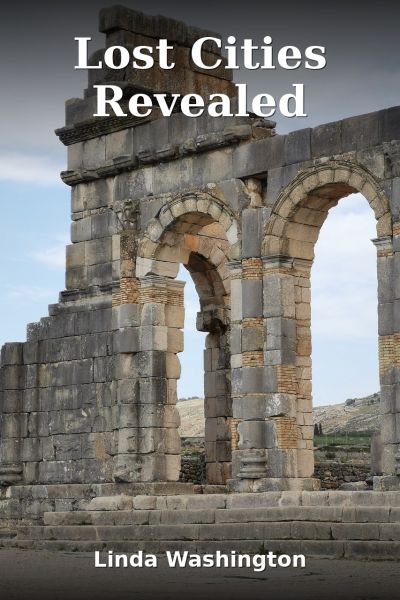
Lost cities have long lived in the space between myth and science, but Linda Washington's Lost Cities Revealed refuses to keep them there. Across twenty-five chapters, she moves from the jungle canals of Angkor to the submerged harbor of Thonis-Heracleion, using each site to ask what makes cities endure — and what makes them vanish.
What the book is about
The book is structured as a world tour of urban collapse and rediscovery. Each chapter focuses on a single city or pair of cities — Mohenjo-Daro, Great Zimbabwe, Palenque, Derinkuyu, the Amazonian Casarabe settlements — tracing its founding, peak, decline, and the circumstances of its archaeological recovery. Washington writes for the curious generalist: readers who know the name Pompeii but not the pyroclastic sequence that preserved it, or who have heard of Machu Picchu but not the Quechua farmer Agustín Lizárraga who reached it nine years before Hiram Bingham. The tone is journalistic but grounded in current scholarship; she cites tree-ring data from Angkor, LiDAR surveys in Bolivia and Ecuador, and the 2023 coin find at Crnobuki that may link the site to Alexander the Great's grandmother. The final chapters synthesize these case studies into explicit lessons for modern urban planning, water management, and climate resilience.
Technology as a character, not just a tool
One of the book's strongest threads is how remote sensing has rewritten what we thought we knew. LiDAR appears repeatedly — not as a gimmick but as a narrative engine. In Chapter 21, helicopter-borne LiDAR over the Llanos de Mojos reveals "a vast urban settlement pattern that extended across some 80 square miles" of the Casarabe culture, transforming isolated mounds into "a unique form of 'low-density urbanism.'" The same technology at Upano Valley in Ecuador exposes "more than 6,000 rectangular earthen platforms" connected by straight roads up to 33 feet wide. At Crnobuki (Chapter 24), drone LiDAR turns a presumed 3rd-century BCE military outpost into a seven-acre acropolis with a possible Macedonian theater. Washington lets the data speak: "These discoveries are confirming what indigenous Amazonian groups have maintained all along: their ancestors built complex, large-scale societies."
Water as the maker and breaker of cities
If there is a single environmental variable that structures the book, it is water. Mohenjo-Daro's 700 wells and covered drains (Chapter 5) set a Bronze Age standard for sanitation that many modern cities still struggle to match. Angkor's *barays* — reservoirs up to five miles long — enabled triple rice cropping and fed a population of perhaps a million (Chapter 1 and 17). The Nabataeans at Petra engineered dams, cisterns, and terracotta pipelines to green a desert (Chapter 9). Yet water also destroys: the liquefaction that swallowed Thonis-Heracleion (Chapter 15), the megadrought that weakened Nineveh before its sack (Chapter 10), the alternating droughts and "intense monsoons" that overwhelmed Angkor's canals (Chapter 17). Washington summarizes the pattern: "This 'one-two punch' of environmental stress and infrastructure overload teaches us about the fragility of even the most sophisticated systems when pushed beyond their limits."
Rediscovery is rarely a solo act
Chapter 12, "Explorers and Locals — Who Really Found the Lost Cities?", dismantles the lone-genius myth. Bingham followed Melchor Arteaga to Machu Picchu; Henri Mouhot relied on Khmer guides at Angkor; workers digging a well stumbled onto Herculaneum. Washington writes, "The popular image of the lone adventurer… often overlooks the crucial role played by indigenous peoples, local guides, and even accidental encounters." The Amazon chapters deepen this point: LiDAR reveals what indigenous oral history never forgot. The Casarabe and Upano Valley urban networks "were never truly lost to the people who lived nearest to them." This reframing runs through the book — local knowledge as data, not folklore.
Collapse as a process, not an event
Washington resists the dramatic "fall" narrative. Cahokia's palisade, built hastily around 1175 CE, signals "increasing social tension or a perceived external threat" (Chapter 3). Great Zimbabwe empties gradually as trade shifts north and the Mutapa State rises (Chapter 4). The Classic Maya cities stop erecting stelae but their people disperse rather than vanish (Chapter 8). Even Nineveh, sacked in 612 BCE, shows earlier strain from a 60-year megadrought (Chapter 10). Chapter 16 makes this explicit: "The reasons for a city's disappearance are rarely singular. More often, it's a confluence of factors, a 'perfect storm' that pushes a society past its tipping point." The framework recurs in the final chapter, where science journalist Annalee Newitz is quoted: lost cities "suffered from prolonged periods of political instability coupled with environmental crisis."
Ancient urbanism as a comparative dataset
The book's closing argument is that these sites constitute a real-world laboratory. Mohenjo-Daro's grid zoning, Angkor's monsoon-adaptive hydraulics, the Inca's seismic-resistant ashlar masonry, the Casarabe's raised causeways and drainage canals — each is a tested response to density, climate, or geography. Washington notes Roman waste separation and metal recycling, Greek city-state mediation practices, and the Orkney villagers' midden-insulated stone furniture at Skara Brae (Chapter 22) as "early forms of resource conservation" and "localized architectural responses to climatic conditions." She does not romanticize; she catalogs. The takeaway is comparative: modern planners can stress-test today's infrastructure against a 5,000-year record of what worked, what failed, and what failed after working for centuries.
Who should read this
Readers who want a single volume that moves fluently between archaeological detail and big-picture synthesis will find this book rewarding. It suits anyone interested in urban history, climate adaptation, or the politics of archaeological narrative — especially those who appreciate having the primary evidence (LiDAR maps, coin dates, sediment cores) named and explained. Specialists in any one region may find individual chapters familiar, but the cross-regional structure is the point. Casual readers looking for adventure storytelling or Atlantis speculation should look elsewhere; Washington is rigorously evidence-based and her prose favors clarity over drama. For the reader who asks "So what?" after every ruin description, the final chapters answer directly.
Read “Lost Cities Revealed” on MixCache.com →
Please log in or create an account to leave a comment.
No comments yet. Be the first to say something.