
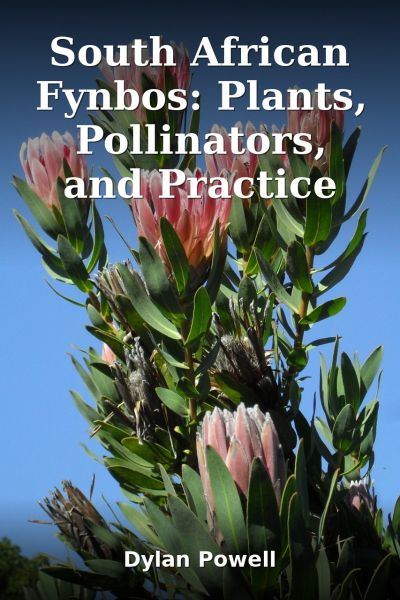
South African fynbos is a paradox: a landscape of ancient, nutrient-starved sands that somehow produces one of Earth's most spectacular floral displays. Dylan Powell's South African Fynbos: Plants, Pollinators, and Practice unpacks that paradox across 25 chapters, showing how plants, pollinators, and fire have co-written a survival manual that gardeners and land stewards can actually use. The book doesn't just catalog species — it teaches you to read the landscape's hidden logic.
What the book is about
The book moves systematically from ecological foundations to practical application. Early chapters establish the physical template — geology, climate, and the phosphorus-poor soils of the Cape Floristic Region (Chapters 1–2) — then examine how major plant families (Proteaceae, Ericaceae, Restionaceae, bulbs and geophytes) express adaptations like sclerophylly, serotiny, and specialized root systems (Chapters 3–7). Three chapters on pollination syndromes reveal how birds, insects, mammals, lizards, and even wind shape floral architecture (Chapters 8–10). Fire ecology, smoke-triggered germination, nutrient cycling via mycorrhizae, and water relations including fog harvesting follow (Chapters 11–14). The second half translates this science into horticulture: garden design, propagation, nursery management, irrigation, pest and disease control (especially Phytophthora), invasive species, and restoration planning through implementation and monitoring (Chapters 15–25). Case studies from the Cape Flats, mountain plantations, drained wetlands, and coastal headlands ground the principles in real projects. The intended audience spans botanists, horticulturists, restoration practitioners, and serious gardeners — anyone willing to trade conventional "pampering" for ecological alignment.
Fire as architect, not catastrophe
Powell reframes fire from threat to "fundamental ecological architect." Chapter 11 explains that fynbos "has evolved with flames as a reset button, a way to clear space, unlock nutrients, and trigger germination." Return intervals, intensity, and mosaic patterns determine which species persist. The book argues that suppression backfires: "Human attempts to suppress fire have often backfired spectacularly in fynbos, creating fuel accumulations that eventually ignite with catastrophic force." Chapter 12 details the biochemical cues — heat shock and smoke-derived karrikins — that break seed dormancy, turning propagation into a mimicry of post-burn conditions. For practitioners, this means prescribed burns aren't optional; they're "a process to be guided, not merely feared."
Pollination as a multi-voice chorus
The three pollination chapters reveal a system far richer than the sunbird-protea postcard. Chapter 8 describes how sunbirds and sugarbirds drive flower morphology: "corollas that vary in length by millimeters and orientations that face the path of the sun to catch the attention of fast-moving targets." Chapter 9 introduces oil-collecting bees — "a guild that has rewritten the rules of floral reward by specializing on scents and oils rather than sugars" — and beetles that "arrive with the confidence of creatures that know they were here long before flowers became fancy." Chapter 10 adds nocturnal rodents ("soft-furred mice and spiny mice that emerge when the sun drops"), lizards, and wind-pollinated restios that "have abandoned the pursuit of animal couriers altogether." The takeaway: a resilient fynbos garden must accommodate this full cast, not just the charismatic birds.
Mycorrhizae as the hidden economy
Chapter 13 positions mycorrhizal fungi as "the central nervous system of survival," especially for Proteaceae. The partnership is specific, not generic: "Some proteas are famously selective, thriving only with particular strains that reflect the chemistry and history of their home patch of earth." This explains why nursery fertilization fails — "Adding phosphorus to these soils can shift competitive balances, allowing weeds that are better at exploiting sudden abundance to outpace the specialists." The practical lesson: "The safer path is to enrich the soil biology rather than the soil chemistry, trusting that healthy fungal networks will do the work if they are given the conditions to prosper." Restoration projects that ignore this invisible layer "may achieve short-term greenery but risk long-term failure."
Horticulture as ecological translation
Chapters 15–19 form a cohesive manual for gardening with fynbos logic. The core principle: "Success in this context requires listening as much as labor, translating ecological truths into decisions about soil mix, watering intervals, and companion choices." Specifics include using lean, acidic, sharply drained media; watering deeply but infrequently to mimic winter pulses; mulching with coarse pine bark or gravel — "a mediator, not a sealant"; and avoiding phosphorus fertilizers entirely. Chapter 18's design guidance emphasizes temporal layering — "early-, mid-, and late-season bloomers arranged so that the garden is never entirely dormant" — and spatial mimicry of natural drifts. Chapter 19 warns that "warm, wet soil is a playground for the root rots that can kill a protea in days." The garden becomes "a potential 'stepping-stone' in a larger fynbos corridor," linking fragmented habitat.
Restoration as long-term negotiation
The final chapters (22–25) treat restoration not as a planting event but as "a craft and a commitment" measured in decades. Chapter 22 insists on reading the site first: "A handful of dirt can reveal whether a site is acidic or alkaline, sandy or clay-bound, rich in organic ghosts or stripped to mineral bones." Chapter 23 details sourcing local provenance — "introducing genes from the wrong side of a mountain can undermine resilience" — and hardening off nursery stock until it "feels almost too tough to handle." Chapter 24 frames monitoring as "turning observation into action," using photopoints, fire logs, and pollinator counts to drive adaptive management. The five case studies (Chapter 25) share a pattern: "What separated the successful projects was not an absence of setbacks but a willingness to learn from them." One project on the Cape Flats used shallow swales to catch road runoff instead of installing irrigation; another in the mountains broke an invasive grass-fire cycle with timed burns. The through-line: "The goal is not to recreate a static snapshot of the past but to maintain the processes that allow the biome to persist and evolve."
Who should read this
This book rewards readers who want to understand why fynbos works the way it does, not just what to plant. Serious gardeners in Mediterranean climates will find a complete, ecologically grounded cultivation framework. Restoration professionals and land managers gain a process-oriented toolkit with explicit techniques for seed treatment, soil preparation, fire planning, and monitoring. Botanists and ecologists get a synthesized view of pollination syndromes, mycorrhizal specificity, and fire-germination cues across the biome. Casual gardeners looking for quick-care ornamental advice may find the demand for patience, observation, and restraint frustrating — this is not a "plant and forget" guide. But for anyone willing to work with the grain of an ancient, fire-adapted, nutrient-thrifty system, Powell delivers both the science and the practice.
Read “South African Fynbos: Plants, Pollinators, and Practice” on MixCache.com →
Please log in or create an account to leave a comment.
No comments yet. Be the first to say something.