
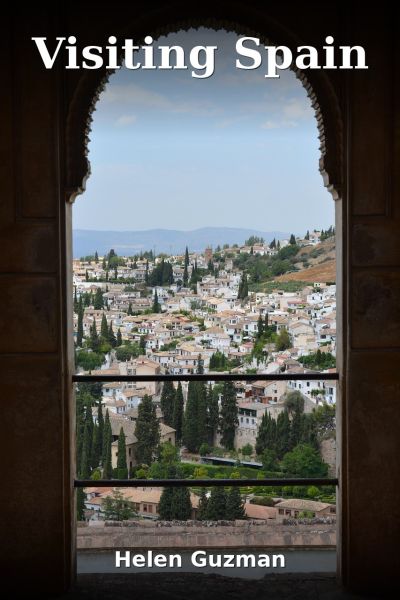
Most travel guides hand you a highlighter and a list of must-sees. This one hands you a framework for thinking about Spain as seventeen distinct worlds sharing a peninsula. Helen Guzman's Visiting Spain: A Guide for Tourists spends 25 chapters building that framework — from visa strategy to the etiquette of the sobremesa — and the result is a reference that respects the country's complexity as much as the reader's intelligence.
What the book is about
The guide opens with planning fundamentals — defining travel style, budgeting realistically, choosing when to go — then moves through visas, currency, and Spain's layered transport network (Chapters 1–8). Chapters 9–11 map the country's regional personalities and iconic attractions, while 12–15 devote four full chapters to food culture: ingredients, tapas traditions, paella variants, and dining etiquette. Chapter 16 tackles social norms (greetings, personal space, punctuality's dual standards), Chapter 17 walks the festival calendar, Chapter 18 surveys art and architecture from Altamira to Gehry, Chapter 19 explores flamenco and regional music, Chapter 20 covers shopping from El Corte Inglés to village mercadillos, and Chapters 21–23 detail outdoor pursuits across mountains, coasts, and national parks. The final two chapters address safety — specifically petty theft tactics and scam awareness — and a meticulous pre-departure checklist. The intended reader is someone who wants to understand how Spain works, not just where to point a camera.
Spain as a collection of countries, not a single destination
The guide's organizing insight appears early: "Spain is not one homogenous entity but a vibrant collection of distinct identities, landscapes, and histories, bundled together under a single flag" (Chapter 9). This isn't decorative prose — it structures the entire book. Chapter 10 devotes pages to Andalusia, Catalonia, the Basque Country, Valencia, Galicia, Castile and León, and Madrid as a hub, noting co-official languages, climate regimes, and culinary borders. The practical payoff appears in Chapter 2: "Think of Spain not as having one climate, but several" — the Meseta's extremes versus Green Spain's mild dampness versus the Canaries' eternal spring. A traveller who internalizes this stops asking "What's the weather in Spain?" and starts asking "What's the weather in the Pyrenees in October?"
Food as social infrastructure, not just flavor
Four chapters treat cuisine as a system of rituals with regional grammars. Chapter 13 distinguishes three tapas economies: Granada's free-tapa-per-drink model ("With each subsequent round of drinks, the tapas often become progressively more interesting"), the Basque pintxos counter where you self-serve and pay by the toothpick, and the rest of Spain's menu-priced tapa/media ración/ración tier. Chapter 14 defends paella's Valencian orthodoxy — "Forget seafood for a moment. The traditional recipe typically features short-grain rice... chicken, rabbit, three types of local beans" — while cataloguing arroz negro, arroz caldoso, and baked arroz al horno. Chapter 15 codifies the sobremesa: "Rushing off immediately after finishing your dessert is considered somewhat abrupt." Chapter 12 grounds it all in pantry logic: olive oil as "liquid gold," sofrito as "savoury depth," bread as "essential tool." The takeaway: you don't just eat in Spain; you navigate a set of shared protocols.
Transport as a set of deliberate choices, not defaults
Chapters 5–7 refuse the "just take the train" shorthand. Chapter 5 frames geography as destiny: "This topography means that some journeys naturally take longer or involve traversing winding roads or tunnels." Chapter 6 compares AVE speed ("Madrid to Barcelona... in under three hours") against bus reach ("Buses connect virtually every corner of Spain"), domestic flight efficiency for island hops, and the freedom of a rental car — while flagging the "hybrid approach" many veterans adopt. Chapter 7 then zooms into urban mobility: Metro validation protocols, bus solicite parada buttons, taxi meter supplements, and the patchy legality of ride-hailing apps. The guide even explains the Vías Verdes network — "over 2,900 kilometres developed across the country" — for car-free countryside travel. A reader finishes these chapters with a decision matrix, not a preset itinerary.
Cultural fluency through specific, testable norms
Chapter 16 replaces vague "be respectful" advice with observable behaviors: the dos besos cheek-kiss sequence ("starting by touching right cheeks"), the ¿Quién es el último? queue query at deli counters, the 15–30-minute social lateness window versus strict official punctuality, the ban on beachwear beyond the sand ("considered inappropriate and disrespectful"), and the tacaño elbow-tap gesture for stinginess. Chapter 17 then maps the festival calendar as cultural immersion points: Las Fallas "sensory overload" with daily mascletàs, Seville's Feria de Abril with its private casetas and rebujito, Pamplona's encierro ("strongly discouraged for inexperienced visitors"), and Buñol's La Tomatina ("goggles are essential"). The guide treats festivals as logistical puzzles — "accommodation prices soar" — not just photo ops.
Safety grounded in pattern recognition, not fear
Chapter 24 catalogues pickpocket choreography: the spill-and-swipe, the map distraction, the fake petition, the rosemary scam ("aggressively demand payment"), the plainclothes-police impostor, the bird-dropping accomplice. It specifies countermeasures — money belt, crossbody bag worn forward, ATM selection ("inside bank lobbies"), DCC refusal ("always choose to pay in the local currency (Euros)"). Chapter 25 converts this into a departure protocol: passport validity buffers, ETIAS monitoring, insurance emergency numbers in three formats, medication documentation, offline map downloads, and a mental flexibility pledge: "Spain operates on its own rhythm. Things might run slightly later than scheduled... Accept this as part of the adventure, not a source of frustration." The tone is calm competence, not alarm.
Who should read this
Travellers planning a first trip who want more than a highlight reel will find the book's structure genuinely educational — it teaches you how to ask better questions of any source. Repeat visitors who've only scratched the Costa del Sol or Barcelona will appreciate the regional depth in Chapters 9–10 and 21–23. Readers who prefer narrative flair over reference density, or who want a lightweight pocket guide for a long weekend, should look elsewhere; this is a 25-chapter manual meant to be studied, not skimmed at the gate. For anyone willing to invest a few evenings before departure, it pays off in fewer surprises and richer days on the ground.
Read “Visiting Spain” on MixCache.com →
Please log in or create an account to leave a comment.
No comments yet. Be the first to say something.