
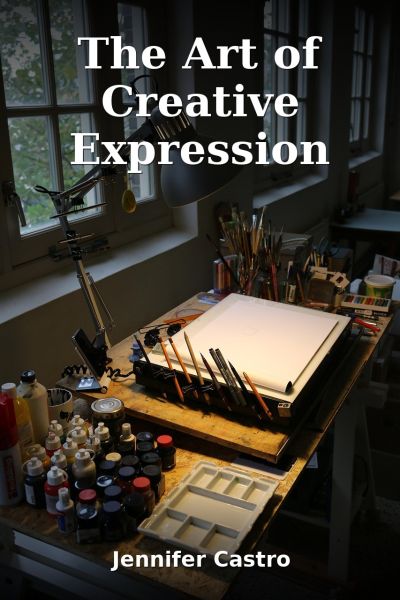
Most people carry a quiet conviction that creativity belongs to someone else — the painter, the musician, the writer with a book deal. Jennifer Castro's The Art of Creative Expression systematically dismantles that assumption across twenty-five chapters, arguing that imaginative expression is a fundamental human birthright as essential to well-being as sleep or movement. The result is less a manifesto than a comprehensive toolkit for anyone who has ever thought, "I'm just not creative."
What the Book Is About
The book moves in three broad arcs. The first establishes foundations: Chapter 1 reframes creativity as a universal capacity rather than a rare gift, Chapter 2 surveys the neuroscience of divergent and convergent thinking, and Chapter 3 traces creative expression across cultures from Lascaux cave paintings to the digital revolution. The middle section tackles the psychological barriers that silence most people — procrastination (Chapter 7), perfectionism (Chapter 8), fear of failure (Chapter 9), and the inner critic (Chapter 10) — each paired with specific counter-strategies. The final third explores five creative modalities in depth (visual arts, writing, music, movement, photography) before addressing practice-building, collaboration, healing applications, and sustaining a creative identity over a lifetime. Castro writes for the curious beginner and the lapsed maker alike, assuming no prior artistic training but demanding honest self-examination.
Creativity as a Cognitive Partnership, Not a Lightning Strike
Chapter 2 offers one of the book's most liberating reframes: creativity is not a mystical download but a measurable interplay between the brain's default mode network (active during daydreaming and mind-wandering) and the executive control network (responsible for focus and evaluation). Castro explains that "creative thought often involves a flexible interplay between these two networks" — divergent thinking casts the net, convergent thinking reels in the catch. This neurological framing removes the pressure to "be inspired" and replaces it with a learnable skill: deliberately alternating between open exploration and focused refinement. The chapter also introduces Mihaly Csikszentmihalyi's flow state as an accessible target, not an elite achievement, describing it as "that deeply immersive, intensely focused state where you become so engrossed in an activity that time seems to disappear."
Naming the Saboteurs: A Taxonomy of Creative Blocks
Rather than treating "writer's block" as a monolith, Chapters 6 through 10 catalog distinct obstacles with surgical precision. Chapter 6 identifies eleven specific barriers, from the "I'm just not creative" belief to fixation — "staring so hard at one tree that you fail to see the entire forest." Chapter 7 reframes procrastination as a fear-management strategy, not laziness, and offers the Pomodoro technique and environmental design as practical counters. Chapter 8 distinguishes perfectionism ("an anxiety-driven need for flawlessness") from healthy excellence-seeking, while Chapter 9 redefines failure as feedback: "true failure is in not trying at all." Chapter 10 personifies the inner critic — suggesting names like "Captain Critic" or "Dame Doubt" — to create psychological distance. Together these chapters function as a diagnostic manual; a reader can identify which specific wall they're hitting and apply the corresponding remedy.
Five Modalities, One Invitational Spirit
Chapters 11 through 15 each devote sustained attention to a creative form: visual arts, writing, music, movement, and photography. What distinguishes these chapters from typical how-to guides is their consistent emphasis on perception over technique. In Chapter 11, Castro notes that drawing teaches "observation rather than flawless reproduction" through exercises like blind contour drawing. Chapter 12 frames writing as "a form of active processing, far more engaged than simply thinking passively" and introduces the "zero draft" — "a messy, unedited outpouring of ideas, free from the pressure of perfection." Chapter 13 observes that "every human being is inherently responsive to music" and suggests starting with voice or phone apps rather than formal instruments. Chapter 14 reframes dance as "a direct conversation between your body, your emotions, and the music, free from the constraints of choreography." Chapter 15 treats photography as "the art of light" and a mindfulness practice: "To capture a compelling moment, you must be fully engaged with your surroundings, actively observing and anticipating." Across all five, the message is identical: the medium matters less than the attention you bring to it.
Creativity as a Healing Language
Chapter 21 makes the book's most clinically significant claim: creative expression functions as a non-verbal pathway for processing experiences that resist language. Castro describes how trauma memories "are often stored in the limbic system of the brain, bypassing the verbal centers," making art, music, and movement "alternative languages to express these unspeakable experiences." The chapter draws on expressive arts therapy principles without requiring clinical supervision, offering examples like collage-making for fragmented feelings and letter-writing to the deceased for grief processing. This section also connects creativity to physiological regulation — the "rhythmic nature of many creative acts" lowering cortisol — and to narrative therapy's re-authoring techniques: "By writing your own narrative, you can challenge limiting beliefs, reframe past experiences, and envision a more empowering future." For readers carrying unspoken wounds, this chapter alone may justify the book's purchase.
Who Should Read This
This book serves the person who has always wanted to make things but stopped at "I can't draw" or "I have no talent," the professional who suspects creative thinking could improve their problem-solving, and the therapist or coach seeking accessible creative interventions for clients. It will frustrate readers looking for advanced technique in any single discipline — Castro covers breadth, not mastery — and those who prefer prescriptive programs over self-directed experimentation. For everyone else, it offers a rare combination: rigorous psychological grounding, cross-cultural perspective, and enough concrete exercises to begin today. The final chapter's invitation — "Step forward, not just as someone who does creative acts, but as someone who is forever a creator" — lingers long after the last page.
Read “The Art of Creative Expression” on MixCache.com →
Please log in or create an account to leave a comment.
No comments yet. Be the first to say something.