
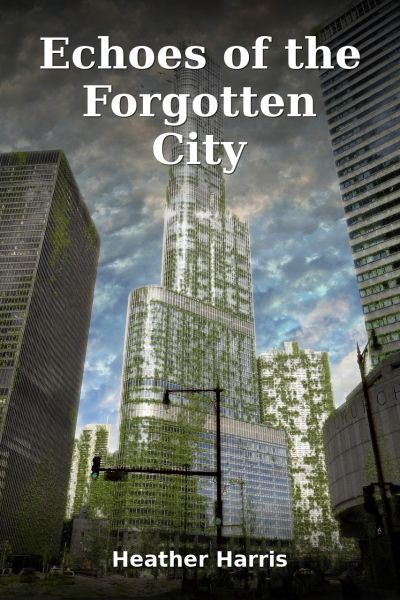
When Maya Sinclair answers her brother’s desperate call, she steps into a city that has been erased from maps but not from memory. What begins as a personal rescue mission quickly unfolds into a layered investigation of power, legacy, and the ways a place can hold onto its truth long after its people have left.
What the book is about: Heather Harris’s novel follows Maya as she navigates the subterranean tunnels, abandoned buildings, and hidden chambers of Veritas, a metropolis that was deliberately depopulated by a shadowy organization known as the Veritas Collective. The story is structured as a chronological journey—from Maya’s arrival on a midnight bus, through her discovery of cryptic symbols, her alliance with reluctant locals, and finally to a confrontation with the Architect, the mastermind behind the city’s demise. While the plot is driven by suspense and action, the novel also explores themes of family history, inherited responsibility, and the moral ambiguity of resistance, making it appealing to readers who enjoy atmospheric thrillers with a strong emotional core.
The Layered Symbolism of the Echoes
Throughout the novel, the recurring motif of the Echo—an intricate swirling symbol—serves as both a literal marker and a metaphor for the persistence of truth. Early in the story, Maya finds a tarnished silver locket bearing the Echo, described as "a single, tarnished silver locket… intricately engraved with a swirling, almost tribal design" (
A glint of metal against the dark stone. … A single, tarnished silver locket.). Later, Kaelen explains that the symbol predates the Architect and represents "the true frequency of Veritas" that the corrupt power structure attempts to hijack (
"The symbols are not just designs; they are frequencies. Patterns of thought."). This duality allows the Echo to function as a guide for those who seek the city’s authentic history while also being twisted by the Collective into a tool of control. The symbol’s evolution—from a family heirloom to a resistance emblem and finally to a corrupted emblem of the Architect’s ambition—mirrors the novel’s broader theme: how meaning can be reshaped by power, yet never fully erased.
Family Legacy and the Buried Past
Maya’s personal journey is inseparable from the Sinclair family’s hidden role as keepers of Veritas’s truth. A letter Adam never sent reveals that their father "was part of it, in his own quiet way. He used to leave me little clues, breadcrumbs, in his old history books" (
"He used to leave me little clues, breadcrumbs, in his old history books. Symbols, obscure references. He was teaching me to see, to understand their language."). This inheritance frames Maya’s investigation not merely as a search for a missing brother but as a continuation of a generational duty to protect the city’s memory. The novel repeatedly returns to moments where Maya recalls childhood explorations with Adam, noting that their father’s fascination with "ancient masonry" and "hidden foundations" was actually preparation for the very tunnels they now navigate. By tying the protagonists’ motivations to a lineage of quiet resistance, Harris elevates the suspense into a meditation on how personal history can intersect with collective memory, urging readers to consider what legacies they inherit and what they choose to preserve.
The Architect’s Vision of Control
The antagonist, referred to simply as the Architect, embodies a chilling blend of utopian idealism and authoritarian cruelty. His plan is not merely to profit from Veritas’s decay but to "harness the city itself… to draw power from its very foundations" and to use that power to "amplify the city’s ‘resonance’ through the portal, and transmit it globally" (
"He believed the city held a unique ‘resonant frequency,’ a psychic energy, if you will. That by controlling it, by manipulating the flow of people and resources, he could refine it."). The novel details his experiments: the orchestrated Exodus that emptied the city, the genetic manipulation that produced the "Guardians" and the "Chameleon" prototype, and the construction of a hidden "Nexus Point" designed to broadcast a mind‑control frequency worldwide. This vision positions the Architect as a modern‑day tyrant who treats an entire metropolis as a laboratory, raising ethical questions about the limits of scientific ambition and the danger of believing that a single individual can redesign humanity.
Ordinary Allies in a Hidden War
While Maya and Adam drive the central narrative, the novel’s tension is sustained by a cast of everyday characters who become unlikely resistance figures. Elias, the gaunt custodian of the Mercantile Building, provides Maya with a hand‑drawn map of the old utility tunnels and warns her that "this city… it hides things in plain sight" (
"This city… it hides things in plain sight. You need to know how to see."). Kaelen, the ancient keeper of the glowing fountain, acts as a spiritual guide, reminding Maya that "the Echoes have found their voice" and that the true power lies in the city’s pure resonance, not the Architect’s corrupted version. Even the broken detective Miller, initially presented as a drunk in a dive bar, sacrifices himself to buy Maya time, declaring, "I’ll buy you time!" These characters illustrate Harris’s point that opposition to tyranny often arises not from grand armies but from individuals who, despite their own flaws, choose to act when confronted with injustice. Their collective efforts underscore the novel’s belief that truth emerges through solidarity, even when the odds appear overwhelming.
The Atmosphere of the Forgotten City
Harris’s prose leans heavily on sensory detail to make Veritas feel like a character in its own right. The opening chapters describe the city’s approach: "The skyline of the city emerged through the fog—jagged, broken, strangely beautiful" and the air as "cool, damp, and carrying the faint, metallic tang of rust and something else she couldn’t quite place" (
The bus shuddered to a halt… Outside the grimy window, the world was a canvas of muted greys and charcoal…). As Maya descends into the tunnels, the atmosphere shifts to oppressive darkness punctuated by the "echoing hum" of dormant machinery and the "phosphorescent light" of ancient water. These descriptions serve a dual purpose: they heighten the suspense of Maya’s physical journey while also reinforcing the idea that Veritas retains a lingering vitality beneath its decay. The setting becomes a metaphor for the buried truths that persist despite neglect, suggesting that places, like people, can hold echoes of their former selves long after they appear abandoned.
Who should read this: Readers who appreciate tightly plotted thrillers with rich world‑building, atmospheric settings, and a strong undercurrent of familial and historical intrigue will find much to engage with in Echoes of the Forgotten City. The novel balances action sequences with thoughtful explorations of power, memory, and resistance, making it suitable for fans of both suspense fiction and literary‑tinged adventure.
Recommendation: If you enjoy stories that pit an ordinary protagonist against a vast, hidden conspiracy while also prompting reflection on how personal histories shape our understanding of place, this book is worth your time. Those seeking a fast‑paced, plot‑driven narrative without deeper thematic layers may find the occasional reflective passages slower, but the overall payoff—a satisfying blend of mystery, emotion, and revelation—makes the novel a worthwhile addition to the thriller shelf.
Read “Echoes of the Forgotten City” on MixCache.com →
Please log in or create an account to leave a comment.
No comments yet. Be the first to say something.