
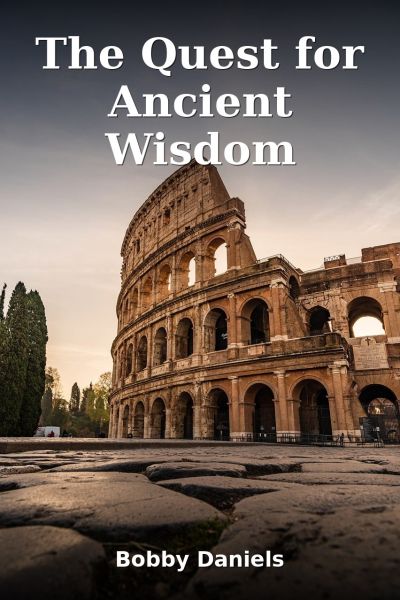
Archaeology began as a pursuit of gold and glory, but it matured into a discipline that reads humanity's biography in broken pottery and buried DNA. The Quest for Ancient Wisdom follows that transformation across continents and centuries, showing how each methodological leap — stratigraphy, radiocarbon dating, LiDAR, ancient genomics — rewrote what we thought we knew about the societies that came before us.
What the Book Is About
The book moves chronologically and thematically through twenty-five chapters. It opens with the birth of archaeology as a science (Chapters 1–5), profiling pioneers like Schliemann, Carter, and Mary Leakey while explaining the toolkit — from trowels to satellite-based LiDAR — that lets researchers "peel back the layers of time with increasing precision." The middle section surveys major civilizations: Egypt (Chapters 6–10), the Inca, Maya, and Aztec (Chapters 11–15), Mesopotamia and the Indus Valley (Chapters 16–17), Angkor and Southeast Asia (Chapter 18), Mediterranean enigmas like Tartessos and Atlantis (Chapter 19), and the often-overlooked kingdoms of Africa and Oceania (Chapter 20). The final chapters turn to the digital frontier: space archaeology, ancient DNA, virtual reconstruction, and the ethical frameworks that now govern the field. The intended reader is curious but not specialist — someone who wants a coherent narrative that connects a potsherd in Peru to a pyramid in Giza without oversimplifying either.
From Treasure Hunting to Testable Hypotheses
The first two chapters illustrate how dramatically the discipline's standards have risen. Early excavators "lacked any systematic approach or scientific rigor" and treated context as an afterthought; the turning point came when figures like Flinders Petrie insisted on "detailed documentation of every artifact, no matter how seemingly insignificant, and its exact position within the archaeological layers." The book traces this professionalization through the decipherment of hieroglyphs and cuneiform, the establishment of stratigraphy, and the advent of radiocarbon dating — each advance converting speculation into chronology. A telling detail: the 1922 discovery of Tutankhamun's tomb, while sensational, also "set new benchmarks for archaeological fieldwork" because Howard Carter documented over 5,000 objects methodically despite global media pressure.
Technology That Sees Through Jungle and Time
Chapters 3, 21, and 23 make a compelling case that remote sensing has done for archaeology what the microscope did for biology. Airborne LiDAR "can penetrate dense forest canopies, effectively stripping away vegetation in the digital realm to reveal features that would be utterly invisible from the ground," exposing entire urban complexes beneath the Amazon and Maya lowlands. Space-based Synthetic Aperture Radar adds another layer, penetrating cloud cover and even dry sand to map buried riverbeds and settlements in the Sahara. The book also details how Ground-Penetrating Radar and magnetometry create "a virtual cross-section of what lies beneath" before a single trowel breaks soil, turning excavation from guesswork into targeted inquiry.
Ethics as a Core Method, Not an Afterthought
Chapter 4 reframes stewardship as a scientific necessity. The Native American Graves Protection and Repatriation Act (NAGPRA) "mandates the return of Native American human remains, funerary objects, sacred objects, and objects of cultural patrimony to lineal descendants," and similar frameworks now guide work worldwide. The author argues that an artifact divorced from its community loses interpretive power: "an artifact divorced from its cultural context loses a significant part of its meaning." Chapter 20 extends this logic to Africa and Oceania, where colonial narratives long dismissed sites like Great Zimbabwe as foreign imports — a bias archaeology itself helped dismantle through "extensive archaeological research since the early 20th century" that confirmed indigenous authorship.
Biological Archives: Diet, Disease, and Kinship
Chapter 22 demonstrates that the most intimate revelations now come from molecules. Ancient DNA extracted from dental plaque has identified specific pathogens in individuals thousands of years old, while stable isotope analysis of bone collagen distinguishes "diets dominated by C3 plants (like wheat and rice) or C4 plants (like maize)." The book cites a Neolithic cemetery where researchers "were able to identify multiple generations of a family buried together," turning anonymous skeletons into a genealogical chart. These techniques also clarify macro-historical puzzles: genomic data map the spread of agriculture into Europe and the peopling of the Americas, while paleoproteomics promises to identify foods even when DNA has degraded.
Patterns That Cross Oceans
Reading the civilization chapters side by side reveals striking convergences. The Inca's *andenes* terraces, the Maya's raised fields, and the Aztec's *chinampas* all solved the same problem — intensive agriculture in marginal environments — with hydrologically sophisticated, locally adapted systems. Monumental architecture in each region encoded astronomical knowledge: the Great Pyramid's cardinal alignment, the Intihuatana's solstice function, El Castillo's equinox serpent shadow. Collapse narratives echo too; the Classic Maya decline and Angkor's abandonment both intertwine "prolonged periods of drought" with "overexploitation of resources" and political fragmentation. The book presents these not as coincidences but as evidence that human societies, wherever they arise, grapple with a shared set of environmental and organizational constraints.
Who Should Read This
Readers who enjoy synthesis — seeing a LiDAR scan of a Maya causeway alongside a cuneiform tablet's accounting records — will find the book's scope rewarding. It assumes no prior expertise but respects the reader's intelligence, explaining stratigraphy and isotopic ratios without jargon overload. Specialists may wish for deeper engagement with current scholarly debates (the "Classic Maya collapse" discussion, for instance, leans toward consensus views). Anyone looking for a thriller-style dig diary should look elsewhere; the tone is measured, the pace deliberate. For the intellectually curious who want to understand how we know what we know about the deep past — and how that knowledge keeps changing — this is a thorough, trustworthy guide.
Read “The Quest for Ancient Wisdom” on MixCache.com →
Please log in or create an account to leave a comment.
No comments yet. Be the first to say something.