
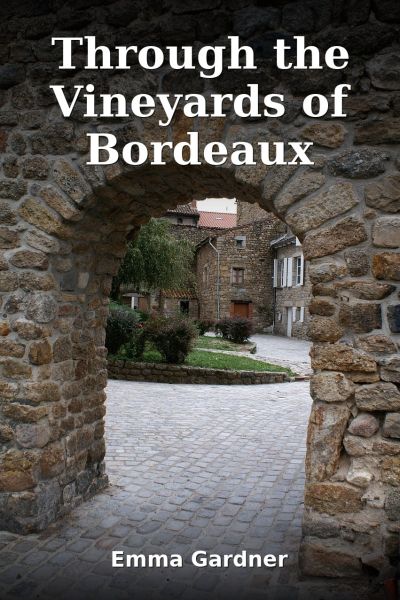
Few wine regions carry the weight of history quite like Bordeaux, yet most writing about it either reveres the famous châteaux or reduces the place to tasting notes. Emma Gardner takes a different approach: she treats Bordeaux as a living ecosystem where geology, politics, family dynasties, and climate crisis all shape what ends up in the glass.
What the book is about
Through the Vineyards of Bordeaux spans 25 chapters organized as a layered journey — beginning with the land itself (Chapters 1–2), moving through two thousand years of history (Chapters 3–5), mapping the appellation system (Chapter 6), profiling iconic estates (Chapter 7), then turning to the people, rituals, food, city, countryside, and finally sustainability and climate adaptation (Chapters 8–25). The structure mirrors a physical visit: you start with soil and rivers, meet the winemakers, eat at their tables, walk the city quays, then venture into rural villages and vineyards. Gardner writes for the curious traveler, the serious wine student, and the armchair explorer alike, balancing technical detail (soil compositions, classification rules, grape variety regulations) with narrative vignettes — conversations in cellars, recipes from bistro kitchens, interviews with chefs and vignerons. The tone is authoritative but never academic; she explains why the 1855 Classification still matters while also telling you which market stall serves the best oysters with a glass of Entre-Deux-Mers.
Terroir as a geological detective story
The opening chapters reframe terroir not as a buzzword but as a forensic puzzle. Gardner traces Bordeaux's soils to "ancient riverbed deposits, remnants of glacial activity from millions of years ago" on the Left Bank, where gravel acts "like a natural radiator, absorbing the sun's heat during the day and radiating it back to the vines at night." On the Right Bank, she describes clay-limestone soils that "retain water more effectively" and suit Merlot's earlier ripening. The Gironde estuary functions as a "thermal flywheel," moderating temperature extremes. These aren't poetic flourishes — they explain why Pauillac produces structured Cabernet Sauvignon while Pomerol yields velvety Merlot. Chapter 2 adds precision: the Ciron River's cold waters hitting the warmer Garonne create the morning fogs essential for Botrytis cinerea in Sauternes, a "delicate balance; too much humidity can lead to undesirable grey rot, while too little means the fungus won't grow at all."
History as a series of commercial pivots
Gardner resists the temptation to romanticize. The Roman planting of 71 AD was strategic — the Garonne offered a "ready-made highway for trade." The 1152 marriage of Eleanor of Aquitaine to Henry Plantagenet turned Bordeaux into an English possession, opening the British market so completely that by the late 1300s Bordeaux was "the second-most populous city under British control, surpassed only by London itself." When the Hundred Years' War ended English rule, merchants simply pivoted to Scotland via the Auld Alliance. The 17th-century Dutch drainage of the Médoc — "a monumental task that reshaped the very topography" — created the gravelly plateau that now hosts the First Growths. Even the 1855 Classification, often treated as sacrosanct, was a marketing exercise for the Paris Exposition Universelle, formalizing existing market prices. Gardner notes the classification has changed only once in 170 years: Mouton Rothschild's 1973 promotion after decades of lobbying by Baron Philippe, who declared, "Premier je suis, Second je fus, Mouton ne change."
The human scale: families, not just labels
Chapters 8 and 9 shift focus from institutions to individuals. Bordeaux has over 5,660 producers, and Gardner introduces both dynasties and newcomers. Mathilde de Caix-Lurton champions sustainability at Châteaux Couhins-Lurton and La Louvière; Claire Villars Lurton left physics for biodynamics and agroforestry. The Baron family at Château Haut Baron in Saint-Estèphe represents multigenerational continuity — their son Lucas added a cuvée labeled with his dog Maïko's paw print. Jean Philippe Saby describes winemaking as "not only a matter of patrimony, it's also a matter of philosophy, patience, and way of life in general… no Sunday, no Saturday, no particularly holiday." These portraits reveal a culture where the cellar is a site of intergenerational dialogue: Christian Moueix sought "the most noble expression of terroir for every wine," a philosophy now carried by his son Edouard. Even the blending process emerges as creative negotiation — "a complex puzzle where different grape varietals and even wines from different vineyard blocks are meticulously combined to achieve balance, complexity, and consistency."
Food as the other half of the conversation
Gardner devotes five chapters to cuisine, arguing that Bordeaux's food culture is inseparable from its wine. The Marché des Capucins — "Stomach of Bordeaux" since 1749 — anchors Chapter 11, while Chapter 12 details signature dishes: entrecôte à la Bordelaise with its red-wine-and-bone-marrow sauce, éclade de moules (mussels steamed under burning pine needles), lamproie à la Bordelaise stewed in its own blood with red wine and Cognac. Chapter 13's pairing philosophy is pragmatic: "match the intensity of the wine with the intensity of the food." Left Bank reds demand rich meats; Right Bank Merlots accommodate duck and mushroom risotto; Sauternes pairs with foie gras by similarity and blue cheese by contrast. Chapter 14's chef interviews — Nicolas Masse at La Grand'Vigne, Philippe Etchebest at Maison Nouvelle, Jérôme Schilling macerating Sauternes with herbs and hay — show cuisine evolving without abandoning roots. Chapter 15 provides tested recipes for the home cook, from canelés (batter rested 24 hours, baked in beeswax-coated copper molds) to cèpes à la Bordelaise.
Climate adaptation as the new classification
The final chapters confront the existential challenge. Harvest now averages "approximately 20 days sooner" than three decades ago, risking higher alcohol and lower acidity. Spring frosts (2017, 2021), hail, and hydric stress are intensifying. Bordeaux's response is systematic: INAO approved six new varieties for Bordeaux and Bordeaux Supérieur — four reds (Arinarnoa, Castets, Marselan, Touriga Nacional) and two whites (Alvarinho, Liliorila) — each chosen for heat tolerance and late ripening. Petit Verdot plantings have grown "over 200% between 2000 and 2019" because it thrives in warmth. In vineyards, cover crops, delayed pruning, and precision viticulture using drone data are spreading. In cellars, carbon capture turns fermentation CO₂ into biodegradable products; Château Pontet-Canet produces bicarbonate, making the estate carbon negative. The CIVB's "Cultivons Demain" strategy targets 100% certified environmental practices by 2030 and carbon neutrality by 2050. As Chapter 23 frames it: "The future of the vine in Bordeaux is not about static tradition, but dynamic evolution."
Who should read this
This book rewards readers who want to understand Bordeaux as a total system — geology, history, economics, culture, and ecology intertwined. Wine students will appreciate the clear appellation breakdown and classification context; travelers will find practical guidance on markets, villages, tour booking, and seasonal timing; cooks gain authentic recipes and pairing logic. Readers seeking only tasting notes, investment advice, or a coffee-table photo book should look elsewhere. Gardner's strength is synthesis: she connects the Roman amphora shard in a Saint-Émilion vineyard to the Touriga Nacional trial plot planted today, showing a region that has always adapted to survive. The lesson, as she writes in the final chapter, is that "true greatness in wine is a reflection of its origins, a profound connection to the earth that cannot be replicated elsewhere" — and that preserving that connection now requires innovation as much as reverence.
Read “Through the Vineyards of Bordeaux” on MixCache.com →
Please log in or create an account to leave a comment.
No comments yet. Be the first to say something.