
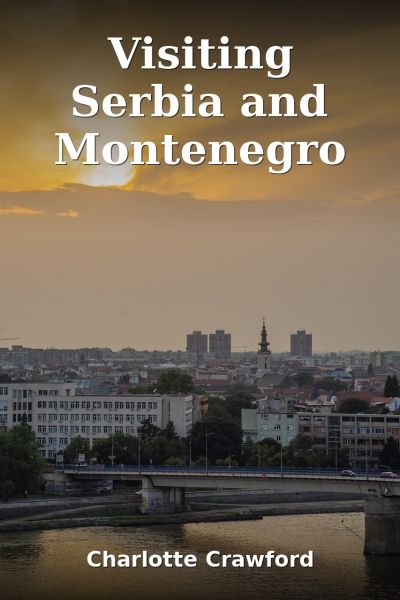
Most travel guides lump neighboring countries into a single chapter, but Serbia and Montenegro deserve better. They share a border and a tangled history, yet they run on different currencies, different alphabets, and different seasonal rhythms. This guide respects those differences while mapping the practical threads that connect them.
What the Book Is About
Charlotte Crawford's "Visiting Serbia and Montenegro: A Guide for Tourists" is a 25-chapter manual built for travelers who want to move confidently between two sovereign nations without treating them as interchangeable. The book opens with planning fundamentals — trip duration, seasonal timing, entry rules, and money — then splits into parallel deep dives: Serbia's cities (Belgrade, Novi Sad, Niš), national parks (Đerdap, Tara, Fruška Gora, Kopaonik), monasteries (Studenica, Sopoćani, Mileševa), and festivals (EXIT, Guča, Nišville); followed by Montenegro's coastal towns (Kotor, Perast, Budva, Ulcinj), mountain parks (Durmitor, Biogradska Gora, Lovćen, Prokletije), and historic sites (Ostrog, Cetinje, Stari Bar). Dedicated chapters cover cross-border transport, accommodation types, food cultures, etiquette, safety, and a bilingual phrase guide. The tone is practical, not poetic: it tells you which ATMs charge Dynamic Currency Conversion fees, how to register with police within 24 hours, and why you should never change money on the street.
The Two-Currency Reality
One of the book's most immediately useful insights is its clear-eyed treatment of money. Serbia uses the dinar (RSD), a closed currency that's nearly impossible to exchange outside the country; Montenegro uses the euro despite not being in the EU or Eurozone. Crawford warns: "Aim to spend most of your Dinars before you leave. If you do have leftover notes, your best bet is to exchange them back into Euros or another major currency at an official Menjačnica or at the airport before you depart Serbia." She also flags the Dynamic Currency Conversion trap at ATMs in both countries — always choose to be charged in the local currency, not your home currency. The guide even notes that border crossings rarely offer fair exchange rates, so you should arrive in each country with usable cash or a plan to hit an ATM in the first real town.
Monasteries as Living History
The Serbian monastery chapters read like an art-history survey grounded in geography. Crawford traces three architectural schools — Raška, Morava, and the Fruška Gora cluster — and ties each to specific rulers and historical turning points. At Studenica, "its main church, dedicated to the Virgin Mary, is a masterpiece of the Raška style, famed for its elegant white marble facade, intricate Romanesque portal and window carvings, and harmonious proportions." At Mileševa, the "White Angel" fresco becomes a lens for discussing medieval Serbian art's international reach. In Montenegro, Ostrog Monastery gets its own gravitational pull: "Clinging impossibly to a sheer vertical cliff face high above the Zeta Valley near Nikšić, its gleaming white facade is visible from miles away, appearing almost miraculous against the dark rock." The guide doesn't just list sites; it explains dress codes, photography rules, and which monasteries offer overnight stays for pilgrims versus tourists.
The Festival Spectrum: From Brass to Beats
Crawford maps Serbia's festival calendar as a cultural circuit rather than a list. EXIT Festival transforms Petrovaradin Fortress into "a sprawling, multi-stage musical universe" with the Dance Arena "nestled in a vast ditch within the fortress, renowned for its intense atmosphere and world-class DJ lineups." Guča Trumpet Festival is its raw counterpart: "Forget subtlety; Guča is about overwhelming sensory immersion. Multiple brass bands, often dressed in traditional attire, roam the streets, playing simultaneously, engaging in friendly musical duels." Nišville Jazz Festival adds sophistication inside Niš Fortress, while Belgrade Beer Fest offers free entry and domestic rock acts at Ušće Park. The guide is honest about logistics — EXIT requires months-ahead booking; Guča means camping in fields and cash-only everything — so readers can match their tolerance for chaos to the right event.
Montenegro's Dual Nature: Coast vs. Mountains
The book refuses to let Montenegro's coastline overshadow its interior. Coastal towns get granular treatment: Herceg Novi's "City of Steps" and fortresses, Tivat's Porto Montenegro luxury enclave, Kotor's 1,350-step fortress climb, Perast's twin islets, Budva's split personality (medieval Stari Grad vs. modern beach bars), and Ulcinj's 13-kilometer Velika Plaža with its kitesurfing scene. But the mountain chapters — Durmitor's glacial lakes and Bobotov Kuk ascent, Biogradska Gora's primeval forest, Lovćen's panoramic Njegoš Mausoleum hike, Prokletije's "Accursed Mountains" for serious alpinists — argue that the country's identity is equally alpine. Lake Skadar bridges both worlds: a bird-rich wetland accessible by boat from Virpazar, with island monasteries like Starčeva Gorica and Beška. The guide's structure forces you to confront the travel-time trade-offs: the Adriatic Highway's summer gridlock versus the winding mountain roads that demand winter tires from November to April.
Practical Logistics That Save Headaches
Beyond sights, the book excels at the friction points that derail trips. The registration requirement — "foreigners are legally obliged to register their presence with the local police within 24 hours" — gets repeated emphasis because hotels handle it automatically but Airbnb hosts often don't. Border procedures are spelled out: bus passports collected en masse, train officials boarding compartment by compartment, car drivers needing Green Card insurance and winter tires in season. The transport chapters compare bus (frequent, 6–10 hours Belgrade–Podgorica), train (scenic but "notoriously slow," 11–14+ hours on Belgrade–Bar), flight (under an hour but 4–5 hours door-to-door), and car (flexibility with hairpin bends and border queues). City transit details — Belgrade's "Beogradska Kartica" system, Kotor's parking nightmare, the Verige Strait car ferry shortcut — show the guide was written by someone who has actually stood in these lines.
Who Should Read This
This guide suits travelers planning a multi-week, two-country itinerary who want granular logistics over inspirational prose. It's ideal for independent explorers comfortable with buses, rental cars, and occasional Cyrillic signage, and for festival-goers needing advance-booking timelines. First-time Balkan visitors will appreciate the cultural-etiquette chapter (three-kiss greetings, Slava traditions, modest dress at monasteries) and the safety chapter's specific warnings about taxi scams, air-quality spikes in winter, and tick-borne encephalitis in rural areas. Readers seeking a coffee-table photo book, a history narrative, or a curated "top 10" list should look elsewhere. Crawford delivers a reference manual you'll annotate with sticky notes — exactly what a complex, two-currency, two-alphabet trip demands.
Read “Visiting Serbia and Montenegro” on MixCache.com →
Please log in or create an account to leave a comment.
No comments yet. Be the first to say something.