
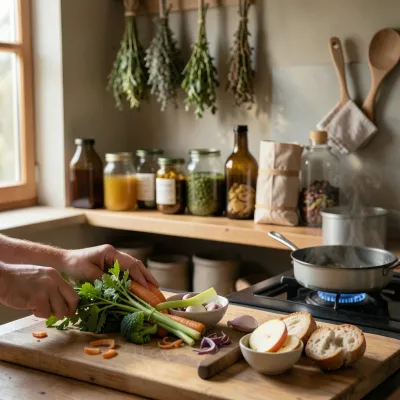
Most cookbooks treat food waste as an afterthought, something to manage with a compost bin and good intentions. Scott Hall's Zero Waste Kitchen flips that assumption entirely, presenting waste reduction not as sacrifice but as a framework for better cooking, deeper flavor, and a more resilient pantry. The book argues that peels, bones, stale bread, and spent coffee grounds aren't leftovers — they're ingredients waiting for a technique.
What the Book Is About
Zero Waste Kitchen is a 25-chapter manual organized as a progressive curriculum, moving from mindset shifts through kitchen setup, shopping habits, meal planning, and inventory systems before diving into specific techniques. Chapters 6 through 19 each tackle a category of ingredients — vegetables, meat, stocks, sauces, pickles, ferments, drying, freezing, canning, bread, dairy, legumes, fruit, and even coffee and tea scraps — showing how to extract maximum value from every part. Later chapters address flavor building, creative leftovers, composting, tool maintenance, batch cooking, and community food sharing. The tone is instructional but not dogmatic; Hall emphasizes "continuous improvement" over perfection and provides flexible templates rather than rigid recipes. The intended reader is a home cook who already knows their way around a kitchen but wants to systematize waste reduction, whether motivated by budget, ecology, or culinary curiosity.
Scraps as Assets: The Core Mindset Shift
The book's foundational argument, laid out in Chapter 1, is that "scraps" is a category error. Hall writes: "Consider, for a moment, the abundance of edible parts we routinely discard. Broccoli stems, watermelon rinds, citrus peels, stale bread – these are not waste products but rather untapped sources of flavor, nutrition, and culinary potential." This reframing runs through every subsequent chapter. Carrot tops become pesto (Chapter 6), onion skins dye broth gold (Chapter 8), cheese rinds deepen tomato sauce (Chapter 16), and chickpea liquid — aquafaba — whips into meringue (Chapter 17). The mindset shift is practical: before tossing anything, the cook asks, "Can this be used? Can it be repurposed? Can it be transformed?" This question, Hall notes, "opens up a world of creative possibilities, pushing you beyond conventional cooking habits."
Kitchen Systems That Make Waste Reduction Automatic
Chapters 2 and 5 argue that willpower is a poor substitute for infrastructure. Hall details how to arrange work zones, choose storage containers, and implement a first-in, first-out (FIFO) rotation so older ingredients get used before newer ones. "The principle is exactly what it sounds like: older items move forward so they get used before newer arrivals," he explains. The book covers fridge microclimates (crisper drawers for greens, door shelves for condiments), freezer portioning strategies ("lay bags flat to freeze before stacking"), and labeling habits that prevent "the slow amnesia that turns a well-stocked pantry into a collection of mysteries." A particularly useful passage describes trash tracking: "For a week, notice what actually lands in the bin and why. Patterns will emerge, and with them, practical fixes." This diagnostic approach turns waste reduction into a solvable design problem rather than a moral exercise.
Preservation as a Spectrum, Not a Single Skill
Chapters 10 through 14 present five preservation methods — pickling, fermenting, drying, freezing, and canning — as complementary tools, each suited to different ingredients and goals. Hall distinguishes quick vinegar pickles (ready in an hour, fridge-stored for weeks) from fermented pickles (days to weeks, probiotic, evolving flavor). He explains when to choose water-bath canning (high-acid foods like fruit, pickles, acidified tomatoes) versus pressure canning (low-acid vegetables, meats, soups), noting: "This is not a gray area; it is the line between preserving safely and courting danger." The drying chapter (12) covers everything from oven-dehydrating tomato halves to grinding vegetable peels into umami powders, while the freezing chapter (13) emphasizes portioning and blanching: "A quart of chili can become four single servings or two family portions, and berries can be spread on a tray and frozen loose before being gathered into a bag." This range lets a cook match method to moment — preserving a CSA surplus in August, rescuing limp celery in February.
Creative Leftovers: The Remix Meal Framework
Chapter 21 reframes leftovers as "components waiting for new context, new companions, and new textures." Hall introduces bowl building as a flexible template: a grain or legume base, raw or lightly cooked vegetables for crunch, protein for anchoring, sauce for cohesion, and acid plus texture for contrast. "A satisfying bowl usually begins with a base that offers substance and comfort," he writes, noting that "firm starches absorb sauces more readily and hold their shape under the weight of other ingredients." The chapter emphasizes cooking with future remixes in mind — roasting extra vegetables, simmering a large pot of beans, making a versatile tomato sauce — so assembly becomes effortless. This approach "reduces the pressure to use ingredients immediately, because you know they can be combined in countless ways rather than being tied to a single dish." It's meal planning inverted: instead of shopping for recipes, you build meals from what's already cooked.
Community and Circularity Beyond the Kitchen
The final chapter expands the zero-waste frame from household to neighborhood. Hall describes community fridges ("take what you need, leave what you can"), gleaning programs that harvest cosmetically imperfect crops, and food rescue organizations redirecting restaurant surplus. He also covers tool libraries, repair cafés, and skill-sharing workshops as infrastructure that supports household efforts. "Community, sharing, and food rescue are not add-ons to a zero-waste kitchen but extensions of it," he argues. "They recognize that individual effort is more sustainable and joyful when it is connected to others." This systems view — compost closing the nutrient loop, shared preserves building social ties — positions the book as more than a cooking manual; it's a blueprint for a more connected food culture.
Who Should Read This
Zero Waste Kitchen will reward cooks who already possess basic knife skills and pantry knowledge but want to systematize their approach to waste. It's especially valuable for anyone managing a household food budget, gardeners facing seasonal gluts, or cooks curious about fermentation and canning but intimidated by safety concerns. Readers seeking glossy recipe collections or narrative food writing should look elsewhere — this is a reference work dense with techniques, ratios, and troubleshooting guides. The book's strength is its breadth: it connects mindset to infrastructure to technique to community, showing how each layer reinforces the others. For a cook ready to stop guessing and start building a kitchen where "nothing is dismissed too quickly," it's an exceptionally thorough companion.
Read “Zero Waste Kitchen: Sustainable Cooking and Pantry Skills” on MixCache.com →
Please log in or create an account to leave a comment.
No comments yet. Be the first to say something.