
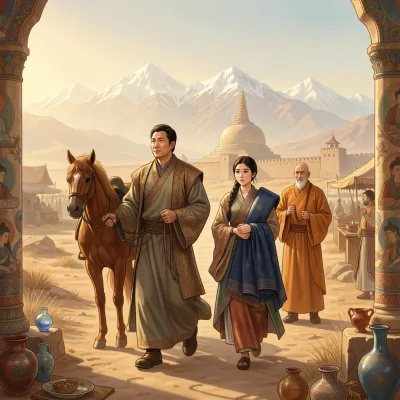
The Silk Road was never just a road for silk; it was a living network that moved ideas, inventions, and even pandemics across Eurasia. Megan Mason’s comprehensive history shows how each shift in power redefined what traveled along those routes and why it matters today.
What the book is about
The book traces the Silk Road from its earliest sporadic exchanges between nomads and farmers to its modern reinterpretation in China’s Belt and Road Initiative. Organized into twenty‑five chapters, it moves chronologically, beginning with early steppe interactions (Chapter 1) and ending with twenty‑first‑century globalization (Chapter 25). Each chapter focuses on a theme—trade, technology, religion, disease, or legacy—while weaving in the stories of merchants, missionaries, and empires that made the network function. The intended reader is anyone curious about how long‑distance exchange shaped civilizations, from students of world history to general readers seeking a nuanced view of globalization’s deep roots.
Trade and Technological Transfer
Mason emphasizes that the Silk Road’s most enduring impact lay in the movement of practical knowledge. In Chapter 18 she notes, "The story of paper begins in China… The pivotal moment for papermaking’s transfer to the Islamic world is often attributed to the Battle of Talas in 751 CE." This episode illustrates how a military defeat became a conduit for a technology that later revolutionized European scholarship. Similarly, gunpowder’s westward spread is tied to Mongol conquests: "The dissemination of gunpowder technology westward along the Silk Road is largely attributed to the Mongol Empire." The book also traces printing, noting that woodblock prints appeared in Dunhuang as early as 868 CE and that the Uyghurs produced "the oldest examples of printing technique in an alphabetical script from the Silk Road." These concrete examples show how the routes acted as a silent engine for innovation, long before the Industrial Revolution.
Cultural and Religious Exchange
Religious ideas traveled as readily as goods. Chapter 4 details how the Kushan Empire became "a vibrant crossroads of trade, culture, and, most significantly, the accelerating spread of Buddhism," with Emperor Kanishka patronizing monasteries that facilitated the faith’s move into Central Asia and China. Chapter 11 expands on this, describing how Buddhist art evolved from Gandharan prototypes to the distinct Chinese styles seen in the Mogao Caves. Mason also covers westward‑moving faiths: Chapter 12 explains how Nestorian Christianity found a foothold in Tang China, evidenced by the Nestorian Stele of 781 CE, and how Manichaeism gained state sponsorship under the Uyghur Khaganate after Khagan Bögü’s conversion in 763 CE. These passages reveal the Silk Road as a corridor where belief systems were adapted, blended, and sometimes challenged by local traditions.
Disease and Demographics
The book does not shy from the darker side of interconnectedness. Chapter 21 opens with, "The Silk Road, a tapestry woven with threads of commerce, culture, and conquest, undeniably brought immense benefits… yet… there was a darker, often devastating, side: the rapid and far‑reaching spread of disease." It traces outbreaks from the Antonine Plague to the Black Death, noting how the same caravan routes that moved silk also moved Yersinia pestis. Mason writes, "The very routes that had brought so much prosperity and cultural exchange now served as the perfect conduits for the spread of this deadly disease." She connects the Black Death’s demographic collapse to later political shifts, such as the Ming Dynasty’s turn toward isolation, showing how pandemics could reroute the course of history.
Legacy and Modern Relevance
Mason closes by linking past to present. Chapter 22 examines how the Silk Road’s "geopolitical shadow lingered," influencing the Great Game and modern pipelines across Central Asia. Chapter 23 details China’s Belt and Road Initiative as a "profound reinterpretation and ambitious revival" that "aims to re‑establish and dramatically expand connectivity across Eurasia." Chapter 24 discusses the Silk Road’s enduring cultural memory, from the romance of Samarkand’s tiles to modern festivals celebrating plov and kebabs. Finally, Chapter 25 argues that "the spirit of the Silk Road lives on, transformed and amplified by the forces of modern globalization," noting parallels between ancient relay trade and today’s global supply chains. These sections make clear that the Silk Road is not a relic but a framework for understanding today’s interconnected world.
Who should read this? Readers who appreciate a deep, evidence‑based look at how trade routes shape culture, technology, and power will find Mason’s work rewarding. Those seeking a light overview or primarily interested in European medieval history may find the breadth overwhelming, but anyone interested in the roots of globalization will gain valuable perspective.
Read “History of the Silk Road” on MixCache.com →
Please log in or create an account to leave a comment.
No comments yet. Be the first to say something.