
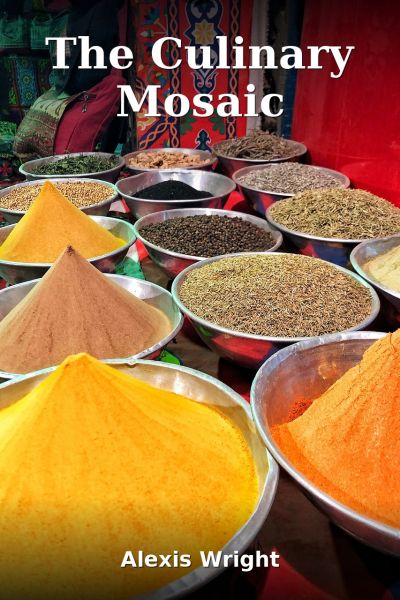
The Culinary Mosaic doesn't just catalog recipes — it maps how human movement shapes what we eat. Across 25 chapters and five major regions, Alexis Wright traces the invisible threads linking a bowl of pho in Hanoi to a plate of jollof rice in Lagos, a tagine in Marrakech to a taco al pastor in Mexico City. The result is a history book disguised as a cookbook, where every ingredient tells a story of conquest, survival, and ingenuity.
What the book is about
The Culinary Mosaic spans Asia, the Mediterranean and Europe, the Americas, and Africa in roughly chronological and geographic order. Its 25 chapters move from the ancient Spice Routes (Chapter 1) through Asian street food markets (Chapter 2), East and Southeast Asian traditions (Chapters 3-4), South Asian festival cuisine (Chapter 5), the Mediterranean basin (Chapters 6-10), French and British Isles cooking (Chapters 11-12), Central and Eastern Europe (Chapter 13), Iberian tapas culture (Chapter 14), modern European innovation (Chapter 15), Indigenous American foodways (Chapter 16), North American melting pots (Chapter 17), Central America and the Caribbean (Chapter 18), South America's Andes-to-Amazon diversity (Chapter 19), contemporary American fusion (Chapter 20), and African foundations through regional cuisines and global legacy (Chapters 21-25). The book assumes no specialized knowledge — it's written for curious home cooks, travelers, and anyone who wants to understand why their plate looks the way it does. Each chapter blends historical narrative, ingredient profiles, signature dish breakdowns, and cultural context, with occasional recipes and chef insights woven in.
The Spice Routes: More Than Trade Goods
Chapter 1 reframes the Spice Routes not as mere commercial highways but as "arteries for cultural diffusion and gastronomic innovation." Wright shows how spices like black pepper, cinnamon, and ginger moved westward while wheat, grapes, and preservation techniques traveled east along the Silk Road. The Arabian Peninsula's merchants "guarded the secrets of the spice origins, spinning fantastical tales of dangerous lands and mythical creatures to maintain their lucrative monopoly," while the Islamic Golden Age produced a "rich body of culinary literature" that spread Persian and Arab techniques across South and Southeast Asia. The arrival of European powers in the 15th century "forever altering the geopolitical and culinary landscape" brought colonization but also new fusions — vindaloo in Goa, for instance, emerged from Portuguese vinegar-marinated meats meeting Indian spices. Even humble ingredients like tamarind (African in origin) and lemongrass (native to maritime Southeast Asia) became "vital components in the culinary lexicons of different cultures." The chapter makes a quiet argument: flavor migration is human migration written in spice dust.
Street Food as Living History
If the Spice Routes built the skeleton of Asian cuisine, Chapter 2 argues street food is its "beating heart." Wright describes night markets of Tang Dynasty China and Edo-period yatai in Japan as precursors to today's hawker centers, where "grandmothers' recipes meet entrepreneurial spirit." The chapter tours Bangkok's pad thai and som tam, Vietnam's pho and banh mi ("a perfect marriage of East and West"), Singapore's Michelin-starred hawker stalls, Japan's festival takoyaki, Korea's late-night tteokbokki, China's regional specialties from jianbing to hand-pulled noodles, and India's chaat culture where pani puri delivers "an explosion of sweet, sour, spicy, and tangy notes in every bite." What unites them? Accessibility, specialization ("many vendors start with humble beginnings, a single cart, and a family recipe, building a loyal following through sheer dedication to quality"), and community — "plastic stools gathered around a humble cart become instant dining rooms." Wright also notes the tension: urban development threatens traditional vendors, even as documentaries and Michelin recognition elevate street food's status. The chapter reads like a defense of informal economies as cultural archives.
Indigenous American Agriculture: The Three Sisters and Beyond
Chapter 16 anchors the entire Americas section by centering pre-Columbian ingenuity. The "three sisters" — corn, beans, and squash — formed a "symbiotic planting system" that was "an ecological marvel, demonstrating a deep understanding of sustainable agriculture." Corn's domestication over 9,000 years ago in Mesoamerica was amplified by nixtamalization, "a crucial indigenous innovation" that "improved the nutritional value by making niacin and amino acids more bioavailable" while improving flavor and grindability. Beyond the triad, Wright catalogs potatoes ("thousands of varieties, adapted to diverse altitudes and climates"), tomatoes, chili peppers, peanuts, vanilla, cacao, avocados, pineapples, and turkeys as American gifts to the world. Regional foodways get specific attention: Pueblo irrigation in the Southwest, pemmican on the Great Plains, salmon preservation in the Pacific Northwest, succotash and maple syrup in the Eastern Woodlands, Aztec markets with chocolate "reserved for the elite," Mayan pib pit-cooking, and Inca freeze-dried chuño potatoes. The Columbian Exchange receives a balanced treatment — "fundamentally altered indigenous diets, often for better (new protein sources) and worse (introduction of diseases, disruption of traditional agricultural practices)." The chapter closes with contemporary indigenous chefs "reclaiming their culinary heritage" through seed saving and food sovereignty movements.
African Foundations and the Diaspora's Global Reach
Chapters 21-25 collectively argue that African cuisine is "the very foundation" of the global feast. Chapter 21 establishes indigenous grains — millet, sorghum, teff, fonio — as "the undisputed monarchs of the African plate" alongside cassava, yams, and legumes, with fermentation as a continent-wide preservation and flavor technique. Chapters 22-24 explore regional expressions: West Africa's jollof rice wars and peanut-based maafe, East Africa's injera-berbere-wot complex and Swahili coast pilau, Southern Africa's braai and potjiekos, North Africa's tagine-couscous-harissa trinity. But Chapter 25 makes the book's most consequential claim: "The most profound and historically significant impact of African culinary traditions outside the continent is undoubtedly found in the Americas, a direct, albeit tragic, consequence of the transatlantic slave trade." Enslaved Africans brought okra, black-eyed peas, rice cultivation expertise, one-pot stewing techniques, and communal dining philosophies that became "the bedrock of many foodways in the Caribbean, Brazil, and the American South." Gumbo, callaloo, feijoada, Hoppin' John — all bear "the indelible mark of West African culinary genius and resilience." Today, ingredients like fonio and teff are entering global markets as "superfoods," while chefs across the diaspora "elevate traditional recipes with modern techniques" without abandoning tradition. The arc from ancient grain to modern plate is unbroken.
Modern Europe: Tradition Meets Innovation
Chapter 15 serves as a pivot point, showing how a continent defined by deep regional identities now navigates fusion, sustainability, and science. Wright traces fusion's modern rise to 1970s French chefs incorporating Asian elements, now "a fundamental aspect of the contemporary food scene" producing dishes like "mussels cooked in coconut milk with Thai spices." Migration-driven exchange diversifies food environments further — "immigrant-run shops and restaurants introducing products and dishes from their countries of origin, sometimes even producing them locally." The farm-to-table movement responds to "growing concerns about food safety, freshness, and the environmental impact of long-distance food transportation," aligning with the EU's Farm to Fork Strategy. Molecular gastronomy, born in France and popularized in Spain, introduced spherification, liquid nitrogen, and espumas — initially dismissed as "confusion cuisine" but now standard in fine dining from Copenhagen to London. Plant-based innovation, zero-waste kitchens, and rediscovery of "ancient grains, forgotten vegetables, and unique local products" round out a chapter that refuses nostalgia: "The modern European dining experience is increasingly diverse and inclusive... reflecting not only changes in consumer tastes but also a deeper understanding of food's role in society."
Who should read this
Readers who enjoy food as a lens for history, geography, and anthropology will find The Culinary Mosaic rewarding — it connects dots across continents without oversimplifying. Home cooks looking for context behind familiar dishes (why does Mexican cuisine use corn? how did tomatoes reach Italy? what makes Ethiopian injera unique?) will appreciate the specificity. Travelers planning culinary trips gain a framework for understanding regional markets and street food. The book is less useful for recipe seekers — while dishes are described, instructions are rare — and readers wanting deep dives into single cuisines may find the breadth occasionally sacrifices depth. But as a panoramic, rigorously researched survey of how humanity feeds itself and why it matters, it delivers exactly what its subtitle promises: a rich tapestry worth studying thread by thread.
Read “The Culinary Mosaic” on MixCache.com →
Please log in or create an account to leave a comment.
No comments yet. Be the first to say something.