
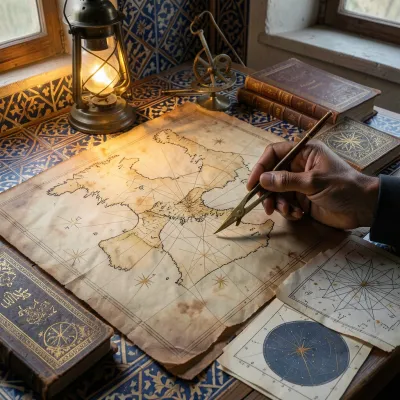
In 10th-century Córdoba, a Jewish cartographer, a Muslim astronomer, and a Mozarab Christian scribe sit at a table crowded with Roman surveys, Arabic star tables, and a trembling magnetic needle. Their collaboration produces the most accurate map of the Western Mediterranean — and immediately attracts the Caliph's secrecy orders, a Castilian spy, and a double agent who turns their own cipher against them. Marie Meyer's The Moor's Compass is not merely a historical novel about mapmaking; it is a sustained meditation on what happens when knowledge becomes power, and when the pursuit of shared truth collides with the interests of kingdoms.
What the book is about
The novel spans twenty-five chapters, moving from the dusty studios of the Judería to the Caliph's observatory in the Sierra Morena, then to the scriptoria of Toledo under Alfonso VI. The narrative follows Isaac ben Solomon, Bashir ibn Amram, and Martín of Córdoba as they reconcile Roman passus, Arabic dhira', and nautical leagues; measure magnetic declination across the Strait of Gibraltar; calculate the qibla for every major port; and encode their most sensitive data in a triple-verification system they call the Cipher of the Wind. The structure mirrors their method: each chapter adds a layer — empirical observation, historical reconstruction, mathematical verification — until the map becomes a character in its own right. The book assumes a reader comfortable with intellectual history and willing to follow technical discussions of spherical geometry, textual transmission, and medieval instrumentation, but it never lets the science obscure the human stakes.
The translation table as a crucible
Early chapters center on the physical and intellectual labor of making disparate systems speak to one another. In Chapter Six, the three men work at a single oak table where "Isaac's dividers and specialized pens, Bashir's astrolabe and meticulously copied star charts, Martín's quills, ink pots, and stacks of crumbling parchments" coexist with Miriam's deliveries of dates and flatbread. The novel renders translation not as a polite exchange but as a form of survival: "When you translate, you do not merely exchange words; you exchange worlds. You force two distinct ways of seeing to confront each other. And often, in that confrontation, a new, more accurate world is revealed." A marginal note in a Visigothic land survey — a Roman bridge measured in both paces and a solstice shadow — becomes the anchor that lets them convert Roman miles into celestial degrees. The scene captures the novel's central conviction: accuracy is built from disagreement, not consensus.
Maps as instruments of power
From the Caliph's first audience in Chapter Five, the map is never just a chart. Abd al-Rahman III understands immediately: "An accurate map of my kingdom is also an accurate map for my enemies." He grants patronage but demands absolute secrecy. Later, in Toledo, Alfonso VI orders seven copies for his admirals and generals, then demands the cipher key so his own cartographers can reproduce it. Isaac responds by designing a "betrayer's map" — a deliberately flawed copy whose errors "would not reveal themselves until a fleet had already committed to a course." The novel traces how every patron, whether Muslim or Christian, sees the map as a weapon first and a tool of knowledge second. Even the Archbishop of Toledo, who shelters the scholars, reads their treatise as political leverage: "A map can be seized. A method — a way of thinking — spreads."
The qibla and the compass: two norths, one map
One of the book's most original conceits is the integration of the qibla — the direction of prayer toward Mecca — into a navigational chart. In Chapter Eleven, Martín proposes adding the qibla for every port alongside magnetic corrections, and Bashir calculates it for each harbor using spherical trigonometry. The result is a map that serves both the body and the soul: "The qibla is not a single direction; it is an infinite set of lines radiating outward from Mecca, each one touching a different city, a different shore, a different praying man." Isaac draws the qibla arrows in green ink, distinct from the red magnetic deviation lines and black coastlines. The gesture reframes the map as a pluralistic object: it does not privilege one faith's orientation but records them all, side by side, as data. As Martín reflects, "Every faith has its qibla. Every faith has its compass. Perhaps that is why this map frightens people. It does not point in one direction. It points in all of them."
Sabotage, cipher, and the double agent
The middle section of the novel turns into a quiet thriller. In Chapter Thirteen, a charred fragment of Bashir's astronomical tables arrives at the studio — evidence that someone infiltrated the observatory and "tampered with the armillary sphere. They loosened the pivots on the great quadrant. Subtle sabotages designed to introduce tiny, almost imperceptible errors." The culprit is Lope de Aguirre, a Castilian agent posing as a bookbinder who recruits Martín's apprentice Diego. Even more damaging, de Aguirre plays both sides: he plants a false cipher key for the Caliphate to find while feeding Alfonso's court intelligence about the map's flaws. Chapter Twenty-Four reveals the full scope: "The entire architecture of their deception — the betrayer's map, the false cipher, the planted evidence — had been, in part, the work of a man who was simultaneously betraying the very masters he seemed to serve." The sabotage forces the scholars to harden their method, inventing the Cipher of the Wind — a triple-ring verification where every coordinate must agree across Hebrew, Arabic, and Latin numerical systems before it is accepted.
From artifact to method: the treatise as legacy
By the final chapters, the physical master chart is lost — seized by Alfonso via Samuel's betrayal — but the scholars pivot to preserving the method. In their Toledo dungeon, they compose a treatise on cartography: "a work of pure methodology, detailing their collaborative, cross-cultural approach... including the 'Cipher of the Wind' — a multi-layered verification system." Isaac insists it be published openly: "The cipher is not a weapon. It is a language — a way of ensuring that whoever reads our map knows whether it can be trusted." The novel ends not with the map's recovery but with its dispersal: the treatise copied for libraries in Toledo, Paris, and Rome; the original sketch — a rough drawing marked only with the word beginning — returned to Isaac by his wife Miriam; and the three men walking south toward an uncertain coast, carrying the data in their heads. As Martín concludes, "The Moor's Compass is not a thing. It is an idea."
Who should read this
Readers who enjoy historical fiction grounded in the history of science — think The Name of the Rose meets Longitude — will find much to admire. The novel rewards patience with technical detail: passages on magnetic deviation, solstice shadows, and gematria-based verification are integral, not decorative. It is less suited for readers seeking fast-paced action or romance; the tension is intellectual and political, built on quiet conversations in scriptoria and the slow accumulation of error and correction. Anyone interested in medieval cross-cultural exchange, the material history of maps, or the ethics of knowledge under patronage will find this a rare novel that takes the work of scholarship seriously — as labor, as risk, and as a form of fidelity.
Read “The Moor's Compass” on MixCache.com →
Please log in or create an account to leave a comment.
No comments yet. Be the first to say something.