
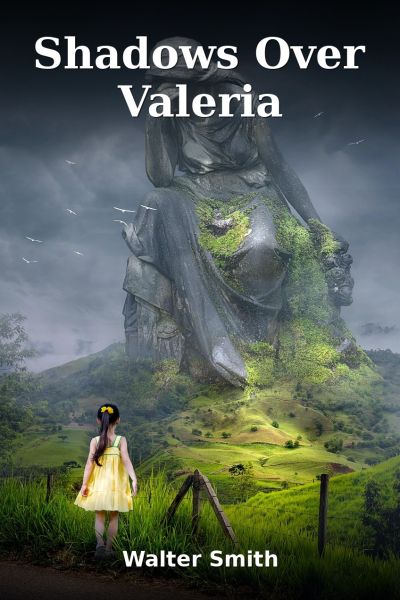
In a genre often content with retreading familiar ground, Shadows Over Valeria builds its sprawling narrative on a simple but potent premise: three people cast out by the institutions they once served must decide whether a kingdom that rejected them is still worth saving. Walter Smith stretches that tension across twenty-five chapters that escalate from personal survival to a multi-realm struggle for the nature of magic itself.
What the Book Is About
The novel is a doorstopper epic fantasy structured as a single continuous saga rather than a trilogy, tracking Prince Aerin, healer Freya, and magician Kael from their separate exiles through a converging quest for the Ember of Aethel — the metaphysical heart of Valeria's magic. The story moves through distinct phases: a character-driven opening (Chapters 1–3), a road-trip alliance formation (Chapter 4), political intrigue in the capital (Chapters 5–8), descent into elemental strongholds (Chapters 9–12), memory-warfare in dwarven ruins (Chapters 13–14), a royal reckoning (Chapter 15), and a series of escalating confrontations against the Veil Weavers' layered contingencies (Chapters 16–23) before a final diplomatic-healing circuit across four foreign realms (Chapters 24–25). Smith writes for readers who want traditional high-fantasy scaffolding — prophecies, ancient evils, chosen ones — but with modern attention to psychological consequence and institutional rot. The prose is accessible, the magic system rules are demonstrated rather than explained, and the pacing alternates between tactical set-pieces and quiet character beats.
Exile as Crucible, Not Backstory
Each protagonist's banishment is rendered as lived experience rather than flashback fodder. Chapter 1 opens with Aerin two years into exile: "His features, once refined and youthful, were now sharper, etched with a grim determination and a weariness that belied his twenty years. He'd learned to hunt, to track, to fight without the luxury of training grounds and sparring partners." Freya's year in Oakhaven (Chapter 2) shows her building trust through competence while hiding a forbidden life-magic that "bordered on creation." Kael's scarred forearm throbs as a constant reminder of the Spire disaster that made him a pariah (Chapter 3). Smith uses these parallel openings to establish that the "unlikely trio" trope here rests on earned competence and specific, different fractures — political, spiritual, magical — rather than generic angst.
Prophecy as Intelligence, Not Destiny
The Shadowed Crown prophecy appears in fragments across the first act — Borin's mountain fireside version (Chapter 1), Maeve's Temple-text corroboration (Chapter 2), Corvus's tavern gossip (Chapter 3) — and the characters treat it as actionable intelligence. They verify details (the Glyph of Sundering in Eldorian Archives, Chapter 6), test its predictive power (the King's shadow sickness), and exploit its psychological utility (spreading rumors of Freya's miracles to force Thorne's hand, Chapter 8). When Aerin finally channels the Ember in Chapter 11, the text notes he acted "not to wield the Ember's power, but to *connect* with it, to awaken its protective spirit." The prophecy frames the conflict but never replaces agency; the climax at the Summit of Skyfire (Chapter 23) turns on Aerin anchoring reality with will, Freya weaving life-magic, and Kael channeling ordered elemental power — choices, not fate.
Corruption as Bureaucracy and Biology
The Veil Weavers are frightening because they operate through systems. Thorne doesn't assassinate the King; he replaces physicians, curtails ceremonies, and administers a "wasting sickness" that mimics natural decline (Chapter 6). The Great Forgetting (Chapter 13) is a memory-altering ritual targeting "memory anchors" — the Royal Gardens, the Obsidian Spire, the High Temple — to rewrite history at scale. Even the final Great Reshaping (Chapter 23) is framed as a ritual to "force the harmony into dissonance" at an elemental nexus. Smith makes magical evil feel like policy: the Shadow Lord's lieutenants are project managers with contingency plans (the Citadel of Whispers, the Veiled Sanctuary, the Silver Fire, the Whispering Labyrinth, the Last Gate, the Staff of Dissonance). The horror accumulates in the mundane — a stable master's fear, a dwarf's fragmented memories, a druid's dismissed decay — until the systemic scope becomes undeniable.
Healing Magic as Offensive Force
Freya's life-magic consistently reframes what combat looks like in this world. At the Sundermere inn (Chapter 4), her "vibrant, emerald green energy" burns a shadow wraith because "they are creatures of corrupted life" and her power "is anathema to them." In the Citadel of Cinder (Chapter 10), she stabilizes Kael's volatile spellcasting mid-ritual. During the Great Confluence (Chapter 17), she doesn't attack the tearing nexus but "heal[s] the wound, to reinforce the remaining connections." At the Silver Fire (Chapter 19), she separates a possessed ranger from the Shadow Lord's essence by "mend[ing] the damage" rather than destroying the vessel. The pattern culminates in the Frozen Tundra (Chapter 25), where she reignites dead magic by "breathing life into a corpse." Smith avoids making her a passive support character; her magic is the only thing that can permanently undo the Veil Weavers' entropy, and the narrative treats that as strategic fact, not sentiment.
An Ending That Opens Outward
The final two chapters refuse the "evil defeated, kingdom saved" full stop. Chapter 24's ethereal map reveals "fractured connections" extending beyond Valeria's borders — the Emerald Isles' Stifling Glyphs, the Sunstone Deserts' Unraveling Glyphs, the Frozen Tundra's Void Glyphs — and the trio's sky-ship departure frames their expertise as exportable. Chapter 25 shows them applying the same template: detect the glyph, teach local practitioners the counter-frequency, restore the nexus, leave behind alliances. The closing image — "The shadows were gone, dispelled by the light of their courage and the strength of their unity" — earns its grandeur because the book has spent 800+ pages showing exactly what that courage and unity cost, and how fragile the peace remains without vigilance.
Who Should Read This
Readers who enjoy Brandon Sanderson's systemic magic or Robert Jordan's ensemble scope but want a single-volume commitment will find a complete, self-contained arc here. The political maneuvering in Valerius (Chapters 6–8, 15) satisfies intrigue fans, while the elemental strongholds (Chapters 9–12, 23) deliver set-piece spectacle. Those allergic to "chosen one" narratives should note: the prophecy is real, the three are marked, and the ending leans into mythic resonance. But the characters' flaws — Aerin's privilege, Freya's secrecy, Kael's volatility — are given enough room to breathe that the destiny feels earned. Skip it if you prefer grimdark ambiguity or low-magic settings; this is unapologetically high fantasy, optimistic in its core thesis that institutions can be repaired and magic can be healed, provided someone is willing to do the work.
Read “Shadows Over Valeria” on MixCache.com →
Please log in or create an account to leave a comment.
No comments yet. Be the first to say something.