
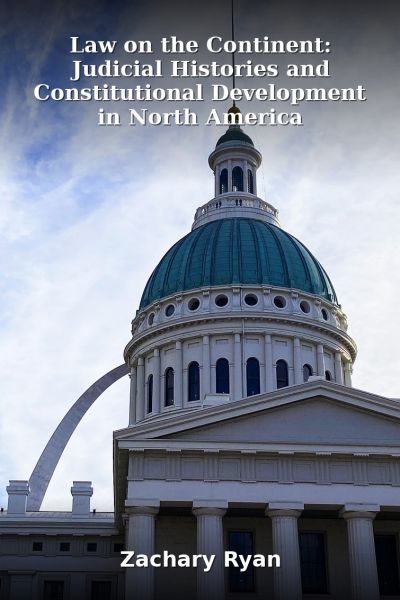
Most histories of North American law treat the United States, Canada, and Mexico as separate stories with occasional border crossings. Zachary Ryan's Law on the Continent refuses that convenience. Instead, it builds a single, continent-spanning narrative that begins not with European arrival but with the sophisticated legal orders of the Haudenosaunee, Anishinaabe, Pueblo, and Pacific Northwest nations — orders that persisted, adapted, and continue to shape modern jurisprudence. The result is a work that reads less like a survey and more like a map of the legal terrain we all inhabit.
What the book is about
The book runs 25 chapters organized both chronologically and thematically. It opens with Indigenous legal traditions before contact (Chapter 1), moves through the imperial legal regimes of Spain, France, and Britain (Chapter 2), and traces treaty diplomacy, nation-making, and the construction of court systems across the three modern states. Separate chapters treat mixed jurisdictions (Quebec, Louisiana, Puerto Rico), Mexico's constitutional path from 1824 to 1917, federalism and separation of powers, property regimes, slavery and race, citizenship and immigration, Indigenous sovereignty, the Marshall Trilogy, Canada's court evolution, Mexico's amparo remedy, family and gender law, labor and the administrative state, crime and policing, expressive and religious freedoms, civil rights in the U.S., Canada's Charter revolution, environmental governance, Indigenous title and reconciliation, transnational constitutionalism, and the twenty-first-century court facing digital rights and democratic resilience. The intended audience includes legal scholars, historians, and serious general readers comfortable with doctrinal detail; the prose is precise but not jargon-heavy, and each chapter stands on its own while contributing to the comparative arc.
Indigenous law as foundation, not footnote
Chapter 1 establishes the book's most important corrective: "The history of law on this continent did not begin with parchment and ink, or with robes and courtrooms. It began with people, place, and practice." Ryan details the Haudenosaunee Great Law of Peace, Anishinaabe governance, Pueblo councils, and Pacific Northwest potlatch systems as structured legal orders with dispute resolution, property concepts, and diplomatic protocols. The Two Row Wampum (Guswenta) — "symbolized parallel paths of Indigenous and European peoples traveling the river of life without steering each other's canoes" — becomes a recurring interpretive key. Rather than vanishing, these orders were "layered" beneath colonial law, creating the "persistent condition of legal pluralism" that defines the continent. This framing reshapes every subsequent chapter: treaties, property, sovereignty, and reconciliation are not accommodations granted by the state but negotiations between co-existing legal worlds.
Three imperial legalisms, one contested frontier
Chapter 2 contrasts the Spanish Recopilación de las Leyes de Indias and Real Audiencia system, the French Coutume de Paris and Conseil Souverain in New France, and the English common law received through colonial charters. Each empire "brought distinct conceptions of authority, property, and procedure" yet all "met local realities: Indigenous diplomacy, settler resistance, and frontier pragmatism reshaped imported doctrines into hybrid regimes that endured long after flags changed." The Spanish encomienda and ejidos, the French seigneurial tenure, and the English fee simple estate created property logics that still undergird water rights in the Southwest, land patterns in Quebec, and title systems across the U.S. Ryan shows how colonial courts "struggled to resolve disputes with doctrines that frequently favored imperial interests" while Indigenous law "could not be ignored" — a tension that produced forum shopping, intermediary roles, and pragmatic accommodations that foreshadowed modern conflicts of law.
The Marshall Trilogy's long shadow and its continental echoes
Chapter 13 gives the Marshall Trilogy — Johnson v. M'Intosh (1823), Cherokee Nation v. Georgia (1831), Worcester v. Georgia (1832) — its most thorough comparative treatment I've seen. Ryan walks through Marshall's articulation of the Doctrine of Discovery ("European Christian nations had a superior right to lands simply by virtue of having 'found' them"), the invention of "domestic dependent nations," and the federal preemption of state law in Worcester. He then traces how Canada and Mexico absorbed or rejected this logic. In Canada, the Crown's "ultimate title" derived from discovery became the baseline against which Aboriginal title was recognized as a "burden" — a framework the Supreme Court of Canada only began to dismantle in Calder (1973) and Tsilhqot'in (2014). In Mexico, the Spanish Requerimiento played a similar legitimizing role, but the 1917 Constitution's Article 27 asserted national ownership of subsoil resources and restored communal ejidos, charting a different path. The chapter makes clear that the Trilogy "served as a legal straitjacket for Indigenous sovereignty" yet also "provided a legal basis for tribal self-governance" — a paradox that still structures litigation from McGirt v. Oklahoma (2020) to pipeline consultations in British Columbia.
Mexico's amparo and the architecture of social constitutionalism
Chapters 7 and 15 form a powerful pair on Mexico's distinctive contributions. The 1917 Constitution, "forged amidst armed conflict," embedded social rights directly into the constitutional text: Article 27 on land and subsoil resources, Article 123 on labor (eight-hour day, minimum wage, right to strike, profit-sharing), Article 3 on secular education. The amparo — a remedy with roots in the 1812 Spanish Constitution — became the engine for enforcing these rights. Unlike U.S. judicial review, which nullifies a law for everyone, an amparo" judgment only benefits the specific plaintiff (“relativity of judgments”). But through jurisprudencia — five consistent Supreme Court rulings — a principle becomes binding on all lower courts. This "building block" approach produces "gradual constitutional development without abrupt judicial activism." Ryan shows how amparo litigation drove agrarian reform, labor enforcement, and, recently, reproductive rights: a 2023 Supreme Court series established that criminalizing abortion violates women's rights, creating binding jurisprudencia that "renders restrictive laws unenforceable in practice." It is a model of rights protection that is distinctly Mexican yet deeply relevant to comparative constitutional design.
Courts as institutions: from colonial peripheries to constitutional centers
Chapters 5 and 14 track the material and institutional birth of the U.S. and Canadian supreme courts. The U.S. Supreme Court began in a "modest" New York courtroom with six justices who rode circuit on dangerous roads (Justice Iredell drowned crossing a river). Marbury v. Madison (1803) established judicial review through a "masterful opinion that asserted judicial review while denying Marbury's request" — a strategic restraint that became a global model. Canada's Supreme Court, created in 1875, labored for 74 years under the Judicial Committee of the Privy Council in London. The JCPC's "pith and substance" doctrine favored provincial autonomy, while the post-1949 Canadian Court developed the "double aspect" doctrine and the Oakes proportionality test under the Charter. Ryan's institutional history reminds us that doctrines we treat as abstract — judicial review, federalism, proportionality — emerged from concrete struggles over dockets, travel, partisan appointments, and the slow accretion of legitimacy.
Who should read this
This book rewards readers who want to see North American law as an interconnected system rather than three national silos. Law students and scholars will appreciate the precise doctrinal mapping; historians will value the attention to social practice (wampum, potlatch, encomienda, ejidos) alongside court opinions. General readers without legal training may find the density of case names and statutory references demanding, but the thematic chapters on Indigenous sovereignty, property regimes, and digital rights stand alone as accessible entry points. If you've ever wondered why water law differs east and west of the hundredth meridian, or why Quebec's Civil Code coexists with the Charter, or how a Mexican amparo differs from a U.S. injunction, this is the single volume that answers all three — and shows how the answers are related.
Please log in or create an account to leave a comment.
No comments yet. Be the first to say something.