
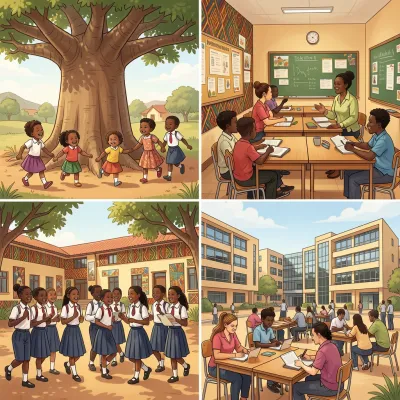
In 2011, the lecture halls of Côte d'Ivoire's public universities stood empty. No registration lines snaked across campuses. No new cohorts arrived in Yamoussoukro, Bouaké, or Abidjan. The academic calendar had been erased by conflict. Students who should have been sitting exams or starting theses waited in limbo, their transcripts marked with a term that sounded almost administrative but carried the weight of catastrophe: année blanche — blank year.
The Miracle That Preceded the Collapse
Two decades earlier, the story was radically different. Between the 1970s and 1980s, Côte d'Ivoire rode an economic miracle fueled by coffee and cocoa. The state poured a staggering 40 percent of its national budget into public education, including universities. The University of Abidjan, founded as a Center for Higher Education in 1959 and renamed in 1964, expanded rapidly. Campuses buzzed with the confidence of a nation building its own intellectual elite. Primary enrollments climbed. The system, though modelled on France's, began to reflect Ivorian ambition.
Then came the long unraveling. Political instability crept in during the early 1990s. By 2001, a near-decade-long crisis had settled over the country. Schools were disrupted. Infrastructure crumbled. A rapidly growing student population collided with chronic neglect. Overcrowding became the norm. Dropout rates surged. Teacher shortages bit hard, especially in the central and northern rural areas, while educators clustered in the relative safety of Abidjan.
The Term That Meant Nothing Happened
By the time the post-election crisis erupted in late 2010, the higher education system was already fragile. The violence that followed — months of stalemate, then open conflict in early 2011 — delivered the final blow. Public universities, the flagship institutions of the state, simply did not open. The term année blanche, previously an occasional bureaucratic notation, became a lived reality for an entire generation. Academic cycles were incomplete. Degrees were delayed. Research stalled. For students, it meant a year of life suspended, credentials frozen, plans dissolved.
The phenomenon was not limited to the capital. In the north and center, where the crisis cut deepest, even primary and secondary schools shuttered. Children were forced out of classrooms. The few teachers who remained often could not reach their posts. The disparity between the south and the rest of the country, already stark, widened into a chasm.
Rebuilding From a Standing Start
When the guns fell silent in April 2011, the government faced an education system that had effectively stopped. The response was sweeping. A 2015 law made education free and compulsory for children aged 6 to 16, a direct bid to reclaim lost ground. The 2016–2025 Education and Training Sector Plan (PSE) followed, targeting teacher training, curriculum modernization, and vocational pathways. But the most visible scar of the blank years was in higher education.
To decentralize and relieve pressure on Abidjan, the state launched an ambitious university construction program. New public universities rose in Bouaké, Daloa, Korhogo, and Man — cities that had borne the brunt of the crisis. The Félix Houphouët-Boigny University in Abidjan was split into specialized institutions. The National Polytechnic Institute (INP-HB) in Yamoussoukro, a confederation of engineering schools, was held up as a model of technical excellence, its graduates snapped up by industry.
The Long Shadow of a Lost Year
Enrollment numbers eventually rebounded. Gross primary enrollment topped 110 percent by 2023–24. The Baccalauréat, the high-stakes gateway to university, regained its rhythm. Yet the blank years left a demographic echo. A cohort of students graduated late, entered the workforce late, or never returned. Teachers who fled the north during the crisis were slow to come back, perpetuating regional imbalances. The 40 percent budget share of the miracle years never returned; education spending stabilized at lower levels, forcing reliance on external partners like the World Bank and the Global Partnership for Education.
Today, the term année blanche appears less in official reports and more in the memories of those who lived it. It stands as a reminder that in Côte d'Ivoire, education is not just a service but a barometer of the nation's stability. When the system breaks, the silence in the lecture halls is the first sound of trouble.
This is one episode in a much longer story. For the full account of education in Côte d'Ivoire, read “Education In Côte d'Ivoire” by Nicole Morales on MixCache.com.
Please log in or create an account to leave a comment.
No comments yet. Be the first to say something.