
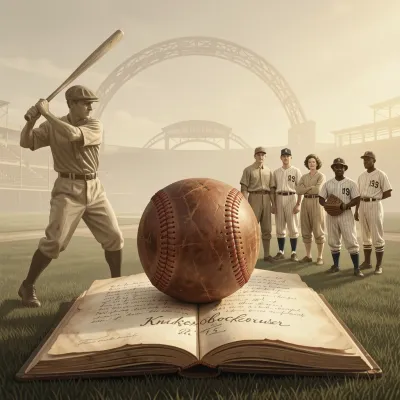
In the spring of 1943, as American troops shipped overseas and major league rosters thinned to the point where a one-armed outfielder took the field for the St. Louis Browns, Philip K. Wrigley sat in his Chicago office and wondered whether baseball could survive the war at all. The Cubs owner, heir to a chewing-gum fortune, had watched attendance dip and heard the grumbling that professional sports were a frivolity in wartime. His answer was as improbable as it was audacious: if the men couldn't play, women would.
A League of Their Own Making
Wrigley dispatched his advertising executive Ken Sells and Dodgers executive Branch Rickey to build a league from scratch. They recruited through newspaper ads and word of mouth, holding tryouts in cities across the country. More than a few scouts expected a novelty act; they found athletes. The first contracts went to sixty women, many of whom had played industrial or amateur softball for years. They were assigned to four Midwestern teams — the Racine Belles, Kenosha Comets, South Bend Blue Sox, and Rockford Peaches — each backed by a major league club and each required to attend evening charm-school sessions run by Helena Rubinstein's company.
The charm-school mandate was explicit: players learned makeup application, posture, and etiquette. They signed contracts pledging to maintain "high standards of personal appearance" and to avoid drinking, smoking, or "ungentlemanly" behavior in public. Uniforms featured short skirts with satin shorts underneath, a design chosen to emphasize femininity while allowing movement. The message was clear: these were ladies first, ballplayers second — even if the game they played was anything but ladylike.
Fastpitch in Skirts
On the field, the rules were a hybrid of baseball and softball. The pitching distance started at forty feet — ten feet shorter than the men's game — and the ball was twelve inches in circumference, larger and softer than a standard baseball. Pitchers threw underhand in a windmill motion. Base paths were sixty-five feet, five feet shorter than the big-league standard. Yet the women played with a ferocity that belied the trappings. They slid hard into bases, dove for line drives, and threw with velocity that stunned spectators expecting a gentle exhibition.
By midseason, the league quietly adjusted. The mound moved back, the ball shrank, and overhand pitching was permitted. The game sped up. Dottie Kamenshek, a left-handed first baseman for Rockford, emerged as the league's first true star. She hit .316 in 1943 and led the league in batting three times, all while playing a first base so smooth that former major leaguer Wally Pipp called her the finest fielder he had ever seen at the position. Jean Faut of South Bend threw two perfect games and mastered an overhand curve that buckled knees. These were not curiosities; they were professionals.
War, Work, and a Million Fans
The league's timing was impeccable. With gas rationing limiting travel and factory shifts running around the clock, Midwestern communities embraced the teams as affordable, local entertainment. Families walked to ballparks after dinner. Factory workers caught doubleheaders on weekends. Attendance climbed steadily: 176,000 in the inaugural season, 450,000 by 1945, and nearly 910,000 in 1948, when the league expanded to ten teams stretching from Fort Wayne to Grand Rapids. The players, most in their early twenties, earned fifty to eighty-five dollars a week — good money for the time, though a fraction of what minor-league men made.
Life on the road was grueling. Teams traveled by bus on two-lane highways, playing almost daily, often in unlit parks with makeshift dressing rooms. Players lived in private homes arranged by the league, subject to curfews and chaperones. Injuries were treated with tape and aspirin; torn ligaments ended careers. Yet the women kept playing. "We didn't think of ourselves as pioneers," Kamenshek said decades later. "We just wanted to play ball."
The Long Curve Home
When the war ended in 1945, the men came back. Major league rosters refilled. The novelty that had drawn crowds began to fade. Wrigley sold the league to his advertising executive, Arthur Meyerhoff, who ran it as a barnstorming operation for a few years before returning it to local ownership. The game continued to evolve — the ball shrank to nine inches, the mound reached sixty feet, the skirts gave way to pants — but the cultural winds had shifted. Television brought major league games into living rooms. Suburban sprawl emptied the small industrial towns that had sustained the franchises. By 1954, after twelve seasons, the league folded.
The players scattered. Some taught physical education. Others raised families and rarely spoke of their playing days. The league's records gathered dust in attics and basements. It took a 1992 feature film, A League of Their Own, to pull the story back into public memory. By then, the surviving alumnae were in their seventies and eighties, finally recognized as the athletes they had always been.
What Remains
The All-American Girls Professional Baseball League lasted barely longer than a presidential administration. It left no direct lineage in today's professional structure. Yet its existence proved something that the baseball establishment had long resisted: that women could play the game at a high level, draw paying crowds, and sustain a professional enterprise. The league's peak attendance of nearly a million fans in 1948 wouldn't be matched by a women's professional team sport in the United States until the WNBA's inaugural season half a century later. The skirts and charm schools now read as concessions to a bygone era's expectations, but the box scores tell a different story — one of hits, steals, shutouts, and a brand of baseball played with everything on the line.
This is one episode in a much longer story. For the full account of the history of baseball, read “Baseball” by Jacqueline Ruiz on MixCache.com.
Please log in or create an account to leave a comment.
No comments yet. Be the first to say something.