
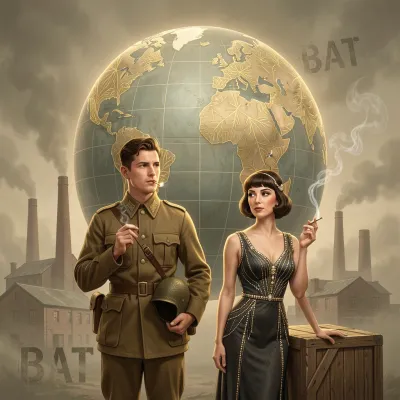
The price war had been bleeding both sides dry for months. James Buchanan Duke, the American who had crushed every rival at home, flooded the British market with cheap cigarettes backed by a seemingly bottomless war chest. The newly formed Imperial Tobacco Company, a desperate merger of Britain's oldest firms, fought back with cuts of its own. By late 1901, the two giants were locked in a trench warfare of coupons, rebates, and slashed margins that threatened to destroy the very markets they were fighting to control.
Neither man could afford to blink. Duke had already spent a fortune buying distribution networks across the Empire. Imperial's shareholders were watching their dividends evaporate. The stalemate was costing both companies more than either had anticipated when they first squared off across the Atlantic.
The meeting at the Carlton
The breakthrough came not on a battlefield but in a private dining room at the Carlton Hotel in London. Representatives of American Tobacco and Imperial Tobacco sat down in early 1902 to negotiate a ceasefire. The terms they hammered out were breathtaking in their simplicity: Imperial would stay out of the United States. American Tobacco would withdraw from the United Kingdom. Everywhere else — Canada, Australia, India, China, Africa, South America, continental Europe — would belong to a new joint venture, capitalised at £4 million, with Duke providing most of the cash and Imperial contributing its overseas factories, brands, and distribution routes.
They called it the British American Tobacco Company. The press nicknamed the agreement the "Treaty of London," and the name stuck.
A division of spoils
The treaty did more than end a trade war. It created the first truly multinational tobacco enterprise, a company designed from day one to operate without a home market. BAT had no domestic base to protect, no nationalist sentiment to appease. Its only mandate was growth in the vast territories the parents had agreed to leave alone.
Duke's American Tobacco put up £3 million of the initial capital. Imperial Tobacco contributed assets it had accumulated across the Empire: a factory in Australia, another in Canada, a stake in a German concern, and embryonic networks in India, China, and South Africa. The board was split evenly between nominees of the two parents, ensuring neither could dictate strategy without the other's consent.
For Duke, the deal was a masterstroke of strategic retreat. He secured his American monopoly — which the U.S. Supreme Court would soon dismantle anyway — and gained a vehicle for global expansion without risking further capital in a British market he could never fully crack. For Imperial's chiefs, the treaty saved their dividend and gave them a share of a world they lacked the resources to conquer alone.
First moves in Shanghai and Sydney
Within weeks of the signing, BAT agents were negotiating for factory sites in Shanghai and Hong Kong. In Australia, the company took over the Imperial plant in Sydney and began machine-rolling cigarettes for a market that had never seen them at scale. In Canada, it absorbed the American Tobacco subsidiary and the Imperial operation, merging them into a single dominant player.
The pace was ruthless. By 1905, BAT had factories in Germany, the Netherlands, Sweden, and Egypt. It was buying leaf directly from growers in Rhodesia and India, bypassing the London auction houses that had controlled the trade for generations. Its sales force, a polyglot army of travellers, carried sample cases into bazaars from Buenos Aires to Batavia.
The company's early advertising revealed its ambitions. In China, posters depicted modern Chinese women smoking "Pirate" cigarettes beside rickshaws and telegraph poles. In Java, the "Three Castles" brand borrowed Javanese motifs. BAT did not export British tastes; it manufactured local ones.
The war that proved the model
The Treaty of London faced its first real test in 1914. When the Great War broke out, BAT's global structure — autonomous local factories, decentralised management, diverse supply chains — allowed it to keep producing and selling while national companies faltered. British soldiers smoked BAT cigarettes rolled in Egypt. German soldiers smoked BAT cigarettes rolled in Berlin. The company supplied both sides, its neutrality protected by the very treaty that had birthed it.
By 1915, annual sales had reached 25 billion cigarettes. The war turned the cigarette from a niche product into a global habit, and BAT owned the infrastructure that fed it.
A century of the same logic
The Treaty of London established a template BAT would follow for a hundred years: when regulation tightens in one market, pivot to another; when a competitor threatens, absorb it; when a new technology emerges, buy the expertise. The 1999 merger with Rothmans, the 2017 acquisition of Reynolds American, the pivot to vaping and heated tobacco — all echo the logic of 1902. The parents have changed, the products have changed, but the fundamental bargain remains: divide the difficult markets, pool the resources, and let the joint venture hunt wherever the rules allow.
The Carlton Hotel was bombed in 1940. The dining room where the treaty was signed no longer exists. But the company it created still operates in more countries than almost any other, still runs factories on five continents, and still follows the strategy two exhausted rivals sketched on a tablecloth over a century ago.
This is one episode in a much longer story. For the full account of the history of British American Tobacco, read “A History of British American Tobacco” by Walter Diaz on MixCache.com.
Please log in or create an account to leave a comment.
No comments yet. Be the first to say something.